


The realm of space exploration has witnessed a groundbreaking collaboration between the University of California, Davis, and Proteus Space, which is set to redefine satellite technology as we know it. The duo has announced the launch of a government-backed satellite designed to carry a revolutionary payload that integrates cutting-edge artificial intelligence. This initiative promises to usher in the first dynamic digital twin in space, marking a pivotal advancement in the way we assess and predict spacecraft conditions.
Scheduled for launch in October 2025 from Vandenberg Space Force Base in California, this satellite project is notable not just for its advanced technology, but also for its speed of development. The design to deployment timeline is a mere 13 months, a staggering contrast to the usual timeline of several years that is typical in the small satellite industry. This new approach indicates a significant shift towards more agile methodologies in aerospace engineering, paving the way for future opportunities and breakthroughs.
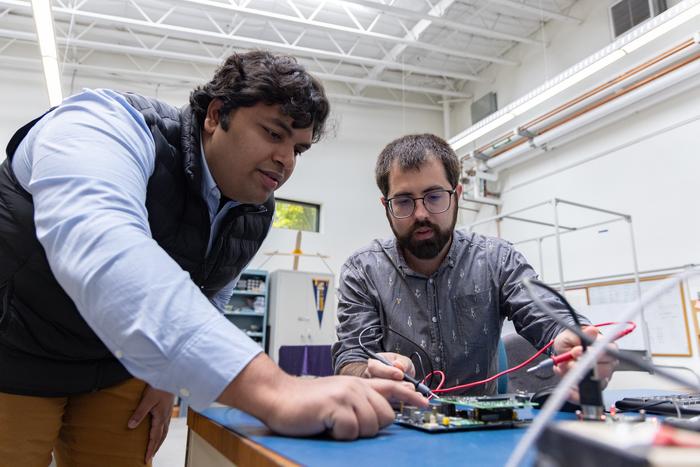
At the heart of this mission lies a payload developed by Professor Stephen Robinson and his team at UC Davis’s Human/Robotics/Vehicle Integration and Performance Laboratory. This innovative payload acts as a dynamic digital twin, which models the spacecraft’s current power system conditions in real time while also predicting its future states. Unlike traditional systems operating from ground-based mission control, this autonomous capability onboard signifies a remarkable leap forward in spacecraft technology.
The implementation of this digital twin technology allows for unprecedented self-monitoring capabilities. It will enable the satellite to actively communicate its operational status, essentially transforming how spacecraft health is monitored. Adam Zufall, a graduate student part of this initiative, emphasizes that this system will the spacecraft independently assess its well-being, something that has historically relied heavily on human oversight.
Sensors embedded in the satellite will continuously measure vital parameters such as battery voltage and operational health metrics. The digital twin software analyzes these readings in real time, offering a comprehensive view of the satellite’s performance. This level of situational awareness, augmented by artificial intelligence, not only allows for constant health assessments but also enhances the satellite’s ability to learn from its environment and conditions, thereby improving predictive capabilities for future operational states.
One of the most compelling aspects of this project is its potential to revolutionize satellite intelligence. Current satellites operate with a reactive monitoring approach, responding to issues as they arise. In contrast, this new technology anticipates problems before they manifest, helping to avoid mission-critical failures. By getting smarter over time, this satellite could offer a significant advantage, enhancing operational efficiency and reliability in low Earth orbit.
The collaborative efforts extend beyond just Robinson and Zufall. The team also includes Xinfan Lin, an associate professor whose expertise lies in intelligent battery management systems, all working in tandem to solidify the mission’s technological foundation. Alongside them are dedicated doctoral and master’s students, including Jackson Fogelquist, Ayush Patnaik, and Ancha Prashanth, all of whom contribute to the meticulous development of this advanced system.
The satellite itself is comparable in size to a half refrigerator, a compact yet powerful vessel ready to perform a variety of tasks in orbit. After its launch, it will descend into low Earth orbit, where it is expected to operate efficiently for up to twelve months. Remarkably, following a three-year orbital mission, the satellite will re-enter Earth’s atmosphere, where it will disintegrate, showcasing a commitment to environmentally sustainable practices in space exploration.
Recent technological advancements in artificial intelligence and machine learning are integral to this project. The development of a reliable, in-space digital twin reflects an understanding of the growing complexities within aerospace missions. As satellites become more sophisticated, the need for real-time monitoring tools that can adjust and respond independently is paramount, enhancing not just operational success but also safety in increasingly crowded orbital pathways.
Furthermore, the implications of this project reach far beyond the immediate mission. By demonstrating the effectiveness of dynamic digital twins in satellite operations, this initiative could lead to the proliferation of intelligent systems within not only commercial space assets but also within space agencies worldwide. It lays the groundwork for a future in which spacecraft can autonomously manage their own health, reducing the reliance on extensive ground support while optimizing mission performance.
The collaboration between UC Davis and Proteus Space is not merely a technical advancement; it represents a paradigm shift in satellite design philosophy. By prioritizing rapid development, intelligent systems, and sustainable practices, the team is not only preparing for a successful mission in 2025 but is also setting a benchmark for future aerospace endeavors. This innovative project exemplifies the exciting potential of space exploration and artificial intelligence, capturing the imagination of what lies ahead for technology beyond our planet.
As we move closer to the launch date, anticipation builds around how this satellite will redefine operational capabilities in space. The integration of AI, together with the agile development process, speaks volumes about the future of engineering in this field and the transformative power of collaboration in addressing complex challenges. The success of this mission will not only influence future satellite missions but will also inspire the next generation of engineers and designers who will continue to push the boundaries of exploration and technological innovation.
With this ambitious initiative on the horizon, the collaboration underscores a pivotal moment in aerospace engineering, paving the way for smarter, more efficient, and self-sustaining spacecraft. As the team prepares for launch, it is evident that the future of space exploration brightens with every innovation and partnership formed in pursuit of understanding the cosmos.
Keywords
Space exploration, dynamic digital twin, UC Davis, Proteus Space, satellite technology, artificial intelligence, aerospace engineering, spacecraft health monitoring.
Cite Scienmag News
Grant Pearson. (June 25, 2025). UC Davis and Proteus Space Set to Launch the First Dynamic Digital Twin into Space. Scienmag. https://scienmag.com/uc-davis-and-proteus-space-set-to-launch-the-first-dynamic-digital-twin-into-space/
Grant Pearson. "UC Davis and Proteus Space Set to Launch the First Dynamic Digital Twin into Space." Scienmag, 25 June 2025, https://scienmag.com/uc-davis-and-proteus-space-set-to-launch-the-first-dynamic-digital-twin-into-space/. Accessed 3 September 2026.
Grant Pearson. "UC Davis and Proteus Space Set to Launch the First Dynamic Digital Twin into Space." Scienmag. June 25, 2025. https://scienmag.com/uc-davis-and-proteus-space-set-to-launch-the-first-dynamic-digital-twin-into-space/


