


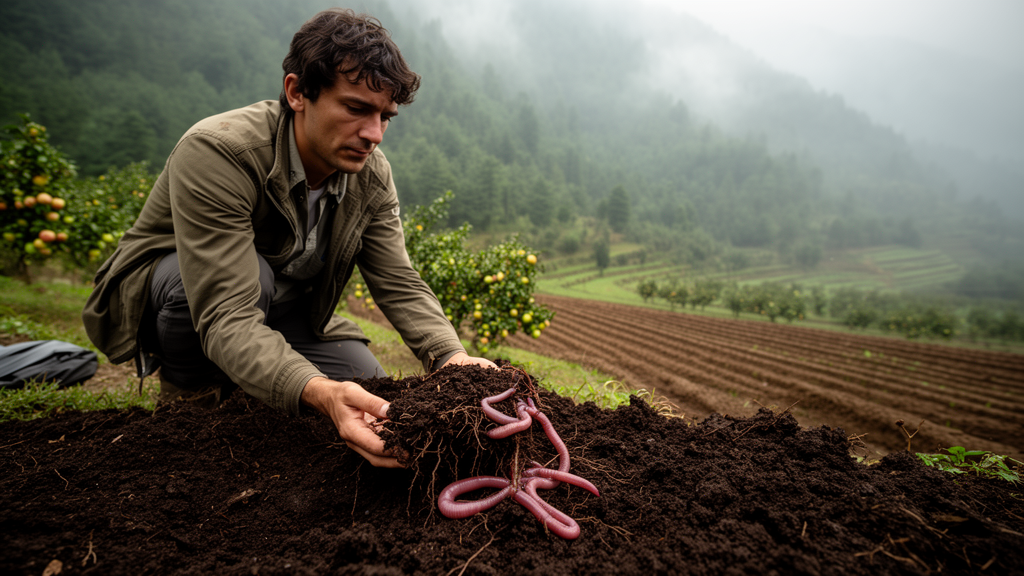
A two-year field survey documented eight earthworm species across forest, orchard and crop-field habitats in Bani Valley, a previously unexplored landscape in the western Himalayan Region of Jammu and Kashmir, India. The inventory comprised three families and six genera, with crop fields consistently supporting the highest earthworm density and biomass, followed by orchards and forests. Only one recorded species, Drawida nepalensis, was classified as native; the other seven were exotic.
The study, conducted from March 2021 to January 2023, examined Bani Valley in Kathua district at latitudes 32°41′23″–32°43′15″ N and longitudes 75°43′59″–75°48′11″ E. The sampled habitats included oak-dominated forest, apple orchards and crop fields where maize and mustard were cultivated in rotation. Earthworm sampling followed the Tropical Soil Biology and Fertility method at bimonthly intervals. During each sampling, researchers selected three 100 m² plots in each habitat and extracted five monoliths measuring 25 cm by 25 cm and 30 cm deep, without resampling the same area.
Adult earthworms were extracted, counted and weighed to determine fresh biomass, while representative specimens were preserved for taxonomic identification. Identification followed standard earthworm monographs. The researchers also measured soil temperature, moisture, pH, electrical conductivity, texture, organic carbon, nitrogen, phosphorus and potassium. A phylogenetic analysis used partial mitochondrial cytochrome c oxidase subunit I sequences, alignment in MEGA X, and a Maximum Likelihood reconstruction with the Tamura–Nei model and 1,000 bootstrap replicates.
Lumbricidae dominated the eight-species community, with Aporrectodea caliginosa caliginosa, Aporrectodea caliginosa trapezoides, Octolasion tyrtaeum, Dendrodrilus rubidus and Bimastos parvus. Moniligastridae was represented by Drawida japonica and Drawida nepalensis, and Megascolecidae by Amynthas corticis. Six species were categorized as endogeic, while Bimastos parvus was epigeic and Amynthas corticis was epi-endogeic. Octolasion tyrtaeum had the highest mean density in both study years: 34.31 ± 2.54 individuals per m² in 2021–22 and 27.91 ± 1.88 in 2022–23. It also had the highest mean biomass, at 16.47 ± 1.22 g/m² and 13.40 ± 0.90 g/m², respectively.
Seasonality was pronounced. The monsoon period from July to September was the most favorable overall, and density, biomass and species richness reached their highest values in July of both years. In July 2021, crop-field density reached 188.80 individuals per m², compared with 137.60 in the orchard and 96.00 in the forest. The minimum values were not uniform across all measures: forest density was lowest in March of both years and January 2023, forest biomass was lowest in January 2023, orchard density and biomass were lowest in January 2023, crop-field density was lowest in January 2022 and January 2023, and crop-field biomass was lowest in May 2022. The first study year recorded significantly higher density and biomass than the second.
Diversity indices varied significantly among habitats and months for dominance, Simpson’s index and the Shannon–Wiener index, while differences in evenness were not significant. Shannon–Wiener values ranged from 0.50 to 1.67 in forest, 0.64 to 1.97 in orchards and 0.80 to 1.92 in crop fields. The study reported significant differences between forest and both other habitats, but no significant difference between orchards and crop fields. The maximum Shannon–Wiener value in each habitat occurred in July 2022, while the minimum occurred in January 2023.
The Maximum Likelihood reconstruction identified three main clades and was largely consistent with classification at genus level. Drawida nepalensis and Octolasion tyrtaeum nevertheless clustered despite belonging to different families. The authors stated that this intergeneric grouping could reflect convergent mitochondrial evolution or unresolved divergence caused by limited variation in COX1, and that it warrants further investigation. The analysis therefore provided a baseline for relationships among the eight species rather than resolving their evolutionary placement conclusively.
Canonical correspondence analysis indicated associations between species distributions and measured soil properties. For density, the first canonical axis explained 53.47% of the total variance and was associated with temperature, moisture and pH; the second explained 21.57% and was associated primarily with organic carbon and nitrogen. For biomass, the first two axes together explained 77.85% of the variance. Bimastos parvus, Dendrodrilus rubidus, Drawida nepalensis, Drawida japonica and Amynthas corticis were associated with different combinations of temperature, moisture, pH and electrical conductivity. Aporrectorea caliginosa caliginosa and A. caliginosa trapezoides aligned with phosphorus, organic carbon and nitrogen. Octolasion tyrtaeum was associated with different ecological conditions, consistent with its abundance throughout the year. These ordination results describe statistical associations and do not establish that particular soil properties caused the observed distributions.
All eight species were reported as new records for Kathua district, bringing its documented earthworm diversity to 18 species. Dendrodrilus rubidus was not found in comparisons with adjacent parts of the western Himalayan Region and was reported for the first time from Bani Valley, although the authors noted that further investigation was needed. The study was limited to one valley, three selected habitat types and two years of sampling, so it provides a localized baseline rather than a comprehensive picture of Himalayan earthworm diversity.
Subject of Research: Earthworm diversity and habitat-related distribution patterns in Bani Valley
Article Title: Earthworm diversity in an unexplored Himalayan landscape: Patterns across forest, orchard and crop field ecosystems
Article References: Lal, M., Bhagat, A., Ahmed, S., & Kaur, A. (2025). Earthworm diversity in an unexplored Himalayan landscape: Patterns across forest, orchard and crop field ecosystems. One Ecosystem, 10, Article e166980. https://doi.org/10.3897/oneeco.10.e166980
Image Credits: AI Generated
DOI: 10.3897/oneeco.10.e166980
Keywords: earthworms, Bani Valley, Himalayas, soil biodiversity, earthworm species, habitat comparison, soil properties, phylogenetics, Jammu and Kashmir, Earthworm, diversity, unexplored
Cite Scienmag News
Alan Morgan. (October 20, 2026). Two-year Bani Valley survey records eight earthworm species across three Himalayan habitats. Scienmag. https://scienmag.com/two-year-bani-valley-survey-records-eight-earthworm-species-across-three-himalayan-habitats/
Alan Morgan. "Two-year Bani Valley survey records eight earthworm species across three Himalayan habitats." Scienmag, 20 October 2026, https://scienmag.com/two-year-bani-valley-survey-records-eight-earthworm-species-across-three-himalayan-habitats/. Accessed 20 October 2026.
Alan Morgan. "Two-year Bani Valley survey records eight earthworm species across three Himalayan habitats." Scienmag. October 20, 2026. https://scienmag.com/two-year-bani-valley-survey-records-eight-earthworm-species-across-three-himalayan-habitats/


