


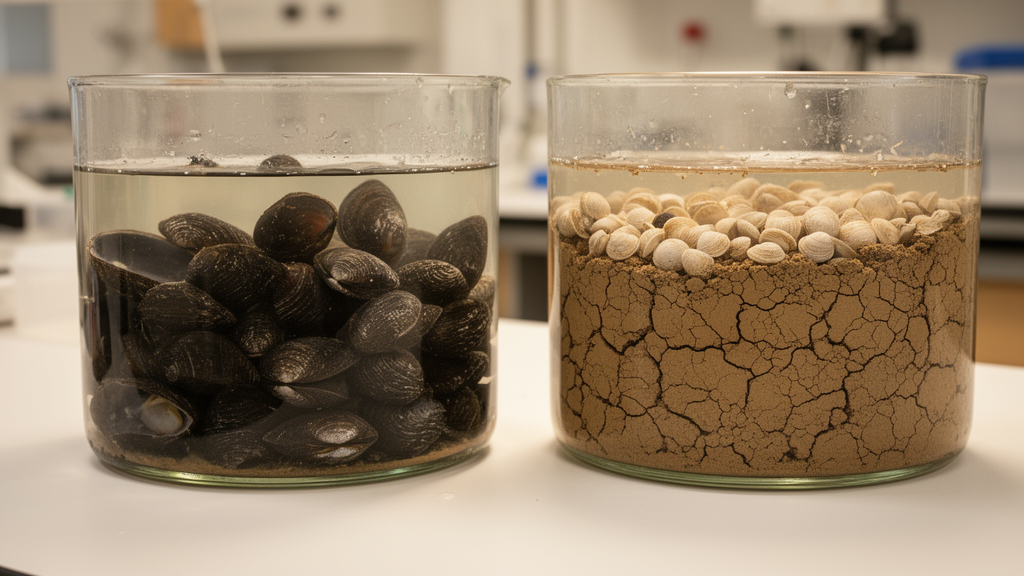
Laboratory experiments in central Poland found that invasive Asian clams of the Corbicula complex survived 15 days of exposure to drying sand, while the native river orb mussel Sphaerium rivicola reached estimated mortality of 50% after 5.3 days and 90% after 7.9 days. The species also differed in how they responded to receding water: S. rivicola moved toward wetter areas, whereas Corbicula generally stayed in place and burrowed.
The researchers collected both taxa from sandy substrates in the Włocławek Reservoir on the middle Vistula during spring and summer in 2023 and 2024. S. rivicola individuals were collected about 20 metres from the nearest Corbicula occurrence, with a reed belt between the sites, to reduce the possibility that their condition had been affected by competition with the invader. The clams were maintained separately in laboratory tanks at an air temperature of 19.5 °C on a 12-hour light and 12-hour dark cycle. Mean shell length was 13.9 mm for S. rivicola and 14.3 mm for Corbicula; different individuals were used in each experiment, and no clam was tested more than once.
Three laboratory experiments examined survival, horizontal migration and burrowing. In the survival experiment, water was removed from containers holding three clams until the sand surface was exposed to air, while control containers remained submerged. In the migration experiment, an inclined tank bottom represented a shore or riverbank slope, and water levels were reduced in drought treatments. A second set of tanks was twice as long to test whether S. rivicola could migrate farther to a submerged refuge. In the burrowing experiment, the researchers measured clam depth in 10 one-centimetre sediment layers after the water level reached the sand surface. Each treatment used 15 replicate containers per species.
No Corbicula mortality was recorded during the full 15-day air-exposure period, even when sediment water content fell to 2%. By contrast, a probit model corrected for control mortality estimated that half of S. rivicola would die after 5.3 days of exposure, when sediment water content was about 12%, and 90% would die after 7.9 days, at 8.5% water content. Control mortality for S. rivicola also increased from the fifth day of the experiment, so the authors cautioned that the survival estimates for this species should be interpreted carefully. The corrected mortality model could not be fitted for Corbicula because no deaths occurred during the observation period.
The migration experiment revealed contrasting escape strategies. Most Corbicula remained in the upper, first-drying zone regardless of treatment, and only two individuals moved in each treatment. In small tanks, 71% of drought-exposed S. rivicola left the upper zone, compared with 36% in twice-as-long drought tanks and 60% in small control tanks. Among individuals that migrated, 56–75% reached the lower submerged zone in drought-exposed large tanks and in both small-tank treatments, whereas no individual reached the lower zone in large control tanks. The results indicate that S. rivicola could escape drying sediment by moving toward remaining water, but the greater distance reduced the proportion able to leave the upper zone.
Burrowing produced the opposite pattern. All Corbicula burrowed into the sediment under both drought and control conditions. During drought, they more often reached depths greater than 1 cm than under control conditions, while the percentage burrowing deeper than 2 cm was marginally higher under drought, with a reported P value of 0.053. S. rivicola burrowed significantly more often under constant water levels than during drought and never reached a depth greater than 2 cm. Together, the observations indicate that Corbicula generally remained where it was and entered the sediment, whereas S. rivicola more often relied on active movement toward wetter areas.
The findings do not establish that drought will cause a particular population-level outcome in the field. This was a controlled laboratory study using clams collected from one reservoir, and its survival conditions included a fixed temperature of approximately 19.5 °C and a mean relative humidity of 54.6%. The experiments also tested the taxa separately rather than directly measuring their interactions under drought. S. rivicola can occur in deeper river sections, where water may remain during longer dry periods, while the capacity of Corbicula populations to persist or recover under extreme conditions may vary. The authors also note that Corbicula can experience mass die-offs under extreme conditions.
The results nevertheless identify a clear difference in drought tolerance under the tested conditions. S. rivicola showed substantial mortality after relatively short exposure to air and drying sediment, while Corbicula showed no mortality during the experiment. Its greater burrowing and limited migration may have supported that result. The authors proposed that drought could filter out drought-sensitive native bivalves while favoring more resistant invasive populations, potentially intensifying competition in the remaining submerged refuges.
They also identified ways in which the two species may affect freshwater habitats. Corbicula feeds by filtration, causes bioturbation and competes for food and space. Empty shells can make burrowing more difficult for native mussels, and dense accumulations of invasive clams and their shells can simplify benthic habitat. As drought reduces the amount of submerged habitat, native bivalves may be forced into smaller refuges alongside Corbicula. The authors therefore called for studies that explicitly examine how the species interact during drought, rather than treating hydrological stress and biological invasion as separate processes.
Subject of Research: Laboratory comparison of drought survival, migration and burrowing in invasive Corbicula and native Sphaerium rivicola clams
Article Title: Clams running dry: greater drought tolerance in the non-native Asian clam ( Corbicula complex) than in the native European Sphaerium rivicola
Article References: Szarmach, D., Lichocka, K., Kobak, J., Bomba, A., Krzeszowiak, A., Terebiński, S., Wiśniewski, K., & Poznańska-Kakareko, M. (2026). Clams running dry: greater drought tolerance in the non-native Asian clam (Corbicula complex) than in the native European Sphaerium rivicola. NeoBiota, 107, 225-242. https://doi.org/10.3897/neobiota.107.176248
Image Credits: AI Generated
DOI: 10.3897/neobiota.107.176248
Keywords: Asian clam, river orb mussel, hydrological drought, sediment drying, invasive species, clam survival, burrowing behaviour, freshwater bivalves, Poland, Włocławek Reservoir, Clams, running
Cite Scienmag News
Violet Maxwell. (October 20, 2026). Polish laboratory experiments find invasive Asian clams tolerate sediment drying better than vulnerable native clams. Scienmag. https://scienmag.com/polish-laboratory-experiments-find-invasive-asian-clams-tolerate-sediment-drying-better-than-vulnerable-native-clams/
Violet Maxwell. "Polish laboratory experiments find invasive Asian clams tolerate sediment drying better than vulnerable native clams." Scienmag, 20 October 2026, https://scienmag.com/polish-laboratory-experiments-find-invasive-asian-clams-tolerate-sediment-drying-better-than-vulnerable-native-clams/. Accessed 20 October 2026.
Violet Maxwell. "Polish laboratory experiments find invasive Asian clams tolerate sediment drying better than vulnerable native clams." Scienmag. October 20, 2026. https://scienmag.com/polish-laboratory-experiments-find-invasive-asian-clams-tolerate-sediment-drying-better-than-vulnerable-native-clams/


