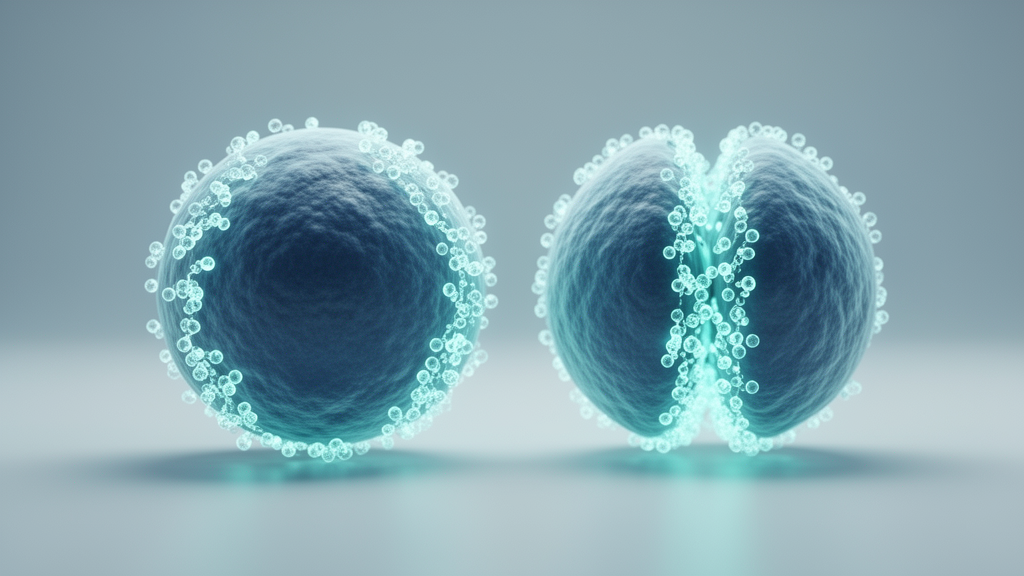
Two closely related ovoid bacteria build their cell walls under the supervision of enzymes that look almost interchangeable on paper, yet a new laboratory study shows they are anything but. In work published in the journal Animal Diseases, researchers compared the eukaryotic-like serine/threonine kinases (eSTKs) of Streptococcus suis and Streptococcus pneumoniae and found that each species’ kinase occupies a strikingly different position within the dividing cell. During septal peptidoglycan synthesis, STKss of S. suis consistently sat at the inner edge of the septum, while STKsp of S. pneumoniae sat at the outer edge. That single spatial difference, the authors report, is dictated largely by the kinase’s fourth extracellular PASTA domain, and it explains why the two enzymes failed completely when swapped into each other’s species.
The study began from a practical concern. Beta-lactam antibiotics, the long-standing first-line drugs against bacterial infections, work by directly inactivating penicillin-binding proteins (Pbps), the enzymes that assemble peptidoglycan. Bacteria have evolved robust countermeasures, including beta-lactamases, overexpressed efflux pumps and mutations in the target Pbps, which have eroded the clinical efficacy of these drugs. Targeting upstream coordinators of peptidoglycan synthesis rather than the synthesis machinery itself has therefore been proposed as an alternative strategy. eSTKs are core coordinators of bacterial cell division and peptidoglycan synthesis in many pathogenic bacteria, and the authors argue that validating whether their regulatory functions are conserved across species is essential before they can be pursued as antibacterial targets.
To test conservation, the team used a markerless stkss deletion strain of S. suis serotype SsSC-19, previously constructed in their laboratory, and built a corresponding stksp depletion strain in a capsule-deficient S. pneumoniae D39 background, in which a zinc-inducible copy of stksp was integrated at an ectopic chromosomal site. Structured illumination microscopy and transmission electron microscopy revealed that deleting stkss caused severe defects in septum formation, with cells becoming significantly elongated, and an obvious accumulation of stage II cells containing multiple unclosed septa. Quantitative morphometric analysis showed significant increases in cell length, width and aspect ratio across all stages of the cell cycle, along with a higher proportion of centrally multiseptated cells and the formation of elongated chains, reflecting defective postdivision cell separation. A complemented strain carrying a reintroduced stkss gene restored the parental phenotype.
Depleting stksp in S. pneumoniae produced parallel but not identical abnormalities. Cells accumulated stage II forms with unclosed septa and became mainly elongated at stages I, II and III, accompanied by a slight reduction in width, giving a thinner morphology than the wild type, and the proportion of cells with multiple incomplete septa rose significantly. Adding 0.1 millimolar zinc restored the wild-type phenotype. The authors summarize the contrast succinctly: S. pneumoniae cells became thinner and more elongated, whereas S. suis cells became both longer and wider. In both species, they conclude, eSTKs play a conserved role in maintaining proper cell division, morphology and peptidoglycan synthesis.
The team then probed whether kinase activity itself was required. They substituted a conserved lysine residue, K42, in the kinase active center, which is required for ATP binding and stabilization of the phosphotransfer reaction, with methionine in both species. The stkss-k42m cells were markedly elongated, frequently contained multiple unclosed septa, accumulated stage II cells, and showed chaining in 56.25 percent of cells and multiseptation in 27.66 percent. The stksp-k42m mutant showed significant septation defects and cell elongation closely resembling the depletion phenotype, with multiseptate cells reaching 24.98 percent, though no significant change in chaining was detected. Notably, in both species the K42M point mutation produced more severe morphogenic defects than complete gene deletion or depletion; the authors suggest that inactive kinase variants may retain physical presence and act as aberrant scaffolds that disrupt normal divisome protein interactions.
The central experiment was reciprocal cross-complementation. Replacing the native stkss gene with stksp in S. suis did not restore the morphological phenotype: cells remained elongated and widened with an increased aspect ratio, multiseptate cells rose to 16.88 percent, and roughly 24.68 percent formed long chains. Similarly, introducing stkss at the native stksp locus in S. pneumoniae, with the inducer removed so that STKss was expressed, failed to complement the depletion phenotype, leaving cells elongated and widened with multiseptation reaching 23.88 percent, comparable to the depletion strain. The authors conclude that STKss and STKsp are not functionally interchangeable, despite their shared role and structural similarity.
Domain-swap experiments pinpointed the culprit. The team subdivided each kinase into its intracellular kinase domain, transmembrane region, first three PASTA domains and terminal fourth PASTA domain, then built partial-replacement constructs. In S. suis, chimeras carrying the kinase and transmembrane regions of STKsp, with or without the first three PASTA domains, restored most of the cell division morphology of the deletion strain, although chaining became even more pronounced. Swapping only the fourth PASTA domain failed to rescue the phenotype. The mirror-image result held in S. pneumoniae: kinase-plus-transmembrane chimeras, with or without P1 to P3, significantly restored abnormal elongation and septum formation, while PASTA4 replacement alone gave the weakest rescue, with retention of multiseptation and unclosed central septa. The incomplete cross-complementation was therefore attributed to structural and functional differences in PASTA4.
Localization experiments explained why. Using GFP-tagged fusions and fluorescent D-amino acid labels that distinguish preexisting from nascent peptidoglycan, the researchers tracked both kinases through the cell cycle. Both localized to the septal division site early in division, but their patterns diverged in two ways. STKss was confined to the inner edge of the septum during early septal synthesis and later aggregated into a focal point at the septal center, appearing at the division sites of newly formed daughter cells only after septal closure. STKsp localized to the outer edge of the septum throughout synthesis and hydrolysis, persisted at the future separation site until the final division stage, and was already detectable at nascent daughter cell division sites before septal closure. Fluorescence intensity profiling confirmed that STKss signals concentrated at the inner edge while STKsp signals concentrated at the outer edge. Deleting PASTA4 or the entire PASTA region caused STKss to mislocalize, dispersing through the cytoplasm, and swapping PASTA4 alone produced aberrant localization in about 90 percent of cells, mirroring full-length kinase swaps.
The kinases also differed in how they coordinated with the core peptidoglycan synthases. Bacterial two-hybrid assays showed that both STKss and STKsp interact extensively with cell division, peptidoglycan synthesis and remodeling proteins, and both generally displayed stronger interactions with components of the peripheral synthesis machinery, including MreC, RodA and Pbp2B, than with core septal synthesis components. In dual-fluorescence colocalization strains, S. pneumoniae showed clear spatial segregation: STKsp and Pbp2Bsp occupied the outer edge of the septum while Pbp2Xsp remained at the inner edge. In S. suis, by contrast, no evident spatial separation was observed, and STKss colocalized with both Pbp2Bss and Pbp2Xss at the inner edge across all division stages. Deleting stkss did not alter the localization of Pbp2B or Pbp2X, indicating that interaction with the kinase does not dictate where these synthases sit. Some interaction differences also emerged between species: STKss bound the elongasome scaffold MreC and the bifunctional synthase Pbp2A, whereas STKsp preferred the glycosyltransferase RodA and Pbp1B.
The authors propose two localization models. In S. suis, STKss localization is directed mainly by the PASTA4 domain and coordinates septal synthesis through sensing of specific, yet unknown, cell wall signals, with the kinase, Pbp2B and Pbp2X collectively at the inner edge until septal closure. In S. pneumoniae, STKsp has a stronger affinity for the peripheral synthesis complex, segregating to the outer edge alongside Pbp2B while Pbp2X remains at the inner edge, and a subpopulation migrates with both synthases to future division sites before the current septum closes. The team notes that further in vivo interaction studies are needed to validate these findings and to determine whether the observed interaction differences are associated with the PASTA4 domain. Given that eSTKs govern growth, metabolism and virulence in various pathogenic bacteria, and that the group has previously identified STKss inhibitors with antibacterial activity in vitro and in vivo, the authors position eSTKs as promising targets for novel antibacterial agents, while emphasizing that the species-specific localization revealed here shows how finely tuned these regulatory systems are even among close relatives.
Subject of Research: Comparative functional analysis of eukaryotic-like serine/threonine kinases in cell division and peptidoglycan synthesis in Streptococcus suis and Streptococcus pneumoniae
Article Title: The eSTKs regulate streptococcal peptidoglycan synthesis with distinct subcellular localizations and coordination with Pbps in S. suis and S. pneumoniae
Article References: Ni, M., Zeng, Y., Zhang, L., Hu, Q., Li, T., Liu, X., Sun, Y., Liang, M., Gong, R., Hu, Z., Langford, P. R., Huang, Q., Han, J., Zhou, R., & Li, L. (2026). The eSTKs regulate streptococcal peptidoglycan synthesis with distinct subcellular localizations and coordination with Pbps in S. suis and S. pneumoniae. Animal Diseases, 6(1), Article 54. https://doi.org/10.1186/s44149-026-00270-6
Image Credits: AI Generated
DOI: 10.1186/s44149-026-00270-6
Keywords: Streptococcus suis, Streptococcus pneumoniae, eSTK, PASTA4 domain, peptidoglycan synthesis, cell division, penicillin-binding proteins, Pbp2B, Pbp2X, antimicrobial resistance, structured illumination microscopy, bacterial two-hybrid
Cite Scienmag News
Kristina Jarvis. (October 28, 2026). Two Streptococci, Two Kinase Blueprints: PASTA4 Domain Dictates Where Cell-Wall Builders Sit. Scienmag. https://scienmag.com/two-streptococci-two-kinase-blueprints-pasta4-domain-dictates-where-cell-wall-builders-sit/
Kristina Jarvis. "Two Streptococci, Two Kinase Blueprints: PASTA4 Domain Dictates Where Cell-Wall Builders Sit." Scienmag, 28 October 2026, https://scienmag.com/two-streptococci-two-kinase-blueprints-pasta4-domain-dictates-where-cell-wall-builders-sit/. Accessed 28 October 2026.
Kristina Jarvis. "Two Streptococci, Two Kinase Blueprints: PASTA4 Domain Dictates Where Cell-Wall Builders Sit." Scienmag. October 28, 2026. https://scienmag.com/two-streptococci-two-kinase-blueprints-pasta4-domain-dictates-where-cell-wall-builders-sit/