


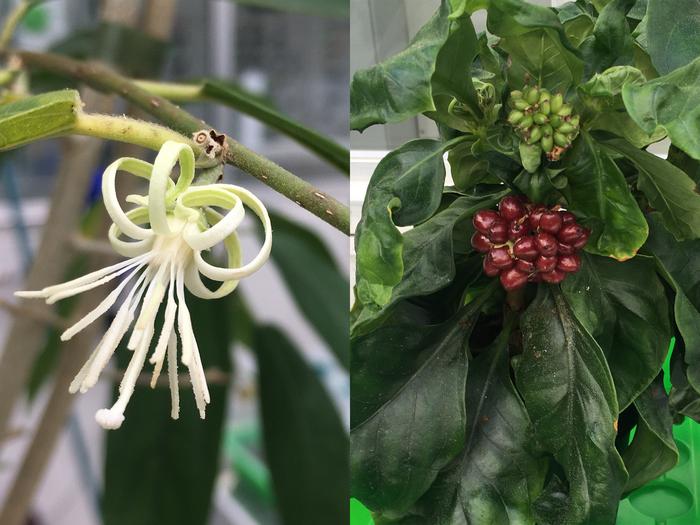
In the vast botanical world, plants have evolved an extraordinary arsenal of natural products essential for their survival, defense, and intricate ecological interactions. Among these compounds, alkaloids stand out due to their complex structures and potent biological activities, often finding vital roles in medicine. Intriguingly, some alkaloids appear in plant species that are evolutionarily distant, raising profound questions about their biosynthetic origins. A recent groundbreaking study uncovers how two distantly related plants, Carapichea ipecacuanha (commonly known as ipecac) and Alangium salviifolium (sage-leaved alangium), independently evolved the ability to produce a class of medically valuable compounds: ipecacuanha alkaloids.
The two species, separated by more than 100 million years of evolutionary divergence—C. ipecacuanha belonging to the gentian family and A. salviifolium to the dogwood family—both synthesize emetic alkaloids including cephaeline and emetine. These substances derive from the central intermediate protoemetine and have historical significance as medicinal agents. Specifically, ipecac syrup, an emetic preparation from C. ipecacuanha, was widely utilized in the pharmaceutical field, particularly in North America until the late 20th century, for inducing vomiting in cases of poisoning. Despite their medicinal importance, the genetic and enzymatic pathways leading to the biosynthesis of these alkaloids remained largely elusive prior to this study.
The research team, led by Maite Colinas at the Max Planck Institute for Chemical Ecology, worked meticulously to untangle the biosynthetic routes in both plants, employing comparative tissue analyses, genetic sequencing, and functional assays. They first quantified ipecac alkaloid accumulation in various plant tissues and discovered that young leaves and underground organs harbor the highest concentrations. This finding directed them to focus molecular analyses on these tissues, contrasting gene expression profiles to isolate biosynthetic candidates.
Novel insights arose from the observation that the initial step of the biosynthetic pathway appears to proceed spontaneously, contrary to classical enzymatic expectations. This non-enzymatic reaction challenges conventional wisdom in natural product biosynthesis, where enzymes typically guide every transformation with high specificity. Additionally, the researchers identified a unique sugar-cleaving enzyme that played a pivotal role later in the pathway. Remarkably, this enzyme’s three-dimensional structure diverged entirely from known classes catalyzing similar reactions, hinting at an unprecedented evolutionary recruitment event.
Further complexity in this pathway emerged from the enzyme’s subcellular localization. Unlike typical biosynthetic enzymes found in the cytoplasm or specialized organelles, this sugar-cleaving enzyme was localized specifically within the cell nucleus, whereas its substrate resided in the vacuole. This spatial separation establishes a defensive strategy: the toxic reactive intermediates formed upon sugar cleavage are generated only when enzyme and substrate meet, such as when herbivores disrupt cellular compartments by feeding. This controlled synthesis avoids autotoxicity, revealing sophisticated chemical defense orchestrated by cellular compartmentalization.
Such compartmentalized activation is found in other plant defense systems, including glucosinolates in crucifers and saponins in various species. This convergent strategy illustrates how plants repeatedly evolve mechanisms that leverage spatial dynamics to confine the production of potent compounds, ensuring metabolic safety coupled with effective deterrence against herbivores. Despite the chemical diversity of these molecules, the underlying defense logic remains consistent.
Crucially, the research underscores that C. ipecacuanha and A. salviifolium arrived at the same biochemical outcome through independent evolutionary pathways—a phenomenon known as convergent evolution. Enzyme comparisons revealed distinct gene lineages and structural architectures, substantiating that the biosynthesis of ipecac alkaloids was reinvented separately in these two species. This discovery provides a valuable model for studying molecular evolution and adaptive innovation in natural product biosynthesis.
The implications extend beyond evolutionary biology. The downstream alkaloids, especially those present in Alangium species like tubulosin, exhibit promising yet underexplored pharmacological properties. Their scarcity in nature has hindered comprehensive bioactivity studies. By dissecting these biosynthetic routes, the study lays the groundwork for future biotechnological production, potentially enabling scale-up synthesis of these compounds for medicinal evaluation and drug development.
Despite these advances, the complete biosynthetic roadmap remains partially charted. To date, the team has elucidated the pathway only up to protoemetine, leaving subsequent enzymatic transformations leading to cephaeline, emetine, and related metabolites unresolved. Deciphering these final steps remains a critical objective, promising to deepen understanding of enzymatic ingenuity and metabolite diversification.
The investigative approaches deployed—ranging from transcriptomic analyses to heterologous gene expression in model systems—highlight the power of interdisciplinary strategies in unraveling complex natural product biosynthesis. Functional characterization of enzymes via genetic transformation experiments not only confirmed the roles of candidate genes but also revealed surprising enzymatic properties defying previous biochemical assumptions.
Beyond the scientific details, this study exemplifies how fundamental botanical research intersects with applied medicine. By tracing the evolutionary and biochemical origins of alkaloid pathways, researchers illuminate pathways towards sustainable production of valuable pharmaceuticals. In an age increasingly focused on natural products and their synthetic biology harnessing, such insights are vital.
In sum, the research carried out at the Max Planck Institute for Chemical Ecology reveals a stunning instance of nature’s ability to independently engineer complex chemical defenses via radically different enzymatic machineries. These findings not only answer long-standing questions about ipecacuanha alkaloid biosynthesis but also open new frontiers in evolutionary biochemistry and plant natural product research. As scientists continue probing the enigmatic final steps and exploring pharmacological potentials, these two plants stand as remarkable exemplars of convergent chemical evolution with significant translational promise.
News Publication Date: 3-Jun-2025
Web References:
10.1038/s41589-025-01926-z
Cite Scienmag News
Gavin Prescott. (June 3, 2025). Two Plant Species Independently Produce the Same Complex and Medically Valuable Compound. Scienmag. https://scienmag.com/two-plant-species-independently-produce-the-same-complex-and-medically-valuable-compound/
Gavin Prescott. "Two Plant Species Independently Produce the Same Complex and Medically Valuable Compound." Scienmag, 3 June 2025, https://scienmag.com/two-plant-species-independently-produce-the-same-complex-and-medically-valuable-compound/. Accessed 4 September 2026.
Gavin Prescott. "Two Plant Species Independently Produce the Same Complex and Medically Valuable Compound." Scienmag. June 3, 2025. https://scienmag.com/two-plant-species-independently-produce-the-same-complex-and-medically-valuable-compound/


