


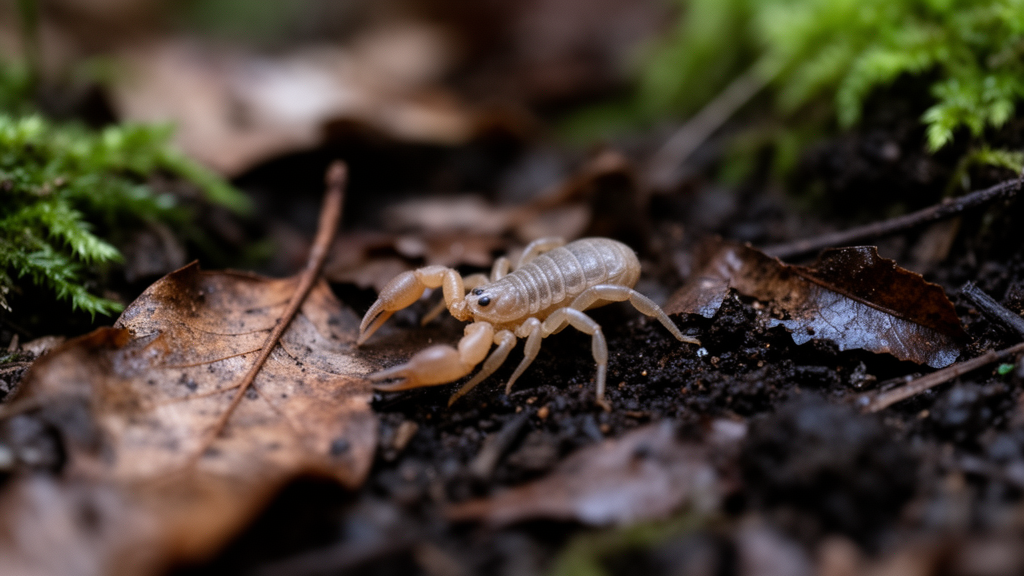
Deep in the moist leaf litter of South Korea’s mountain forests, tiny predators armed with venomous pincers have been hiding in plain sight. Researchers have now formally described two previously unknown species of pseudoscorpions from the genus Pararoncus, tiny arachnids that resemble scorpions but lack the familiar tail. The new species, named Pararoncus leonardi and Pararoncus taeyoungi, were collected from montane habitats on Mount Sobaek and Mount Bangtae, and their descriptions significantly expand what scientists know about a poorly documented group of Korean invertebrates.
Pseudoscorpions are among the most overlooked of all arachnids. With bodies typically just a few millimeters long, they live secretive lives in soil, leaf litter, caves, and under bark, where they hunt even smaller prey with their pincer-like pedipalps. Although more than 3,000 species are known worldwide, the fauna of many regions remains poorly surveyed. Korea is a striking example: only 25 species across 12 genera and 7 families are currently recognized, yet recent DNA barcoding studies suggest the true diversity is considerably higher. Against this backdrop, the discovery of two new species in a single genus is a notable addition to the country’s understudied arachnid record.
The new species belong to the family Syarinidae, a group of morphologically distinctive pseudoscorpions with 125 described species in 18 genera worldwide. Syarinids can be recognized by features such as a lanceolate trichobothrium — a hair-like sensory structure — on the movable finger of the pincer, and a granulate pleural membrane along the sides of the body. Before this study, Korea’s entire syarinid fauna consisted of a single species, Pararoncus japonicus, which also occurs in Japan. The genus Pararoncus itself comprised seven species, most of them associated with caves or forest floor habitats in the Japanese archipelago.
The biogeography of Palearctic syarinid genera is one of the more intriguing aspects of the new work. Many of these genera show restricted, possibly relictual distributions that hint at ancient lineages surviving in isolated refugia. Pararoncus is known from caves and leaf litter in Korea and Japan; Alocobisium occupies high-altitude habitats across central Asia; Arcanobisium and Lusoblothrus are ancient cave relicts on the Iberian Peninsula; Hadoblothrus is known exclusively from caves in Greece and Italy; and Pseudoblothrus inhabits caves on the Crimean Peninsula and in France, Switzerland, and Italy. Such fragmented distributions suggest that these small arachnids may be evolutionary leftovers, persisting in stable, humid microhabitats while their broader ancestral ranges contracted over geological time.
The first new species, Pararoncus leonardi, was collected at Mount Sobaek in Danyang-gun, Chungcheongbuk Province, at elevations between 741 and 1,439 meters. Specimens were found in moist leaf litter, the characteristic microhabitat of many litter-dwelling pseudoscorpions. The species is named in honor of National Basketball Association player Kawhi Leonard, who holds the longest wingspan in the NBA — a playful nod to the animal’s impressively elongated pedipalps. Adults measure roughly 3.6 to 4.0 millimeters in body length, making it the larger of the two new species.
Morphologically, P. leonardi displays the classic features of the genus: an epistome on the front edge of the carapace, an accessory tooth on the movable chelal finger, a characteristic arrangement of trichobothria on the pincer, and an apical process on the first leg’s coxa. Perhaps its most diagnostic trait is shared with its sister species: both new species possess four distinct eyes with lenses. That combination immediately separates them from all other known Pararoncus species, since P. japonicus, P. histrionicus, P. chamberlini, P. yosii, and P. oinuanensis have only two eyes, while the cave-dwelling P. rakanensis and P. uenoi have none at all. The eyes reflect the species’ surface-dwelling, epigean lifestyle, in contrast to the reduced or absent eyes of their subterranean relatives.
The second species, Pararoncus taeyoungi, comes from Mount Bangtae in Inje-gun, Gangwon Province, where specimens were recovered from leaf litter samples at 621 meters elevation using sifting and Berlese-Tullgren funnel extraction — a standard technique in which litter is gradually dried to drive out hidden arthropods. The species is named after former Korean Basketball League player Tae Young Moon, who holds the longest wingspan ratio in the league. It is smaller than its congener, measuring 2.77 to 3.32 millimeters, and can be distinguished by the proportions of the first leg’s tarsus, which is less than five times longer than deep, compared with more than five times in P. leonardi.
The taxonomic work behind the descriptions relied on detailed morphological analysis. Specimens preserved in 70 percent ethanol were examined under high-resolution stereomicroscopes and a scanning electron microscope, allowing the researchers to document fine structures such as the arrangement of marginal teeth on the chelal fingers, the blades of the rallum on the chelicerae, and the complex sclerotized components of the male genitalia. Measurements of body segments, ratios of leg articles, and counts of setae on the carapace and abdominal segments were compiled for both sexes. Together with habitus photographs and line drawings, these data form the basis of a revised identification key covering all nine known species of Pararoncus from Korea and Japan.
That key reveals an interesting ecological pattern within the genus. Species sort cleanly by habitat and eye number: the two troglobitic, narrow-range endemics from Japanese caves lack eyes entirely, three Japanese cave-associated troglophiles have two eyes, and the two new Korean species, along with the widespread surface-dwelling P. japonicus, have either two or four eyes. One species, P. histrionicus, remains something of a mystery — its type specimen was intercepted at quarantine in Hawaii but originated from an unknown locality in Japan, leaving its status uncertain. The new Korean species thus represent the only four-eyed members of the genus, a trait that may prove useful in future phylogenetic work.
The discovery underscores how much remains to be learned about Korea’s invertebrate fauna, even in well-visited mountain parks. Leaf litter ecosystems are among the least explored habitats on Earth at the species level, and pseudoscorpions — sensitive indicators of forest floor health — are frequently missed by conventional surveys. As barcoding studies continue to reveal hidden diversity, taxonomists expect many more new species from the Korean Peninsula and neighboring regions. For now, the two new mountain dwellers stand as a reminder that extraordinary finds can come from the humblest of places: a handful of damp leaves on a forested slope.
Subject of Research: Taxonomic description of two new pseudoscorpion species of the genus Pararoncus from Korean mountain habitats
Article Title: New species of the pseudoscorpion genus Pararoncus ( Pseudoscorpiones , Syarinidae ) from Korea
Article References: Jeong, K.-H., Harms, D., & Yoo, J.-S. (2024). New species of the pseudoscorpion genus Pararoncus (Pseudoscorpiones, Syarinidae) from Korea. Evolutionary Systematics, 8(1), 91-100. https://doi.org/10.3897/evolsyst.8.123108
Image Credits: AI Generated
DOI: 10.3897/evolsyst.8.123108
Keywords: pseudoscorpions, Pararoncus, Syarinidae, Korea, taxonomy, new species, leaf litter, arachnids, biogeography, Mount Sobaek, Mount Bangtae, Evolutionary Systematics
Cite Scienmag News
Drew Townsend. (October 19, 2026). Two New Pseudoscorpion Species Discovered in Korean Mountain Litter. Scienmag. https://scienmag.com/two-new-pseudoscorpion-species-discovered-in-korean-mountain-litter/
Drew Townsend. "Two New Pseudoscorpion Species Discovered in Korean Mountain Litter." Scienmag, 19 October 2026, https://scienmag.com/two-new-pseudoscorpion-species-discovered-in-korean-mountain-litter/. Accessed 19 October 2026.
Drew Townsend. "Two New Pseudoscorpion Species Discovered in Korean Mountain Litter." Scienmag. October 19, 2026. https://scienmag.com/two-new-pseudoscorpion-species-discovered-in-korean-mountain-litter/


