


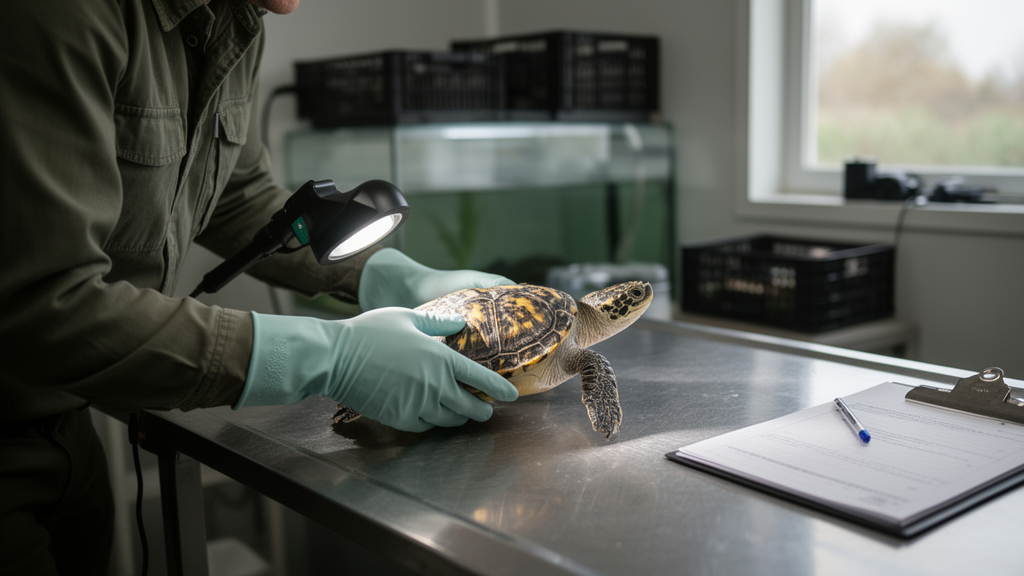
Invasive pond sliders, the familiar red-eared turtles sold for decades in pet shops around the world, are now widespread across Europe’s warmer waterways, where they compete with the native European pond turtle, prey on naive amphibian tadpoles and can spread disease. Removing them from the wild is increasingly seen as necessary for conservation, but every removal method, from a baited trap to a rifle shot, carries consequences for the welfare of the animals being controlled. A new study published in the journal NeoBiota provides the most systematic attempt yet to measure those consequences, assembling a panel of 24 herpetologists, turtle caretakers, veterinarians and welfare specialists to score the suffering associated with each step of managing invasive slider turtles in Europe.
The research team, working across Italy, Switzerland and Germany, confronted a problem that has long troubled invasion biologists: control programmes are typically designed to maximise ecological and economic outcomes, while the welfare of the target animals is treated as an afterthought or ignored altogether. Recent work in conservation decision science has argued that animal welfare should be evaluated as an explicit objective alongside biodiversity benefits, so that trade-offs can be made transparently rather than by default. To do that for slider turtles, however, managers first need to know how much pain, distress or deprivation each technique actually causes, and for a reptile species, that evidence base is remarkably thin.
The study adapted the Five Domains framework, a widely used model in animal welfare science. Domain 1 covers nutrition, including food and water deprivation; Domain 2 covers environmental challenges such as heat, cold or lack of shelter; Domain 3 covers health, injury and disease; Domain 4 covers behavioural and social restrictions; and Domain 5 represents the overall mental consequence, the suffering that emerges from the first four domains. Building on an earlier Australian framework for assessing the humaneness of vertebrate pest control, the researchers defined eight management actions: capture with fyke or minnow traps, capture with basking traps, transportation in covered boxes, containment in semi-natural enclosures, containment in intensively managed facilities, shooting with a rifle, lethal injection, and freezing of eggs removed from wild nests.
Crucially, each action was assessed across explicit time intervals, a significant modification of the original framework. Trapping scenarios ranged from 12 hours to seven days depending on trap type, transportation from 3 to 24 hours, captivity from one year to more than a decade, and lethal methods from the instant of application to beyond 30 minutes until loss of consciousness. The underlying logic is that welfare impacts are not static: a turtle held briefly in a funnel trap may experience little more than behavioural unease, while one left for two days in warm water faces dehydration, overheating, aggression from other trapped individuals and escalating distress.
Because empirical data on turtle welfare barely exist, the team collated whatever evidence they could, including temperature logs and camera footage from field programmes in Hungary and Switzerland, necropsy records, husbandry guidelines and studies of embryonic development, and then turned to structured expert elicitation. Following a modified Delphi protocol, 24 experts scored the expected welfare impact of every action and timeframe on a five-step scale from No impact to Extreme, rating their own confidence after each answer. They then discussed anonymised results in multiple online rounds in English, German and Italian before revising their scores, a cycle designed to expose linguistic misunderstandings and prevent groupthink while preserving the diversity of judgement.
The results offer reassurance for well-run operations and warnings for sloppy ones. Experts broadly agreed that trapping causes no or mild suffering within the first 24 hours, and that transport of up to six hours at appropriate temperatures of 20 to 24 degrees Celsius is similarly benign. Intensively managed captivity, following husbandry standards developed in Italy, was judged to produce predominantly no or mild impacts even over many years. On the lethal side, all experts agreed that a properly placed rifle shot causing immediate loss of consciousness inflicts no suffering, and lethal injection with prior sedation was rated as causing none or mild suffering only. Egg freezing attracted relatively low impact estimates, on the reasoning that cold blocks nerve conduction, although the panel flagged that late-stage embryos, in which neural pathways may already be forming, remain a genuine uncertainty.
Time emerged as the single most important amplifier of harm. Statistical models confirmed that the probability of impacts reaching Moderate or Severe rose steadily, and often nearly linearly, with the duration of every action. Opinions diverged sharply beyond standard practice: once fyke traps were left unchecked beyond 24 hours, or basking traps beyond a few days, or transport stretched to 12 or 24 hours, some experts predicted Severe or even Extreme suffering. The greatest spread of opinion concerned semi-natural containment over decades, where overcrowding, disease transmission, poor water quality and the absence of veterinary care could accumulate into serious welfare decline, yet five of thirteen experts judged decade-long containment as Severe or Extreme while others remained far less concerned.
Expert confidence averaged a relatively high 80 percent overall, but it dropped in revealing patterns. Confidence was higher for non-lethal methods than for lethal ones, highest for transport and lowest for egg freezing, and it fell significantly as estimated impact levels increased and, after controlling for impact, over the longest timeframes. The weakest ground of all was Domain 4, behavioural and social welfare, where experts confessed that the inner states of a non-mammalian species are notoriously difficult to read. Veterinarians tended to rate impacts slightly higher than reptile specialists and caretakers, though the difference was not statistically significant, and their judgements were generally less polarised.
From the discussion rounds emerged a set of concrete best practices that managers can apply immediately. Traps should be checked at least every 24 hours for fyke traps and every three days for basking traps, and placed to offer shade and prevent overheating, with particular care around post-hibernation and breeding periods when densities and activity spike. Transport boxes should be compartmentalised or lined with cotton bags to maintain moisture, avoid mixing turtles of different sizes, and never exceed a few hours. Captive facilities must limit densities, provide varied microhabitats, basking sites, nesting opportunities and balanced diets, since inadequate nutrition is linked to bladder stones, shell deformities and ear infections in captive sliders. Shooting should only be performed by trained marksmen, and injection protocols must account for the ectothermic physiology of reptiles, whose slow metabolism in cold or stressed animals can delay drug action, making verification of anaesthesia, for example by testing the corneal reflex, essential before administering lethal agents.
The authors are careful to note that their findings reflect expert opinion rather than experimental proof, and that they assessed individual welfare only, leaving aside bycatch, multi-step interventions and the numbers of animals affected. Even so, the study demonstrates that formal elicitation can convert scattered, partly intuitive knowledge into a transparent and reproducible baseline for policy, showing decision-makers exactly where consensus is strong and where ignorance reigns. It also identifies where new research would pay off fastest: field studies quantifying first-shot success and time to insensibility in shooting, longitudinal comparisons of captivity facilities, and developmental work on when reptile embryos become capable of sensing pain. As invasive species management intensifies worldwide under pressure from biodiversity loss, the lesson from the humble slider turtle is that conservation and compassion need not be adversaries, provided the welfare costs of every capture, journey and end-point are counted honestly and minimised by design.
Subject of Research: Animal welfare assessment of lethal and non-lethal management methods for invasive slider turtles
Article Title: Animal welfare implications of management strategies for invasive freshwater turtles
Article References: Moser, L. A., Smith, B. R., Matthys, S., Kenup, C., Spongano, I., Cavatoni, S., Dal Zotto, M., Ferrari, N., Ferri, V., Hoby, S., Lloyd Jr., R. B., Moretti, A., Oneto, F., Origgi, F., Ottonello, D., Santicchia, F., Zanirato, N., Zuffi, M. A. L., & Canessa, S. (2026). Animal welfare implications of management strategies for invasive freshwater turtles. NeoBiota, 109, 345-366. https://doi.org/10.3897/neobiota.109.204683
Image Credits: AI Generated
DOI: 10.3897/neobiota.109.204683
Keywords: invasive species, Trachemys scripta, animal welfare, Five Domains framework, expert elicitation, herpetology, conservation management, euthanasia, reptile welfare, trapping, captivity, Delphi method
Cite Scienmag News
Margaret Porter. (October 19, 2026). How Much Do Invasive Turtles Suffer? Experts Map the Welfare Cost of Control. Scienmag. https://scienmag.com/how-much-do-invasive-turtles-suffer-experts-map-the-welfare-cost-of-control/
Margaret Porter. "How Much Do Invasive Turtles Suffer? Experts Map the Welfare Cost of Control." Scienmag, 19 October 2026, https://scienmag.com/how-much-do-invasive-turtles-suffer-experts-map-the-welfare-cost-of-control/. Accessed 19 October 2026.
Margaret Porter. "How Much Do Invasive Turtles Suffer? Experts Map the Welfare Cost of Control." Scienmag. October 19, 2026. https://scienmag.com/how-much-do-invasive-turtles-suffer-experts-map-the-welfare-cost-of-control/


