


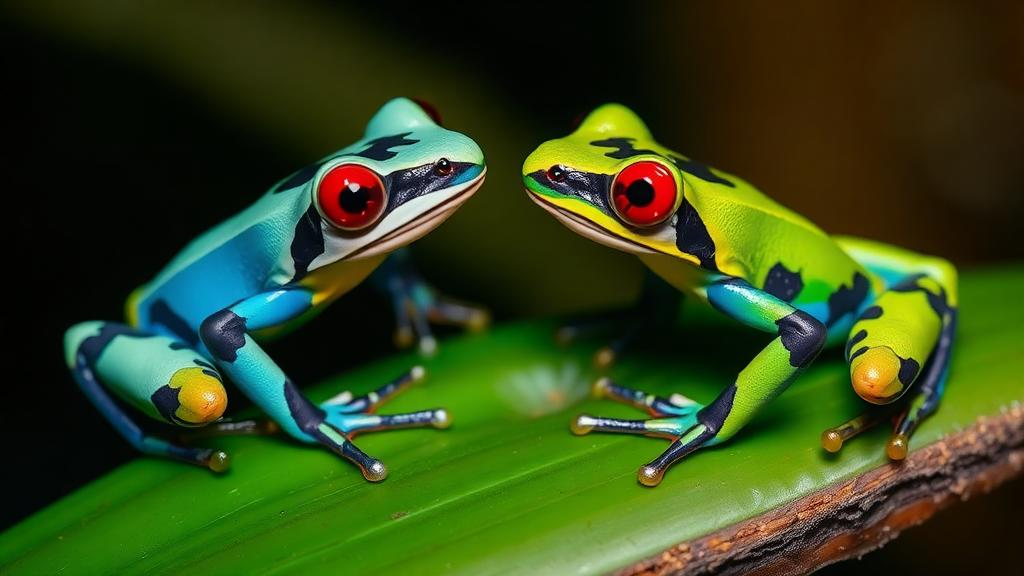
Deep in the tropical forests of southern Vietnam and central Laos, a group of small, burrowing frogs has been hiding in full view of science for decades. A new study published in the journal Herpetozoa has re-examined the painted frogs of the genus Kaloula, a widespread group of Asian microhylids, and concluded that two populations long assigned to a recently described species are in fact distinct. The researchers have formally named them Kaloula discordia, the South Vietnamese Painted Frog, and Kaloula laosensis, the Laotian Painted Frog, bringing the number of recognized species in this once-overlooked genus to twenty.
The genus Kaloula, known commonly as Asian painted frogs, ranges from Korea and northeastern China across Indochina to the Sunda Islands, the Philippines, Bangladesh, and northeastern India. These are medium-sized frogs, typically 35 to 60 millimeters in body length, with round pupils, dilated finger disks, and smooth or slightly rough backs marked with irregular dark patterns. For years the genus attracted far less taxonomic attention than related microhylid groups such as Microhyla, whose recognized species count jumped from 22 to 51 in two decades, or Micryletta, which rose from three species to 13. Kaloula remained comparatively stable at 18 recognized species, even as hints of hidden diversity accumulated.
That stability now looks like an artifact of limited sampling. The new study assembled roughly 2,455 base pairs of mitochondrial DNA from the 12S and 16S ribosomal RNA genes, combining published GenBank sequences with new material collected during fieldwork in Vietnam between 2009 and 2023 and in Laos in 2009. In total, the researchers obtained 16S data for 233 specimens representing 15 of the 18 previously recognized Kaloula species, including topotype specimens of K. baleata from its type locality on the Indonesian island of Java. Bayesian inference and maximum likelihood analyses recovered essentially matching genealogies, confirming the monophyly of the genus and revealing deep structure within the K. baleata species complex.
The genetic evidence was striking. The populations from Khammouane Province in central Laos and from Dong Nai and Lam Dong provinces in southern Vietnam, previously lumped with K. indochinensis, showed uncorrected 16S p-distances of more than 4.45 percent and 4.33 percent respectively from their closest relatives. These values far exceed the commonly used 3 percent threshold for species-level divergence in anurans, and they even surpass the 3.0 percent divergence observed between K. baleata and K. latidisca, two species already recognized as distinct. Mitochondrial genealogy placed the Laotian species as the sister of K. indochinensis, with the southern Vietnamese species as sister to that pair.
Genetics alone does not make a species, so the team turned to integrative evidence. Principal component analysis of 23 morphometric characters, measured with digital calipers under a dissecting microscope and size-corrected against snout-vent length, showed that specimens from Laos, southern Vietnam, and true K. indochinensis occupy non-overlapping regions of morphospace. The new species differ in subtle but consistent traits: K. discordia has comparatively small eyes, two metacarpal tubercles on the hand, and an olive dorsum, while K. laosensis has larger eyes, three metacarpal tubercles with a median tubercle touching both neighbors, and a dark brown back covered with contrasting black blotches forming a pericloacal ring. Both differ from K. indochinensis, which has chocolate-brown to dark grayish-brown coloration and three well-developed subarticular tubercles on the fourth toe.
Bioacoustics added a further line of evidence for the Vietnamese species. Recorded in Cat Tien National Park in August 2023 at an air temperature of 24 degrees Celsius, the advertisement call of K. discordia is a slow, low-pitched, resonant booming sound that resembles a bicycle horn to the human ear. Each call consists of a single note with 11 to 13 pulses, averaging 190.8 milliseconds in duration, repeated roughly once per second with a mean intercall interval of about 1.2 seconds. Compared with K. indochinensis, the new species sings with a slightly shorter call and a markedly longer interval between calls, though the authors caution that the recordings were made at different ambient temperatures, which can influence call parameters.
Perhaps the most sobering finding concerns the type series of K. indochinensis itself, described in 2013. The authors of the new study conclude that six adult male specimens from Khammouane Province, stored at the Field Museum of Natural History in Chicago and included in the original type series of K. indochinensis, actually belong to K. laosensis. Because those specimens were never genetically barcoded against topotypic material from central Vietnam, their distinctiveness went unnoticed. The type localities of the two species lie more than 500 kilometers apart in biogeographically and climatically different parts of Indochina, and the authors argue that including specimens from such distant localities in a single type series without DNA barcoding is an unnecessary gamble.
The study also reshapes understanding of the wider K. baleata complex across Sundaland. Mitochondrial data reveal three shallow but geographically circumscribed lineages within K. baleata sensu lato: one spanning Palawan, Sulawesi, Sumba, Bali, Java, and southern Sumatra; a second covering Borneo, eastern Peninsular Malaysia, Tioman Island, and western Java; and a third known so far from a single locality in the Tanintharyi Region of southern Myanmar. The authors hypothesize that K. latidisca, previously known from northern Peninsular Malaysia, actually extends into southern Thailand as far north as Satun and Suratthani provinces, and that the Titiwangsa Mountain Range separates its range from that of K. baleata lineage 1. These patterns mirror biogeographic partitions reported for other Indochinese amphibians and hint at ancient vicariance events across the Sunda shelf.
The natural history of the new species underscores how much remains unknown. K. discordia inhabits lowland and hilly seasonally dry monsoon forests of southern Vietnam and adjacent eastern Cambodia, emerging from leaf litter, burrows, and tree hollows only after heavy rains between May and November, with breeding peaking during the June to August monsoon. It is semi-fossorial, secretive, a capable climber, and feeds on ants and beetles. K. laosensis is known only from two localities in Khammouane Province, where it inhabits limestone evergreen forests at 100 to 300 meters elevation and likely depends on karst landscapes. Both species are proposed for the IUCN category Data Deficient, though the authors flag habitat loss and degradation, particularly the intensive conversion of southern Vietnam’s lowland forests over the past 40 years, as the principal threat.
What makes the discovery especially remarkable is where it happened. Cat Tien National Park, the type locality of K. discordia, is among the most thoroughly surveyed herpetological sites in Vietnam, with 45 amphibian and 107 reptile species recorded over more than 40 years of expeditions by international teams and summarized in a dedicated monograph. That a new frog species could emerge from such a well-studied park illustrates the authors’ central message: amphibian diversity in Southeast Asia remains hidden in plain sight, even among recently studied taxa. The team calls for continued field surveys, comprehensive morphological datasets in species descriptions, and future work using nuclear genomic loci to test evolutionary hypotheses, assess hybridization, and refine the taxonomy of a genus that, until now, few suspected of concealing so much.
Subject of Research: Taxonomic revision and phylogeography of the Kaloula baleata frog species complex in Southeast Asia
Article Title: Phylogeographic pattern and taxonomic revision of the Kaloula baleata species complex ( Amphibia , Anura , Microhylidae ) with description of two new species from Indochina
Article References: Gorin, V. A., Orlov, N. L., Bragin, A. M., Pawangkhanant, P., Milto, K. D., Le, D. X., Nguyen, T. V., Dufresnes, C., Suwannapoom, C., & Poyarkov, N. A. (2024). Phylogeographic pattern and taxonomic revision of the Kaloula baleata species complex (Amphibia, Anura, Microhylidae) with description of two new species from Indochina. Herpetozoa, 37, 391-420. https://doi.org/10.3897/herpetozoa.37.e137394
Image Credits: AI Generated
DOI: 10.3897/herpetozoa.37.e137394
Keywords: Kaloula, painted frogs, Microhylidae, amphibians, Vietnam, Laos, new species, mitochondrial DNA, phylogeography, taxonomy, bioacoustics, Southeast Asia
Cite Scienmag News
Margaret Porter. (October 19, 2026). Two New Painted Frog Species Emerge from Southeast Asia’s Forests. Scienmag. https://scienmag.com/two-new-painted-frog-species-emerge-from-southeast-asias-forests/
Margaret Porter. "Two New Painted Frog Species Emerge from Southeast Asia’s Forests." Scienmag, 19 October 2026, https://scienmag.com/two-new-painted-frog-species-emerge-from-southeast-asias-forests/. Accessed 19 October 2026.
Margaret Porter. "Two New Painted Frog Species Emerge from Southeast Asia’s Forests." Scienmag. October 19, 2026. https://scienmag.com/two-new-painted-frog-species-emerge-from-southeast-asias-forests/


