


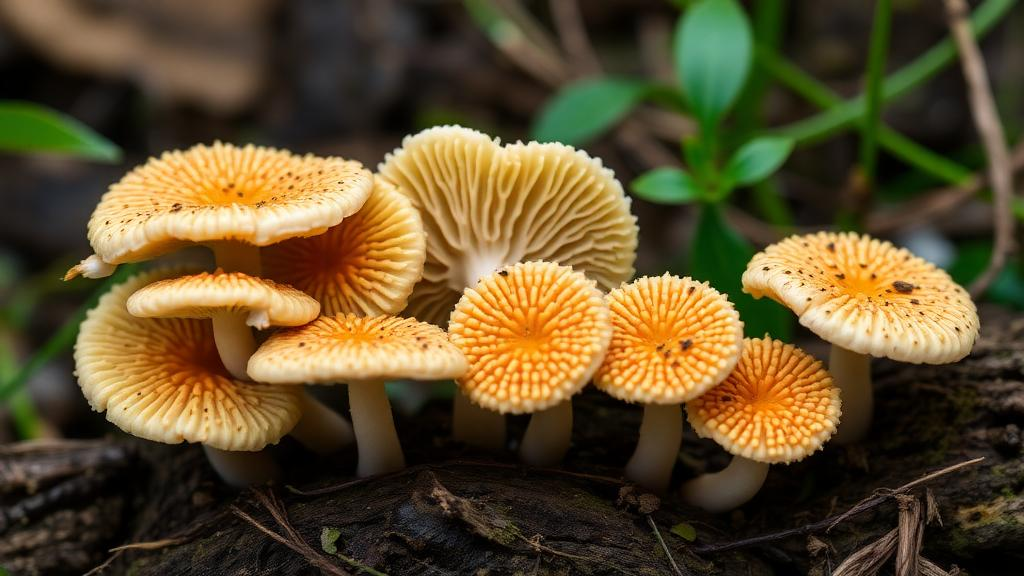
Beneath the leaf litter of the world’s forests grows a group of mushrooms that look like nothing else in the fungal kingdom. Instead of gills or pores, they carry their spores on thousands of tiny teeth, earning them the affectionate names of hedgehog mushrooms or tooth fungi. These are the species of Hydnum, a genus Linnaeus himself described back in 1753, and they have now received the most thorough genetic audit in their history. A new study published in IMA Fungus has combined DNA sequencing of hundreds of specimens with classical microscopy to redraw the family tree of the entire genus, describe two brand-new species from China, and expose just how much tooth fungus diversity still hides in the world’s forests.
The research team, led by Bao-Kai Cui and colleagues at Beijing Forestry University, took a two-pronged approach. First, they built a multi-gene phylogeny using three DNA regions: the internal transcribed spacer (ITS), the large ribosomal subunit (nLSU), and the translation elongation factor gene tef1-alpha. This combined dataset included 426 sequences from 232 specimens, 47 of them newly generated for the study, drawn from field collections in China, France, and Tasmania as well as herbarium loans. Second, they performed a sweeping meta-analysis of 1,293 publicly available ITS sequences, filtering out the short, mislabeled, and poorly annotated records that plague fungal DNA databases, to construct a global picture of the genus.
The results confirm that Hydnum is organized into six subgenera plus a handful of lineages whose placement remains uncertain. The subgenera Rufescentia, Hydnum, Pallida, Brevispina, Alba, and Alba in the broad sense each emerged with strong statistical support from the multi-gene analysis, which used maximum likelihood and Bayesian methods on parallel computing clusters. But the most tantalizing discovery was a seventh, well-supported lineage the authors named Clade Insulana, composed of tooth fungi from the islands of Oceania and the Malay Archipelago, including Australia, New Zealand, New Caledonia, Malaysia, and Singapore. Because researchers lack sufficient physical specimens, the team designated it a clade rather than formally naming a new subgenus, but its genetic distinctiveness is beyond doubt.
Two new species did receive formal names, both from the forests of Yunnan Province in southwestern China. Hydnum flosculoides, whose name refers to its flower-like appearance, produces large, undulating caps up to 110 millimeters wide with orange, downward-running spines and a mild, fruity odor. It was collected at around 1,200 meters elevation in forests mixing bamboo, oak, and pine. Hydnum robustum, by contrast, is named for its sturdy build: short, thick fruiting bodies with wide stipes up to 25 millimeters across, found in pine forests at roughly 1,900 meters. Both species were distinguished from close relatives by combining DNA evidence with scanning electron microscopy of spores, which revealed smooth, thin-walled basidiospores with a distinct hilar appendix at the attachment point.
The new species illustrate a broader lesson from the study: geography matters more than appearance in fungal taxonomy. Specimens from southern subtropical China had previously been misidentified as the Japanese species Hydnum pinicola, but the new collections formed their own strongly supported lineage in the multi-gene tree, with subtle differences in stipe width, spine length, and the diameter of hyphae in the cap skin. Similarly, the analysis confirmed that the North American species Hydnum albidum is genetically distinct from its East Asian lookalike Hydnum orientalbidum, a pattern of intercontinental endemism that repeats across the genus. What once looked like one cosmopolitan species is often a pair of continental twins.
Indeed, the ITS meta-analysis showed that only a handful of Hydnum species are genuinely widespread across continents. Hydnum umbilicatum stands out as a classic Holarctic species with records spanning North America, Europe, and Asia, while Hydnum melitosarx and Hydnum jussii show similar broad distributions. The famous woodland hedgehog Hydnum repandum, long treated as a single variable species, appears instead to be a complex of closely related lineages, with numerous distinct clades containing sequences that had been mislabeled as H. repandum in public databases. The lack of strong bootstrap support for the core repandum clade suggests the taxonomic story of Europe’s best-known tooth fungus is far from finished.
The study also delivers a candid assessment of ITS, the official DNA barcode for fungi. The region remains the workhorse of fungal identification, and the meta-analysis proved its value at the subgenus level, recovering the same seven major clades as the multi-gene tree. But at the species level its limits became clear: 21 species that were cleanly separated in the multi-gene analysis could not be distinguished by ITS alone. In one striking case, the multi-gene tree placed Hydnum minum firmly within subgenus Brevispina, while ITS phylogenies parked it in a different subgenus altogether. The authors conclude that multi-gene approaches remain essential for species delimitation in Hydnum, and they call for better amplification of supplementary markers such as tef1-alpha, rpb2, and mitochondrial SSU.
Ecologically, the picture that emerges is of a genus of obligate ectomycorrhizal fungi, locked into symbiotic partnerships with trees, especially pines, spruces, firs, oaks, and beeches. These partnerships make Hydnum ecologically important, since ectomycorrhizal fungi supply trees with water and nutrients in exchange for sugars, underpinning forest growth and nutrient cycling. The genus also carries economic weight: its species are prized edibles sold in markets from France and Spain to Mexico, Japan, and southwestern China, and species such as H. repandum and H. rufescens have shown antioxidant and antimicrobial properties linked to their polyphenolic compounds. Habitats range from boreal conifer forests to tropical montane cloud forests, on soils from acidic to calcareous, with some European species showing a marked preference for lime-rich ground.
The global tally now stands at 84 confirmed species, of which 33 have been recorded in China, making East Asia and North America the two principal centers of tooth fungus diversity. Yet the meta-analysis also revealed at least 14 putatively new phylospecies and 17 singletons, sequences so distinct and so rarely sampled that they may represent species known only from a single record. Clade Insulana alone harbors at least seven unnamed lineages scattered across the islands of the Southern Hemisphere, and subgenus Pallida contains multiple strongly supported but undescribed lineages in China and Japan. The true species count is almost certainly far higher than the current inventory suggests.
The study’s authors are equally frank about the gaps in the map. Sampling is dense in North America, Europe, and East Asia but thin to absent across most of Africa, South America, and Southeast Asia, with only scattered records from Tunisia, Colombia, Venezuela, India, and Pakistan. Closing those gaps, they argue, will require targeted field surveys, sequencing tied to properly preserved voucher specimens, and region-specific environmental sampling. For a genus that has been on scientists’ books since Linnaeus, the hedgehog mushrooms are proving to be one of the more surprising frontiers of fungal discovery, and the new phylogenetic framework gives researchers the roadmap they need to find what is still hiding under the trees.
Subject of Research: Multi-gene phylogenetics and taxonomy of the tooth fungus genus Hydnum
Article Title: Multi-gene phylogeny and taxonomy of Hydnum ( Hydnaceae , Cantharellales ) including a global phylogeny of ITS sequences for the genus
Article References: Xu, Y.-H., Zeng, L., Xu, T.-M., Song, C.-G., Shen, L.-L., Sun, Y.-F., & Cui, B.-K. (2026). Multi-gene phylogeny and taxonomy of Hydnum (Hydnaceae, Cantharellales) including a global phylogeny of ITS sequences for the genus. IMA Fungus, 17, Article e172544. https://doi.org/10.3897/imafungus.17.172544
Image Credits: AI Generated
DOI: 10.3897/imafungus.17.172544
Keywords: Hydnum, tooth fungi, phylogenetics, ITS barcode, taxonomy, new species, ectomycorrhizal fungi, mycology, China, Clade Insulana, fungal diversity, IMA Fungus
Cite Scienmag News
Roger Howard. (October 19, 2026). Tooth Fungi Get a Family Tree: Global DNA Study Reveals Hidden Hedgehog Mushroom Diversity. Scienmag. https://scienmag.com/tooth-fungi-get-a-family-tree-global-dna-study-reveals-hidden-hedgehog-mushroom-diversity/
Roger Howard. "Tooth Fungi Get a Family Tree: Global DNA Study Reveals Hidden Hedgehog Mushroom Diversity." Scienmag, 19 October 2026, https://scienmag.com/tooth-fungi-get-a-family-tree-global-dna-study-reveals-hidden-hedgehog-mushroom-diversity/. Accessed 19 October 2026.
Roger Howard. "Tooth Fungi Get a Family Tree: Global DNA Study Reveals Hidden Hedgehog Mushroom Diversity." Scienmag. October 19, 2026. https://scienmag.com/tooth-fungi-get-a-family-tree-global-dna-study-reveals-hidden-hedgehog-mushroom-diversity/


