


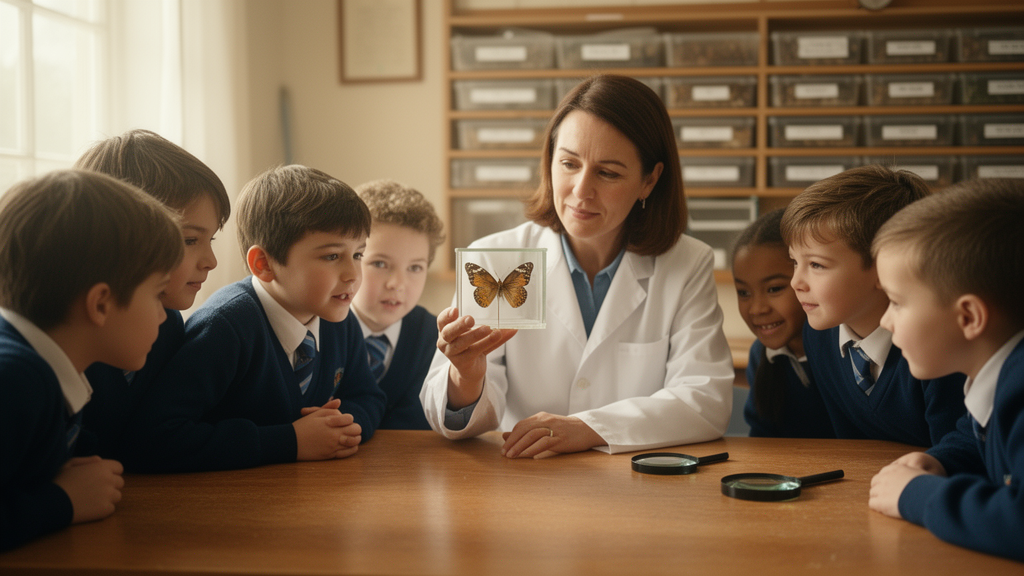
A drawer of dead insects sounds like the least glamorous object in a natural history museum, yet a project born at Clemson University is proving that specimens once destined for the discard bin can become one of the most effective tools for reconnecting people with the natural world. The Museums in Miniature initiative takes unlabeled, unsealed, and unprocessed insect specimens, material that fails to meet museum research standards, and transforms it into curated educational displays placed in schools, libraries, and extension programs across the American Southeast. What began as a pandemic-era workaround has quietly grown into an interstate movement with a projected reach of roughly 165,000 people over its first decade.
The story starts with a familiar problem. During the COVID-19 lockdowns of 2020 and 2021, the Entomology Club at Clemson and the Clemson University Arthropod Collection had built a robust outreach program around in-person visits to elementary and middle schools and public libraries. Young students were fascinated by live demonstrations and real specimens, but as educators across the country reported, those tried-and-true methods lost nearly all their appeal when squeezed through a screen. When schools reopened, requests for demonstrations flooded in faster than a student-run club could handle, and many of the requesting schools sat hours away, making weekday travel logistically impossible for college volunteers.
The solution was sitting in a backlog. Every fall, roughly 40 students in Clemson’s Insect Biodiversity course submit collection projects worth about a third of their grade, each student gathering around 125 specimens spanning 50 insect families. That means approximately 4,000 specimens arrive each semester, and most are large, common, easily captured insects such as paper wasps and June beetles. A few are folded into the museum’s permanent holdings or used to replace broken teaching specimens, and the damaged ones are discarded. The majority, while not museum quality, still hold genuine educational value, and researchers recognized that this steady stream of student-collected material could be repurposed rather than wasted.
Each finished Museum in Miniature contains exactly 100 pinned adult insect specimens arranged in a standard insect drawer with unit trays. The curation is deliberate: some specimens are re-pinned and re-labeled to model proper technique, while taxa are standardized at the family level, meaning any horsefly will do as long as it represents Tabanidae. Selection follows three criteria: how common the taxon is in the state, how likely a non-entomologist is to recognize it, and whether it carries economic or domestic importance as a pest, crop threat, or invasive species. Fourteen insect orders are represented, from dragonflies and stoneflies to beetles, moths, and flies, with the five major orders plus the visually impressive Odonata each getting their own labeled unit tray.
There is personality in the details, too. Each South Carolina drawer includes the state insect, the Carolina mantis, and the state butterfly, the eastern tiger swallowtail, while Mississippi drawers feature the honey bee and the spicebush swallowtail. Species of particular interest, such as the eastern Hercules beetle, earn a spot, and the drawers even honor the people behind the collections: a caddisfly represents curator emeritus Dr. John Morse, chosen because people see caddisflies constantly but almost never recognize them. Header cards printed on bright yellow cardstock carry illustrations, common names, and scientific names, and a life-cycle illustration of the Hercules beetle deliberately reframes the usual butterfly narrative to show how holometabolous insects develop.
The engineering behind each drawer is simple but rigorous. Two packs of clay desiccant keep humidity at bay, hidden beneath two upside-down unit trays used to display written information. Once filled, the drawer is frozen at minus 50 degrees Celsius for 24 hours as pest control, placed in a plastic bag during freezing and thawing to keep condensation off the specimens. After thawing, the lid is sealed to the base with a single strip of clear packing tape to deter skin beetles and other dermestid pests, with a printed care list and contact information sealed underneath. A folded tape handle allows easy reopening for maintenance, and a cardboard topper was added after a glass top broke in transit at a partner library.
Every drawer ships with a binder of teaching materials and access to a Google Drive folder containing lesson plans, coloring sheets, and fact sheets written by students, volunteers, and museum staff. The fact sheets are designed to catch a community member’s interest and teach both children and adults about each taxon, with links to entomological groups and resources for anyone whose curiosity is sparked further. This pairing is intentional: the specimens deliver the emotional jolt, the instinctive WOW response that pinned beetles and dragonflies reliably produce, while the fact sheets supply the intellectual scaffolding that turns a moment of fascination into genuine understanding.
Distribution has scaled faster than expected. The original 20 South Carolina drawers were funded by a $2,000 Entomological Society of America Chrysalis Grant plus $500 from the South Carolina Entomological Society, with the newly formed Pin-It! Entomological Supplies providing quality drawers. Eighteen Museums in Miniature are now deployed across South Carolina, and the Mississippi Entomological Museum at Mississippi State University has received five requests and is filling them through 2025. Current placements include 11 libraries, five school districts covering 25 schools, and an extension agent circulating drawers among 4-H students. One drawer serves 19 schools in a single South Carolina district, and the Pickens County library system gathers its drawers at a central location for maintenance pickup, a model that keeps costs low while multiplying reach.
The impact estimates are striking for a program built on discarded material. If an average of five people per day view each of the 11 library displays, that alone exceeds 14,000 views per year, and if each of the 25 schools uses its drawer for one grade annually at roughly 100 students per grade, the program reaches another 2,500 students. Over ten years, the currently deployed drawers would impact approximately 165,000 people. Custodian feedback has been uniformly positive: librarians report that adults and children alike are captivated by the displays, teachers use them across multiple grades because insects are a core component of elementary curricula, and students talk about the specimens, read the fact sheets, and ask their teachers what the researchers cheerfully call impossible questions.
The deeper stakes extend beyond entomology. As urbanization separates people from nature, fear of insects hardens into learned behavior passed from parents to children, and the only insects most people encounter are pests, which reinforces the idea that nature is uncomfortable or bad. Meanwhile, shrinking funding has closed public museums and orphaned entire collections; when the University of Mississippi discontinued support for its insect collection, the Mississippi Entomological Museum had to rescue the specimens. The Museums in Miniature model offers a counterargument: every natural history collection holds material that fails research standards, and that trash can become a teacher. The team hopes botanists, herpetologists, and other specialists will adapt the framework, and that the enthusiasm these mini-museums generate can be channeled into community science projects that advance biodiversity research while there is still biodiversity left to save.
Subject of Research: Repurposing unprocessed insect specimens as educational museum displays for community outreach
Article Title: From trash to teacher: utilizing unlabeled, unsealed, and unprocessed specimens for community engagement
Article References: Wooden, P. L. S., Artley, N. K., Silva, C. M., & Ferro, M. L. (2025). From trash to teacher: utilizing unlabeled, unsealed, and unprocessed specimens for community engagement. Natural History Collections and Museomics, 2, 1-9. https://doi.org/10.3897/nhcm.2.154471
Image Credits: AI Generated
Keywords: entomology, natural history collections, Museums in Miniature, Clemson University, science outreach, insect specimens, community engagement, biodiversity education, museum curation, STEM education, Mississippi Entomological Museum, insect biodiversity
Cite Scienmag News
Gavin Prescott. (October 19, 2026). Rescued Insect Specimens Become Miniature Museums for Schools. Scienmag. https://scienmag.com/rescued-insect-specimens-become-miniature-museums-for-schools/
Gavin Prescott. "Rescued Insect Specimens Become Miniature Museums for Schools." Scienmag, 19 October 2026, https://scienmag.com/rescued-insect-specimens-become-miniature-museums-for-schools/. Accessed 19 October 2026.
Gavin Prescott. "Rescued Insect Specimens Become Miniature Museums for Schools." Scienmag. October 19, 2026. https://scienmag.com/rescued-insect-specimens-become-miniature-museums-for-schools/


