


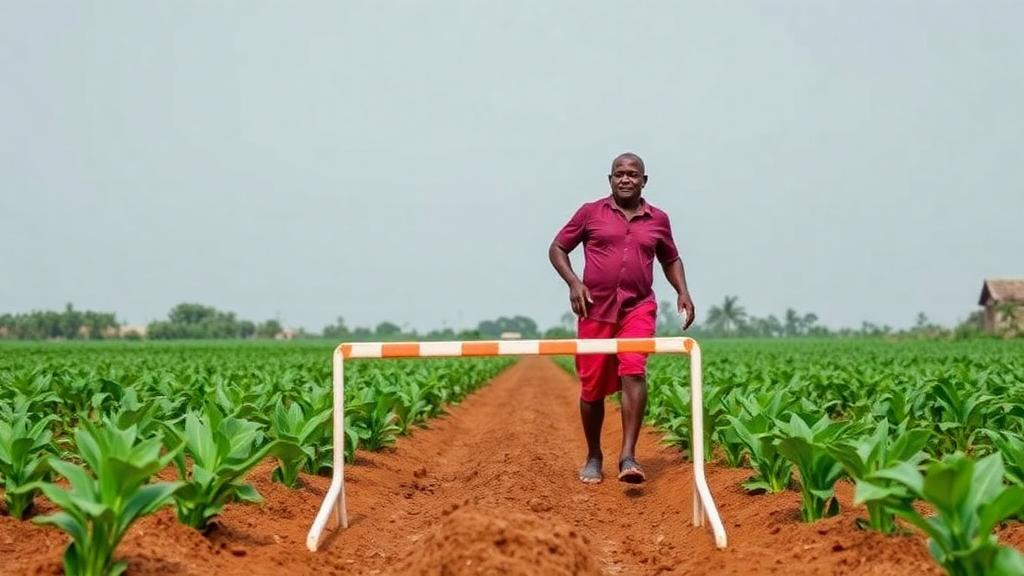
In the rolling farmlands of southwestern Nigeria, where yam, maize, cassava, and cocoa sustain millions of rural households, a quiet crisis of protection is unfolding. Smallholder farmers face a relentless barrage of risks: erratic rainfall, prolonged droughts, devastating floods, pest and disease outbreaks, and violent swings in output prices. Agricultural insurance promises a buffer against these shocks, stabilizing incomes and encouraging investment in better technologies. Yet participation among Nigerian smallholders remains persistently low, even where insurance products are technically available. A new study from Osun State, published in SN Social Sciences, offers one of the most granular explanations yet for why so many farmers remain uninsured, and the answer turns out to be more complicated than a simple lack of interest.
Economists Ayodeji Damilola Kehinde of Obafemi Awolowo University and Abiodun Akintunde Ogundeji of the University of the Free State surveyed 240 smallholder crop farmers across four local government areas in Osun State, using a multistage sampling design drawn from registered farmer databases maintained by the Agricultural Development Programme and the Nigerian Agricultural Insurance Corporation. Their analytical weapon of choice was Cragg’s double hurdle model, an econometric framework first proposed in 1971 that deliberately breaks a single economic decision into two sequential stages. The first hurdle asks whether a farmer is willing to adopt insurance at all; the second, estimated only among those who pass the first, asks how much money that farmer is actually prepared to pay. This distinction matters because conventional single-equation models, such as the Tobit model, assume that the same underlying mechanism governs both the decision to participate and the intensity of payment, an assumption the new evidence decisively contradicts.
The portrait of the average respondent is striking. The typical farmer in the sample was about 50 years old, had accumulated 32 years of farming experience, and cultivated just 1.65 hectares of land. Nearly 91 percent were married, with an average household of five people, and three-quarters had received formal education. But the institutional connections that typically lubricate access to financial products were conspicuously thin: only 31 percent belonged to cooperative societies, a mere 17.5 percent had any contact with agricultural extension agents, and just 12.5 percent reported access to formal credit. Most tellingly, only 34 percent of respondents were even aware that agricultural insurance existed as an option.
That awareness figure may be the study’s most consequential finding. From the perspective of innovation diffusion theory, awareness is the first and most critical stage in any adoption process; farmers who do not know a product exists cannot evaluate its benefits or incorporate it into their farm management decisions. The authors attribute the information gap to weak extension services, inadequate communication channels, and limited interaction between farmers and insurance providers. Compounding the problem, most farmers in the sample exhibited low risk perception, with roughly three-quarters falling into the low-risk-awareness category. The researchers invoke behavioral risk theory to explain this pattern: people tend to underestimate low-frequency, high-impact events, particularly when they have not recently experienced severe losses. Years of successfully managing shocks through informal coping strategies, from family support networks to community risk-sharing arrangements, may breed an optimism bias that reduces the perceived need for formal protection.
When the researchers ran the first hurdle of their double hurdle model, a probit regression estimating the latent propensity to adopt, a distinctive set of factors emerged. Age and farming experience both carried negative and statistically significant coefficients, meaning older and more seasoned farmers were less likely to express willingness to adopt insurance. The authors suggest this may reflect deep familiarity with traditional risk-management practices rather than lower exposure to risk. Marital status, farm size, and access to credit all pushed in the opposite direction, increasing the probability of willingness to adopt. Married farmers face greater household financial responsibilities and therefore stronger incentives to protect farm income, while larger farms place more land, labor, and inputs at risk, raising the potential financial consequences of a single bad season. Access to credit relaxes the liquidity constraints that often make upfront premium payments impossible.
One result stands out as genuinely counterintuitive: years of formal education had a negative and significant effect on the willingness to adopt. This finding runs against a substantial body of evidence from Rwanda, Ethiopia, and elsewhere in Nigeria showing education positively associated with insurance uptake. The authors offer a subtle interpretation. More educated farmers may be better equipped to scrutinize premiums, coverage conditions, exclusions, and claim procedures, and where available products are perceived as costly, opaque, or ineffective, that critical capacity may translate into greater selectivity rather than greater demand. Crucially, the picture flips in the second hurdle: among farmers who had already expressed willingness to participate, education significantly increased the amount they were prepared to pay. Education, in other words, appears to operate differently across the two decision margins, making farmers more skeptical at the entry gate but more generous once inside.
The second hurdle, estimated with a truncated regression on the subset of willing farmers, identified five significant drivers of payment intensity: education, farm size, cooperative membership, risk perception, and insurance awareness. The cooperative effect is particularly interesting from a policy standpoint. Membership in farmer associations improves access to information through meetings, peer interactions, and collective learning, and it allows farmers to learn from the experiences of others. Evidence from China has shown that social networks can substantially increase demand for weather insurance by facilitating the transmission of insurance-related information, and the Osun State results are consistent with that mechanism. Risk perception and insurance awareness both increased the intensity of willingness to pay, underscoring that subjective assessments of danger and basic product knowledge, not just objective exposure, shape how much financial commitment farmers will make.
Diagnostic tests lend the findings credibility. Variance inflation factors averaged 2.41 and 2.38 for the first and second hurdles respectively, well below the conventional threshold of 10, and Breusch-Pagan tests found no evidence of heteroskedasticity in either equation. Both hurdle equations were jointly significant, and the authors were careful to frame the estimated coefficients as conditional associations rather than definitive causal effects, noting that variables such as credit access and insurance awareness could plausibly be correlated with unobserved farmer characteristics like intrinsic risk orientation. The study’s scope is also bounded: with only four of Osun State’s thirty local government areas sampled, the authors caution that findings should be interpreted within the study area rather than generalized to all Nigerian farming households.
The policy implications, however, travel well beyond southwestern Nigeria. Because the drivers of market entry differ from the drivers of payment intensity, insurance programs that treat demand as a single decision risk designing products that miss their target. The authors recommend bundling insurance with subsidized input packages or formal credit facilities so that premiums are covered upfront through loan disbursements, eliminating immediate liquidity constraints. They also point to mobile technology as a game changer: parametric weather-index insurance delivered through USSD and SMS platforms, with satellite remote-sensing data triggering automated payouts, could eliminate costly field inspections, accelerate claim settlement, and build the institutional trust that currently discourages participation. Cooperatives, they argue, should serve as primary distribution channels, aggregating smallholders to lower transaction costs and enable group-discounted premiums.
For a region where climate change is intensifying production risks year after year, the study’s central message is both sobering and actionable. The latent demand for agricultural insurance among Nigerian smallholders is real, but it is gated by two distinct barriers: structural constraints like credit access and farm scale that determine who enters the market, and informational and behavioral factors like risk perception and policy literacy that determine how much those entrants will invest. Unlocking the first barrier requires financial engineering; unlocking the second requires education, extension, and trust. Only by clearing both hurdles, the researchers conclude, can agricultural insurance fulfill its promise of transforming rural vulnerability into resilience.
Subject of Research: Determinants of smallholder farmers' willingness to adopt and pay for agricultural insurance in Osun State, Nigeria
Article Title: Investigating smallholder farmers’ willingness to adopt and pay for agricultural insurance policies in Osun State, Nigeria: a cragg’s double hurdle approach
Article References: Kehinde, A. D., & Ogundeji, A. A. (2026). Investigating smallholder farmers’ willingness to adopt and pay for agricultural insurance policies in Osun State, Nigeria: a cragg’s double hurdle approach. SN Social Sciences, 6(10), Article 489. https://doi.org/10.1007/s43545-026-01779-w
Image Credits: AI Generated
DOI: 10.1007/s43545-026-01779-w
Keywords: agricultural insurance, smallholder farmers, Nigeria, Cragg's double hurdle model, willingness to pay, risk perception, climate risk, cooperative membership, credit access, Osun State, crop insurance, rural finance
Cite Scienmag News
Alan Morgan. (October 1, 2026). Two Hurdles Stand Between Nigerian Farmers and Agricultural Insurance. Scienmag. https://scienmag.com/two-hurdles-stand-between-nigerian-farmers-and-agricultural-insurance/
Alan Morgan. "Two Hurdles Stand Between Nigerian Farmers and Agricultural Insurance." Scienmag, 1 October 2026, https://scienmag.com/two-hurdles-stand-between-nigerian-farmers-and-agricultural-insurance/. Accessed 4 October 2026.
Alan Morgan. "Two Hurdles Stand Between Nigerian Farmers and Agricultural Insurance." Scienmag. October 1, 2026. https://scienmag.com/two-hurdles-stand-between-nigerian-farmers-and-agricultural-insurance/


