


For more than a century, mycologists have treated two fungal genera as separate lineages, one defined by its asexual form and the other by its sexual form. A new study published in IMA Fungus has now shown that this separation was an artifact of history rather than a reflection of evolution. By combining a multi-locus phylogeny built from the internal transcribed spacer regions, the translation elongation factor 1-alpha gene, and the beta-tubulin gene with detailed morphological assessment, researchers demonstrated that species of Sirococcus and Gnomoniopsis cluster within a single, robustly supported monophyletic lineage. The two genera share indistinguishable asexual characteristics, and the authors propose to synonymize Gnomoniopsis under Sirococcus following the principle of priority. Thirty-eight new combinations and a new species are proposed in the process.
The order Diaporthales, within the class Sordariomycetes of the phylum Ascomycota, represents one of the ecologically most diverse and economically significant fungal lineages known to science. Its members act as pivotal plant pathogens, innocuous endophytes, and saprobes involved in litter decomposition across a vast array of woody and herbaceous hosts. Within this order, the family Gnomoniaceae has historically posed considerable taxonomic challenges. Species in this family are notoriously pleomorphic, often exhibiting distinct sexual and asexual morphs that were historically treated as separate biological entities under the dual nomenclature system. This convention, coupled with the paucity of reliable morphological characters for generic delimitation, produced a convoluted taxonomic history that has only recently begun to unravel.
The genus Sirococcus was established by Preuss in 1855 and is typified by Sirococcus conigenus. For over a century, Sirococcus has been widely recognized as a coelomycetous-typified genus, its generic concept firmly anchored in asexual morphology: the production of pycnidial conidiomata, phialidic conidiogenous cells, and distinctive hyaline, fusiform to cylindrical conidia. Ecologically, Sirococcus species are predominantly known as destructive pathogens of conifers. Sirococcus conigenus and Sirococcus tsugae are the causal agents of Sirococcus shoot blight, a disease that inflicts significant economic losses in silviculture and natural forests of Cedrus, Picea, Pinus, and Tsuga in North America and Europe. Because the asexual state is conspicuous on diseased tissues, the name Sirococcus became deeply entrenched in forest pathology literature, while its teleomorphs were never reported, leading to a historical perception of the genus as an exclusively anamorphic lineage restricted to gymnosperms.
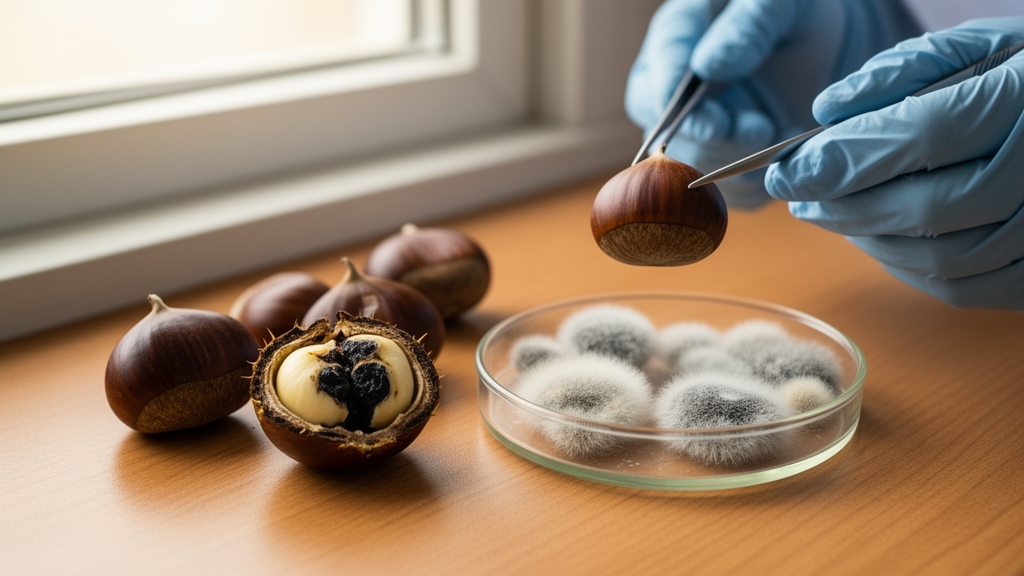
In contrast, the genus Gnomoniopsis was introduced by Berlese in 1893 to accommodate species producing Gnomonia-like perithecia but differing in developing additional septa in ascospores. The type species, Gnomoniopsis chamaemori, is characterized by immersed perithecia with elongated beaks and small, hyaline ascospores. For a long time, Gnomoniopsis remained relatively obscure until its resurrection in 2008 to accommodate a specific clade within Gnomoniaceae. Recently, the genus gained substantial attention due to the global emergence of Gnomoniopsis smithogilvyi, the primary causal agent of sweet chestnut brown rot. This pathogen causes severe nut rot and cankers on Castanea species, threatening chestnut production in Europe, North America, and Oceania. Crucially, extensive studies revealed that Gnomoniopsis smithogilvyi and related species readily produce anamorphs in culture and in nature that are morphologically indistinguishable from Sirococcus, producing identical pycnidial conidiomata, phialidic conidiogenous cells, and fusiform conidia.
This morphological congruence raised a fundamental question: are Sirococcus and Gnomoniopsis truly distinct genera, or do they represent the anamorphic and teleomorphic expressions of a single evolutionary lineage? Despite the overlap of their asexual states, the two genera were maintained as separate entities in most recent classifications, a separation driven largely by a historical emphasis on host preference, with Sirococcus associated with conifers and Gnomoniopsis largely with broad-leaved trees such as Fagaceae, Rosaceae, and Onagraceae. However, host range is rarely a reliable delimiting character at the generic level in Gnomoniaceae. Recent phylogenetic analyses utilizing multi-locus data have consistently recovered species of both genera as a coherent, robustly supported clade, and maintaining two generic names for a single monophyletic group contravenes the principles of phylogenetic systematics.
The new phylogenetic analysis incorporated 131 strains and comprised 2,334 characters after alignment. Maximum likelihood and Bayesian inference analyses of the concatenated multi-locus matrix revealed a well-supported monophyletic lineage, with bootstrap support of 98 percent and a Bayesian posterior probability of 0.99, accommodating all analyzed strains of Sirococcus and Gnomoniopsis. Within this major clade, the type species of Sirococcus, Sirococcus conigenus, and the type species of Gnomoniopsis, now Sirococcus chamaemori, were nested together without forming reciprocally monophyletic sister genera. The subclades representing species previously assigned to Gnomoniopsis were interspersed with those of Sirococcus sensu stricto. Under Article 11 of the International Code of Nomenclature for algae, fungi, and plants, the earliest legitimate name must take priority unless a later name is formally conserved. Since Sirococcus predates Gnomoniopsis by nearly four decades, and Gnomoniopsis is not a conserved name, the synonymy is nomenclaturally mandatory as well as scientifically justified.
The urgency of resolving this taxonomic framework is underscored by the biology of emerging pathogens within the complex. In China, the Chinese chestnut, Castanea mollissima, is a commercially vital crop, and in recent years a severe nut rot disease has been caused by a pathogen previously identified as Gnomoniopsis daii. This pathogen causes significant yield reduction and post-harvest losses, yet until now it was known only from its anamorph found on diseased leaves and in culture. The absence of knowledge regarding its teleomorph and its survival strategies during winter hampered the development of effective disease management protocols. In many Gnomoniaceae species, the sexual stage plays a critical role in overwintering on leaf litter and releasing ascospores as primary inoculum in the spring, making clarification of the life cycle as critical as resolving the generic placement.
Through comprehensive field surveys conducted from 2020 to 2025 across major chestnut-growing regions in Beijing, Fujian, Guizhou, Hebei, Jiangxi, Shaanxi, and Shandong Provinces, the researchers discovered the previously unknown teleomorph of Sirococcus daii on overwintered leaf litter, confirming the saprobic phase of its life cycle. The perithecia exhibit an atypical feature: the lack of elongated perithecial necks. Additionally, the fungus was isolated from apparently healthy female flowers, young nuts, and husks using surface-sterilization techniques, suggesting a latent or endophytic infection strategy. The presence of both sexual and asexual morphs on overwintered debris suggests that Sirococcus daii is homothallic or that compatible mating types are widespread in the field, a capability for sexual recombination that may contribute to the pathogen’s genetic diversity and adaptability, posing potential challenges for long-term resistance breeding in Chinese chestnut.
Based on these findings, the researchers reconstructed the complete life cycle of Sirococcus daii as a hemibiotroph alternating between an endophytic phase in living tissues and a saprotrophic phase on decaying debris. The pathogen overwinters as perithecia and pycnidia on fallen leaf litter and as pycnidia on decaying fruit husks. In spring, ascospores and conidia released from these structures serve as primary inoculum, dispersed by wind or rain splash to colonize emerging tender tissues including young leaves and female flowers. The fungus then establishes a latent infection, persisting endophytically within developing nut kernels throughout the summer without visible symptoms. On leaves, it causes mild necrotic leaf spots where pycnidia release conidia that drive polycyclic secondary infection. As nuts approach maturity, the fungus switches to a necrotrophic phase, producing the characteristic browning and necrosis of the kernel. In late autumn, infected debris falls to the ground, where the fungus survives saprotrophically and develops new fruiting bodies, completing the cycle.
These epidemiological insights compel a fundamental restructuring of disease management strategies for chestnut nut rot. Previously, control measures primarily focused on the nut-growth stage when symptoms became visible, but the discovery of the flower-to-nut latent infection pathway explains why fungicide applications during the visible rot stage are largely futile, since the pathogen is already established within the kernel. Chemical control must therefore shift from curative to prophylactic, strictly targeting the flowering and early fruit-setting stages to block initial colonization. Management protocols must also prioritize the rigorous elimination of fallen leaves and burrs to reduce primary inoculum pressure, while the confirmation of Sirococcus daii as a foliar endophyte implies that the canopy itself acts as a persistent reservoir for secondary inoculum, suggesting that canopy management to improve aeration and the use of systemic fungicides may be necessary to interrupt the polycyclic infection chain. Beyond pathology, the study resolves a major taxonomic conflict in Gnomoniaceae, establishing Sirococcus as a large, biologically diverse genus associated with both gymnosperms and angiosperms and providing a stable framework for future taxonomic and pathological research.
Subject of Research: Mycology
Article Title: Reevaluating Sirococcus : synonymizing Gnomoniopsis and elucidating the life cycle of S. daii
Article References: Jiang, N., Wijayawardene, N. N., Xue, H., & Li, Y. (2026). Reevaluating Sirococcus: synonymizing Gnomoniopsis and elucidating the life cycle of S. daii. IMA Fungus, 17, Article e186049. https://doi.org/10.3897/imafungus.17.186049
Image Credits: AI Generated
DOI: 10.3897/imafungus.17.186049
Keywords: Sirococcus, Gnomoniopsis, Gnomoniaceae, Diaporthales, fungal taxonomy, chestnut nut rot, Castanea mollissima, plant pathology, life cycle, phylogenetics, Reevaluating, synonymizing
Cite Scienmag News
Roger Howard. (October 20, 2026). Two Fungal Genera Merge as One Name Resolves a Chestnut Nut Rot Mystery. Scienmag. https://scienmag.com/two-fungal-genera-merge-as-one-name-resolves-a-chestnut-nut-rot-mystery/
Roger Howard. "Two Fungal Genera Merge as One Name Resolves a Chestnut Nut Rot Mystery." Scienmag, 20 October 2026, https://scienmag.com/two-fungal-genera-merge-as-one-name-resolves-a-chestnut-nut-rot-mystery/. Accessed 20 October 2026.
Roger Howard. "Two Fungal Genera Merge as One Name Resolves a Chestnut Nut Rot Mystery." Scienmag. October 20, 2026. https://scienmag.com/two-fungal-genera-merge-as-one-name-resolves-a-chestnut-nut-rot-mystery/


