


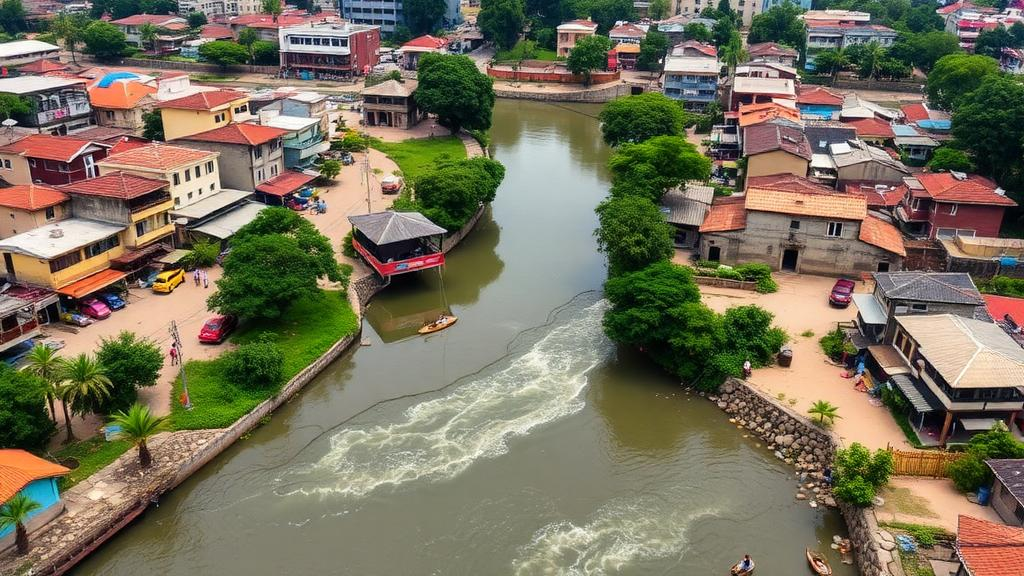
Residents of Loja, Ecuador, identified 662 locations associated with positive and negative social values along the Zamora and Malacatos rivers, providing a neighborhood-scale account of how people experience the city’s urban river corridors. Of these mapped locations, 381 represented negative social values and 267 represented positive ones. The study combined a 2021 participatory survey with environmental and geographic data, finding that unpleasantness received the strongest negative value score, while learning received the highest positive score. The results also showed that positive and negative values can converge in the same places, particularly around the rivers’ confluence in the city center.
The research examined the rivers as they pass through Loja, an Andean city of 285.7 square kilometers and 214,855 inhabitants located at 2,100 meters above sea level. The Malacatos River extends about 14 kilometers, while the Zamora Huayco River extends about 10 kilometers before joining the Zamora and eventually flowing toward the Amazon River. The mapped study area also included approximately 13 kilometers of the Zamora Huayco upstream of the city, covering a peri-urban section. The wider landscape is noted for its biodiversity, including the nearby Podocarpus National Park, but the rivers have been altered by urban development, contaminated discharges, channelization, changes to their basins and the loss of riparian vegetation.
Data collection took place in Loja in 2021 through OpinaRíos, a web questionnaire built with ESRI Survey123. Investigators randomly approached people near the riverbanks and shared survey links through QR codes and text messages. Participants answered questions about sociodemographic characteristics, satisfaction with the rivers, their relationship with the riverbanks and the activities they carried out there. They then used an interactive city map to place locations associated with positive or negative social value and could assign one to three predefined categories to each location. The final sample included 200 people aged between 18 and 70; women represented 44% of respondents and men 53%. The largest age groups were those aged 40–65, at 39.5%, and 25–40, at 34%.
The survey also recorded a broadly negative assessment of the waterways. Forty-seven percent of participants rated the Malacatos River landscape as “Bad,” while 43.5% rated the Zamora River landscape as “Regular.” Overall, 80% of respondents said the current condition of urban rivers negatively affected their quality of life. Their mapped locations identified the perceived disservices more frequently than the benefits: negative locations outnumbered positive ones across the ten social-value categories analyzed. The study therefore documented a landscape in which ecological degradation, unpleasant sensory conditions, inaccessible infrastructure and flood concern were not merely abstract issues, but were associated with identifiable places along the rivers.
To map the social values, the researchers used version 4.0 of the Social Values for Ecosystem Services tool, or SolVES, an open-source QGIS plug-in developed by the US Geological Survey. SolVES combines participatory observations with biophysical variables such as elevation, slope, land use and land cover, landscape form and horizontal distance to green areas. Its maximum-entropy component, adapted from a method originally developed to model species distributions, estimates the geographic areas in which particular social values are most likely to occur. The analysis produces a non-monetary Value Index on a 10-point scale, with higher values representing stronger assessed social importance. Nearest-neighbor spatial statistics were also used to distinguish clustered distributions from random or dispersed patterns.
Model performance was strong for most of the mapped categories, with area-under-the-curve values above 0.9 in most cases. The models were evaluated using 75% of the data for training and 25% for testing. Distance to green areas was the most influential environmental variable across all ten models. It contributed between 34% and 63% to model results and had permutation-importance values of 26% to 57%. Elevation had a permutation importance of 40% for poor or inaccessible infrastructure and 37% for flood threat, while slope contributed 31% for poor or inaccessible infrastructure. Landform and land-use and land-cover variables had the smallest overall participation in the models. These results show an association between proximity to green areas and the mapped social values; they do not by themselves establish that green-space proximity caused the reported perceptions.
Among the positive social values, learning ranked first, followed by aesthetic value, therapeutic value, recreation and life-sustaining value. Learning reached a maximum Value Index of 7 out of 10, making it the strongest positive category in the study. The mapping showed that positive locations were widely dispersed across the urban river landscape, with some clusters in peripheral districts and others near the center. Learning and recreation were scattered across particularly broad areas, while aesthetic, therapeutic and life-sustaining values showed more similar spatial patterns. This differs from the pattern reported in some earlier studies in which aesthetic benefits occupied the leading position. In Loja, respondents instead assigned the highest positive score to the educational value they associated with the rivers.
Negative values were more concentrated and more frequently mapped than positive ones. Unpleasantness reached the maximum Value Index of 10 and was associated with 121 locations, the largest number recorded for any category. The other negative values, in descending order, were poor or inaccessible infrastructure, flood threat, unsafe conditions, delinquency or harassment, and low aesthetic value or lack of vegetation. The strongest negative clusters appeared around the city center and the confluence of the rivers, especially around the architectural landmark Puerta de la Ciudad, where canalization of the Malacatos begins. The area is also described in the study as having inadequate pedestrian infrastructure and being prone to overflowing, providing a physical context for overlapping reports of unpleasantness, insecurity and flood concern.
The central finding is that positive and negative valuations are not mutually exclusive. The Puerta de la Ciudad area combines a high-density urban setting and a strong concentration of mapped points with historical, heritage and educational associations. The same reach was also associated with unpleasantness, unsafe conditions and flood threat. Elsewhere, the peripheral El Carmen neighborhood appeared on many maps of aesthetic and learning value without mapped clusters of negative values. Nearby tributaries of the Zamora River, an access route to the Podocarpus Protected Area and the area’s relative proximity to the rural sector formed part of its local context. Other high-value locations occurred near Zamora Huayco Linear Park, La Tebaida Linear Park, and Jipir Recreational Park and Zoo. Across the maps, the rivers and their surroundings were repeatedly outlined by the intensity and grouping of respondents’ points.
The study is a city-scale, non-monetary assessment based on perceptions collected from 200 participants, rather than a direct measurement of ecological condition, economic value or the health effects of river conditions. Its results describe the specific sample and mapped urban-rural gradient of the Zamora and Malacatos rivers in Loja. The digital platform allowed participants to georeference locations in real time and avoided the manual digitization used in some participatory mapping processes, but it required surveyors to know the city and participants to be able to locate places on a map. The approach also depended on advanced technical knowledge, detailed vector and raster cartographic information and the SolVES modeling workflow. The authors described the study as the first application of SolVES in Ecuador and the third in the Latin American and Caribbean region, illustrating both the potential of participatory GIS to represent intangible social values and the resources required to use it in an urban river landscape.
Subject of Research: Participatory mapping of positive and negative social values associated with the Zamora and Malacatos urban rivers in Loja, Ecuador
Article Title: Evaluation and mapping of the positive and negative social values for the urban river ecosystem
Article References: Alvarado-Arias, N., Moya-Almeida, V., Cabrera-Torres, F., & Medina-Enríquez, A. (2023). Evaluation and mapping of the positive and negative social values for the urban river ecosystem. One Ecosystem, 8, Article e101122. https://doi.org/10.3897/oneeco.8.e101122
Image Credits: AI Generated
Keywords: urban rivers, ecosystem services, ecosystem disservices, participatory mapping, public participation GIS, Loja Ecuador, social values, green infrastructure, urban planning, maxent modeling, Evaluation, mapping
Cite Scienmag News
Gavin Prescott. (October 20, 2026). Participatory mapping reveals social values across Loja’s urban rivers. Scienmag. https://scienmag.com/participatory-mapping-reveals-social-values-across-lojas-urban-rivers/
Gavin Prescott. "Participatory mapping reveals social values across Loja’s urban rivers." Scienmag, 20 October 2026, https://scienmag.com/participatory-mapping-reveals-social-values-across-lojas-urban-rivers/. Accessed 20 October 2026.
Gavin Prescott. "Participatory mapping reveals social values across Loja’s urban rivers." Scienmag. October 20, 2026. https://scienmag.com/participatory-mapping-reveals-social-values-across-lojas-urban-rivers/


