


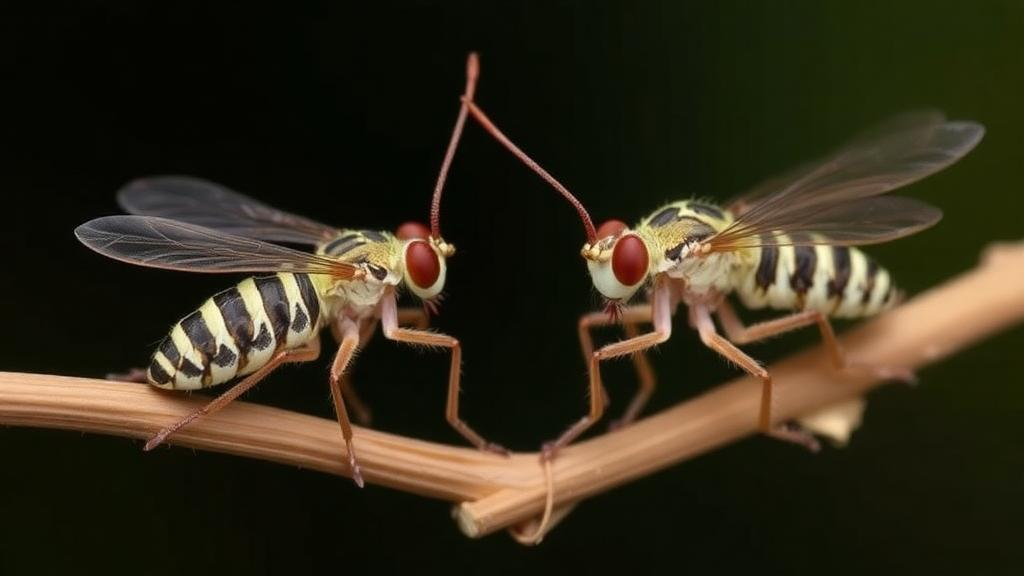
Deep in the mountain forests of western Georgia, in a small unnamed brook at the Kvereti Managed Reserve near Sachkhere, researchers have documented a caddisfly species never before seen in the country. The insect, Calamoceras illiesi, belongs to a family whose larvae are among the largest case-building caddisflies in the world, and its discovery in the South Caucasus marks a significant addition to the freshwater biodiversity of a region that is still proving remarkably rich in unexplored insect life.
The finding, published in the journal Caucasiana, is accompanied by a second milestone: the confirmation of Mystacides azureus, a long-horned caddisfly with a striking metallic blue sheen, as a resident of Georgia. Together, the two records raise the number of caddisfly species known from the country to 250, grouped into 55 genera and 19 families, and they underscore how much remains to be learned about the aquatic insects of the Caucasus.
Caddisflies, the order Trichoptera, are among the most diverse groups of freshwater insects globally, yet their fauna remains poorly studied in many developing countries. Georgia is no exception. The biodiversity of the country’s freshwater ecosystems has long been under-researched, and aquatic insects have been particularly neglected. This neglect is reflected in the pace of recent discovery: more than 100 caddisfly species have been added to the Georgian list in the 2020s alone, and researchers believe many more remain to be found.
The history of caddisfly research in Georgia and the Caucasus stretches back to the nineteenth century, when Robert McLachlan produced some of the earliest records. The most substantial early contributions, however, came from Andrey Martynov, who described 35 new species and recorded 46 species for the first time in Georgia in a series of publications between 1913 and 1934. In the following decades, local and foreign researchers added 18 more species and recorded numerous others for the first time in the country. A new era began in 2019, driven by the exceptionally productive work of János Oláh, who has described over a hundred species from the region.
Despite this progress, much of the Georgian caddisfly fauna remains unexplored. Through their investigation of the country’s caddisflies, the authors of the new study present two additional species: Calamoceras illiesi Malicky & Kumanski, 1974, and Mystacides azureus Linnaeus, 1761, both recorded for the first time in Georgia.
The family Calamoceratidae, to which Calamoceras illiesi belongs, is primarily found in tropical and subtropical regions, with its presence in Europe limited to the genus Calamoceras. The larvae of this family are among the largest case-bearing caddisfly larvae, partly due to their distinctive body shape. They can be differentiated from similar families by morphological characteristics such as a transverse row of about 16 long stout setae in the central part of the labrum, sharp ventral anterior margins of the pronotum and dorsal plates of the mesonotum, and specific blurred margins. Larvae are found sporadically in detritus accumulations of stream pools.
Calamoceras larvae are characterised by a combination of features: a transverse row of 22 to 32 stout setae on the labrum; a hook-shaped fore trochantin; a pronotum with elongated and pointed anterolateral corners; roughly equal-length middle and hind legs with short forelegs; two sclerotised plates on the mesonotum; a membranous metanotum with four very small seta-bearing sclerites; and anal claws that possess an accessory hook. The case is made from pieces of wood. To date, the genus includes three species: C. markusha, C. illiesi, and the recently described C. riffensis from Morocco.
In the new study, researchers collected 2 females and 17 larvae of Calamoceras illiesi from a small, unnamed mountain brook in the Kvereti Managed Reserve, at an altitude of 1,774 metres above sea level. The larvae were caught using a hand net, while the adults were caught with a butterfly net. All specimens were preserved in 95% ethanol and stored in a freezer at −22 °C. When detailed examination of adults was necessary, the abdomens were cleaned in a 10% KOH solution and transferred to glycerol for further preservation. Identification of the larva and imago was based on the descriptions by Sipahiler and Malicky, and all examined material is kept in the collection of the Museum of the Institute of Zoology, Ilia State University, Tbilisi.
Calamoceras illiesi has previously been recorded in Bulgaria, Croatia, Greece, Türkiye, and north-western Russia. In the Caucasus, the genus is represented by a single species, C. illiesi, which occurs in the Western Caucasus, including Novorossiysk and Sochi, and in the North Caucasus, in the southwest of Dagestan. The new record extends the known range of the species into the South Caucasus for the first time. Interestingly, an unknown representative of the genus Calamoceras was recorded by Martynov in 1913 in Akhali Atoni, in western Georgia. The authors assume that this record probably belongs to C. illiesi, but this assumption requires further confirmation, given the high diversity of trichopterans in the region.
In terms of its habitat, despite extensive and repeated sampling, Calamoceras illiesi larvae were found in only one stream, which fully matches the species’ known habitat preferences. The specimens were located at the edge of a small pond, one to two metres wide, formed by a mountain spring, where the slowed flow allows the accumulation of woody debris and leaf litter. Larvae were absent from nearby streams, suggesting a small, microhabitat-dependent population and highlighting its vulnerability. Consequently, protecting this known habitat is essential for the conservation of this rare species.
The second species confirmed in the study, Mystacides azureus, belongs to the family Leptoceridae, commonly known as long-horned caddisflies, one of the largest families within the order, comprising over 1,970 described species classified into 46 extant genera globally. Adults of the family are characterised by extremely long, slender antennae, often two to three times the length of the forewings, which distinguishes them from most other caddisfly families. The head is broad and may bear distinctive sensory projections in some genera. Maxillary palps are five-segmented in both sexes, often modified in males, with the terminal segment annulated or whip-like. The forewings are narrow and covered in dense hairs, with simplified venation.
The genus Mystacides comprises 25 documented species and occurs across temperate regions of the Northern Hemisphere as well as tropical and subtropical areas of Asia. Adults are medium-sized, with elongated slender bodies typically ranging from 7 to 12 millimetres, and wings that often carry a distinct metallic, dark brown to bluish iridescent sheen. The forewings are usually without any pattern or faintly spotted. Maxillary palps are composed of five parts, with sexually dimorphic segmentation in particular species, and the head is hypognathous, with large compound eyes.
Mystacides azureus is one of the most widely distributed species of the genus in Europe, having been recorded in numerous countries including the United Kingdom, Germany, France, Italy, and the Balkan Peninsula. The species is also present in Japan, alongside two newly described species within the M. azureus species group. In the Caucasus region, M. azureus was previously reported from Russia. Notably, the first photographic record of this species in Georgia was made by amateur naturalist Giorgi Makharadze, who posted an image on the Facebook group Wildlife in Georgia in 2020.
In the new study, researchers collected specimens of Mystacides azureus from several locations across Georgia: 2 males and 1 female from Gaghma Dvabzu village in Guria, at 433 metres above sea level; 2 males, 2 females, and 1 larva from Kutaisi in Imereti, at 235 metres above sea level; and 1 male and 1 female from Lia in Samegrelo, at 634 metres above sea level. The initial photograph observation on social media was thus supported by the collection of specimens from multiple locations in the country, providing firm evidence of the species’ occurrence in Georgia.
With the two new species reported in the study, the diversity of Georgian caddisfly fauna has increased to 250 species grouped into 55 genera and 19 families. Of these, 109 species, approximately 44%, are endemic to Georgia, while 141 species, approximately 56%, are endemic to the Caucasus. Among the species-rich families, Philopotamidae stands out with a particularly high level of local endemism, with 16 of 26 species found only in Georgia. An additional 37 Caucasian endemics remain unrecorded in Georgia, reinforcing the need for further research.
The new records highlight both the richness and the fragility of Georgia’s freshwater insect fauna. The discovery of Calamoceras illiesi in a single mountain brook, dependent on a microhabitat of slow-flowing water and accumulated woody debris, serves as a reminder that even common-seeming species can be rare and vulnerable at the local scale. As researchers continue to explore the caddisflies of the Caucasus, the protection of these small, specialised habitats will be essential for the survival of the species that depend on them.
Subject of Research: First record of Calamoceras illiesi and confirmation of Mystacides azureus (Trichoptera) in Georgia
Article Title: The first record of Calamoceras illiesi Malicky & Kumanski, 1974 ( Trichoptera , Calamoceratidae ) and confirmation of the occurrence of Mystacides azureus Linnaeus, 1761 ( Trichoptera , Leptoceridae ) from Georgia
Article References: The first record of Calamoceras illiesi Malicky & Kumanski, 1974 ( Trichoptera , Calamoceratidae ) and confirmation of the occurrence of Mystacides azureus Linnaeus, 1761 ( Trichoptera , Leptoceridae ) from Georgia. (n.d.). https://doi.org/10.3897/caucasiana.4.e172790
Image Credits: AI Generated
DOI: 10.3897/caucasiana.4.e172790
Keywords: caddisflies, Trichoptera, Calamoceras illiesi, Mystacides azureus, Georgia, South Caucasus, freshwater biodiversity, endemic species, aquatic insects, species records, first, record
Cite Scienmag News
Gavin Prescott. (October 16, 2026). Two caddisfly species recorded for the first time in Georgia. Scienmag. https://scienmag.com/two-caddisfly-species-recorded-for-the-first-time-in-georgia/
Gavin Prescott. "Two caddisfly species recorded for the first time in Georgia." Scienmag, 16 October 2026, https://scienmag.com/two-caddisfly-species-recorded-for-the-first-time-in-georgia/. Accessed 16 October 2026.
Gavin Prescott. "Two caddisfly species recorded for the first time in Georgia." Scienmag. October 16, 2026. https://scienmag.com/two-caddisfly-species-recorded-for-the-first-time-in-georgia/


