


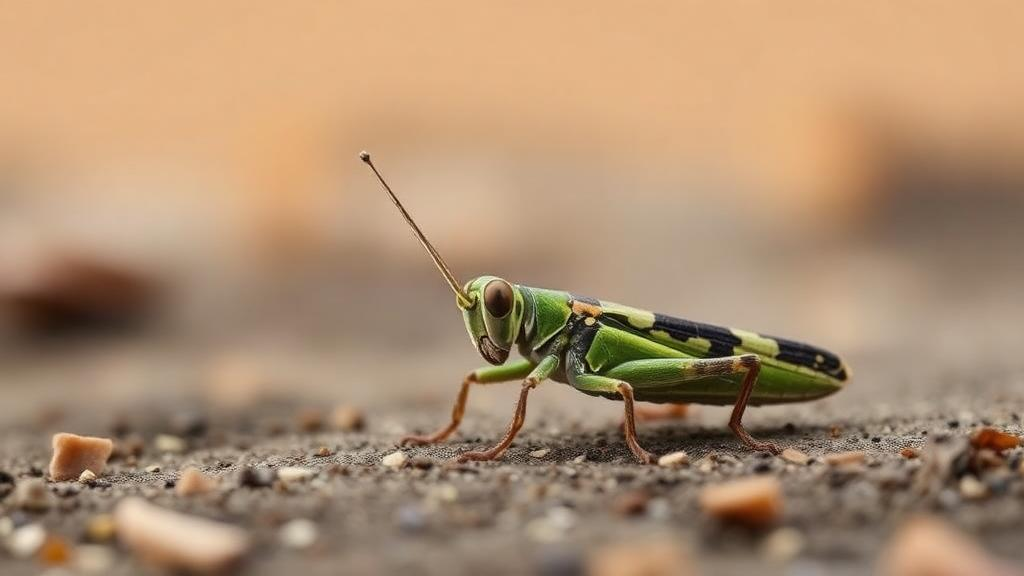
A small, short-winged grasshopper that cannot fly is quietly rewriting one of the central assumptions of range-shift ecology. Pezotettix giornae, a xerothermophilic acridid long confined to the Mediterranean Basin, has been pushing steadily northward across Western and Central Europe for roughly three decades, and a new study in the Journal of Orthoptera Research documents the scale and mechanics of that advance in unprecedented detail. Drawing on more than 19,000 occurrence records from public biodiversity databases, national mapping programs, and targeted field surveys in Slovakia and the Czech Republic, the research shows that a species with no functional wings can nonetheless execute a dynamic, front-like range expansion—one that mirrors the poleward movements of far more mobile insects.
The scale of the evidence base is itself notable. The authors compiled 13,121 records from the Global Biodiversity Information Facility, 6,021 from iNaturalist, 209 from Austrian mapping efforts led by ARGE Heuschrecken Österreichs, 135 from Hungarian literature, 42 from Croatian and Serbian sources, 31 from the Slovakian Orthoptera.sk database, and 60 from their own fieldwork. After removing duplicates and retaining only georeferenced, dated observations, the picture that emerges is of a largely continuous core distribution across the Iberian Peninsula, Italy, the Balkans, and the Pannonian Basin, fraying at its northern and northwestern edges into scattered, isolated outposts—precisely the pattern expected when a species is colonizing new territory faster than its populations can knit together.
That northern frontier now runs through central France, along the southern slopes of the Alps—reaching up to 1,110 meters above sea level in southern Switzerland—through northern Italy and Carinthia, into eastern Lower Austria and southern Moravia in the Czech Republic, and slightly further south through southern Slovakia, eastern Hungary, and northern Romania. Until 2009, the species was known in Central Europe only from Hungary, southern Slovakia, southeastern Austria, Slovenia, Croatia, and Romania. The first records in northeastern Austria came in 2004, with pronounced spreading around Vienna from 2011 onward. Germany recorded nothing until 2018; the first confirmed occurrence, in North Rhine-Westphalia, dates to 2019, with two additional nearby localities from 2020 and a Baden-Württemberg record near the Swiss border by 2023. In that same year, a single individual turned up in the Netherlands—a highly isolated occurrence far beyond the continuous range.
The country-level timelines reveal how quickly a newly arrived species can consolidate. Austria’s first mention of the species dates to Redtenbacher in 1900, but it went unconfirmed until the 1990s; subsequent records in southern Burgenland in 1999 and near Radochen in Styria in 2006 were followed by colonizations of northern Burgenland in 2004, Carinthia in 2010, and Lower Austria and Vienna in 2011—all in regions that had been intensively surveyed since the 1990s, meaning these were genuine new arrivals rather than artifacts of improved sampling. In Slovakia, the species was absent from surveys in the early 1990s and unknown in the 1950s, when experienced orthopterists worked the area; the first documented record came only in 1998, as two specimens on a steep dry slope above the Danube. Within a decade, abundant populations had appeared across southern Slovakia, and today up to one-tenth of mapping squares below 330 meters elevation hold dense populations exceeding 100 adults per 1,000 square meters.
The study’s local case studies make the trajectory vivid. In the Burda Hills of southern Slovakia, surveyed in the 1990s and again after a twenty-year gap, P. giornae was once known from just two sites on the southern foothills, with a single female at each. By the 2010s, it occupied eight of eleven surveyed sites across the entire southern slopes—including the Hegyfárok nature reserve where it had previously been absent—with densities exceeding 10 individuals per 10 square meters in nearly all locations. The grasshoppers favored forest clearings with tall, dry vegetation but also turned up in leaf litter, a reminder that this is a habitat generalist rather than a narrow specialist.
Even more striking is the southeastern Moravian evidence, where the species was first recorded in 2024 after being undetected in 2023 despite repeated surveys of one of the most intensively studied Orthoptera regions in the Czech Republic. A dense population of dozens of individuals per square meter was found at the rest area of the former Lanžhot border crossing on the D2 highway, roughly five kilometers from the Czech-Slovak border—on the side of the road coming from Bratislava. On the opposite side, densities dropped to about one individual per square meter along a shrub line. A pair was found at the Exit 48 cloverleaf near Břeclav, about ten kilometers from the border, again only on the Bratislava-facing side, and the Ladná rest area, fifteen kilometers from the border, showed the same asymmetric pattern. The species was never recorded ten kilometers beyond the border on the opposite side of the highway. This directional gradient, the authors argue, points to recent introduction via vehicular traffic from Slovakia, followed by gradual natural dispersal.
The dispersal mechanism is where the story becomes genuinely counterintuitive. As a brachypterous—effectively flightless—species, P. giornae should be a poor colonizer, yet its expansion appears synchronized, forming a distinct front with isolated outposts beyond it that subsequently fill in. Those outposts are almost certainly the product of passive transport. Grasshoppers can attach directly to car hoods and sheltered vehicle compartments, aided by specialized adhesive pads called arolia, and the same pathway has been documented for the Mediterranean bush-cricket Meconema meridionale, which began spreading northward in the 1960s with the help of automobile transport. Notably, despite the Lanžhot site’s proximity to a railway line with dispersal potential, P. giornae has never been found at the nearby railway station—suggesting road traffic, particularly international truck transport, is the dominant conduit. The authors also flag the horticultural trade as a likely vector for other Mediterranean Orthoptera, citing the recent spread of Rhacocleis annulata through garden centers and nurseries and transport-mediated records of the Egyptian locust Anacridium aegyptium north of its traditional range.
Climate change supplies the enabling condition. Central European annual temperatures have risen by more than 1°C over the past 120 years, and for a predominantly Mediterranean species, that warming was a prerequisite for expansion. But warmth alone is not enough—species must also find suitable habitats to establish, and Central Europe’s stenoecious, extremely xerothermic specialists often cannot, which is why many poorly mobile species have suffered regional extinction rather than expansion. P. giornae’s ecological flexibility is what sets it apart: it occupies open woodlands, shrublands, meadows, ruderal areas, forest edges, and path margins, thriving in low shrubs, dense old grass, and leaf litter, and reaching high densities in anthropogenic habitats. It tolerates meadows with vegetation up to 30 centimeters tall and ground cover above 80 percent, allowing it to exploit the network of linear structures—road verges, forest edges, riverbanks—that threads through agricultural landscapes.
A third factor compounds the first two: the large-scale abandonment of agricultural land across the Carpathian region. Farmland abandonment, already significant during the interwar and socialist eras, accelerated sharply after the collapse of socialism and peaked between 1990 and 2000; the Carpathian Basin ranks among Europe’s highest-abandonment regions between 1990 and 2006. In the Ipeľská Upland, where the Burda Hills sit, most non-forested land originated through deforestation and grazing, and in the absence of grazing, spontaneous succession is now producing exactly the tall, shrubby, successional stages that P. giornae prefers. The authors note a caveat: as succession proceeds toward closed-canopy forest, the species may decline again, though it can persist locally in open forest structures such as edges, clearings, and glades where warm, grassy microhabitats remain.
The broader lesson is methodological as much as ecological. Range shifts are usually detected through newly established populations, because individual dispersal events fall below detectable thresholds for most insects—so distinguishing genuine spread from sampling artifacts requires broad-scale, long-term monitoring of the kind that roughly two decades of standardized Orthoptera mapping in Hungary, Slovakia, Austria, and the Czech Republic has made possible. The authors also caution that part of the surge in recent records, particularly from Croatia, may reflect increased observer activity and citizen-science availability rather than genuine expansion, and they suggest that the long-established southern Pannonian populations likely served as source areas for the northward push—a hypothesis that population genetics could test. For ecological modelers and conservation planners, the case demonstrates that dispersal ability alone does not predict which species will track a changing climate: even a flightless grasshopper can ride Europe’s roads and warming winters to a new northern frontier.
Subject of Research: Northward range expansion of the flightless grasshopper Pezotettix giornae in Central Europe
Article Title: Range expansion of short-winged grasshopper Pezotettix giornae ( Orthoptera , Acrididae ) along the northern edge of its range in Central Europe
Article References: Holuša, J., Vlk, R., Marhoul, P., Kočárek, P., Dvořák, T., Kaláb, O., & Zuna-Kratky, T. (2026). Range expansion of short-winged grasshopper Pezotettix giornae (Orthoptera, Acrididae) along the northern edge of its range in Central Europe. Journal of Orthoptera Research, 35(1), 241-250. https://doi.org/10.3897/jor.35.173175
Image Credits: AI Generated
Keywords: Pezotettix giornae, grasshopper, Orthoptera, range expansion, climate change, Central Europe, passive dispersal, road corridors, habitat abandonment, brachyptery, biodiversity monitoring, Pannonian Basin
Cite Scienmag News
Gavin Prescott. (October 16, 2026). Flightless Grasshopper Marches North Across Europe as Climate Warms. Scienmag. https://scienmag.com/flightless-grasshopper-marches-north-across-europe-as-climate-warms/
Gavin Prescott. "Flightless Grasshopper Marches North Across Europe as Climate Warms." Scienmag, 16 October 2026, https://scienmag.com/flightless-grasshopper-marches-north-across-europe-as-climate-warms/. Accessed 16 October 2026.
Gavin Prescott. "Flightless Grasshopper Marches North Across Europe as Climate Warms." Scienmag. October 16, 2026. https://scienmag.com/flightless-grasshopper-marches-north-across-europe-as-climate-warms/


