


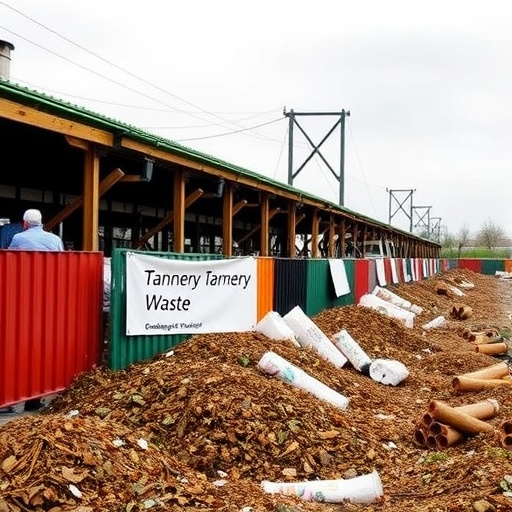
The production of microbial enzymes is a cornerstone of biotechnology, offering solutions in various sectors such as agriculture, food processing, and bioremediation. Recent research conducted by a team led by P.B. Sujiritha from the Department of Environmental Sciences has unveiled a groundbreaking approach for generating a sustainable nitrogen source from tannery fleshing waste. This novel methodology could not only address waste management challenges but also contribute to the circular economy by leveraging organic residues for biotechnological advancement.
Tannery fleshing waste, often disposed of improperly, is a highly nitrogenous byproduct of the leather industry, which has a notorious reputation for its environmental ramifications. The researchers investigate the opportunity to transform this waste into valuable microbial enzymes by using it as a nitrogen source. This transformation approach stands out because it not only addresses waste disposal issues but also harnesses the potential of an otherwise neglected resource. It represents a significant step towards sustainable practices in industrial processing.
In their study, Sujiritha and colleagues analyzed the biochemical properties of tannery fleshing waste, focusing on its nutrient composition, particularly the nitrogen content. The results were promising; the fleshing waste exhibited high levels of proteins and amino acids that can support microbial growth. This nutrient-rich profile stimulates enzyme production in microbial cultures, specifically targeting applications in biotechnological processes. The research underscores the pivotal role of waste valorization in achieving environmental sustainability.
The methodology employed by the researchers involved inoculation of selected microbial strains in a controlled environment, using the fleshing waste as the nitrogen source. This innovative process resulted in elevated enzyme production rates compared to traditional nutrient sources. Such findings are crucial as they indicate that industries can replace synthetic nitrogen fertilizers with organic wastes, leading to reduced chemical input and more eco-friendly operations.
Additionally, the researchers examined various microbial strains for their enzyme production capabilities when grown in the presence of tannery waste. The enzymes produced include proteases, amylases, and lipases, all of which have diverse applications in diverse industrial sectors. Proteases, for instance, are essential in detergent production, leather processing, and food industries. Their study highlights how such abundant waste can be recontextualized as a biotechnological resource.
The experimental data presented in the study illustrated a significant increase in microbial growth and enzymatic activity, establishing a direct correlation between the nitrogen content of the fleshing waste and enzyme production efficiency. This correlation reinforces the value of utilizing waste products as nutrient sources in microbial cultivation. The research acts as a catalyst for industries to rethink waste disposal and microbial enzyme production strategies.
Moreover, the environmental implications of this research are profound. By integrating waste valorization into the enzymatic production sector, industries can significantly lower their carbon footprints, promoting a more sustainable industrial ecosystem. The authors advocate for policy adjustments to support waste reuse initiatives, particularly in developing nations where waste management infrastructure is often lacking. Local economies can benefit immensely from such innovative solutions, facilitating job creation within biotechnological sectors.
The results of this study open the door to further research avenues, suggesting that a broader range of organic wastes can be assessed for their potential nitrogen content. This could lead to diversified microbial enzyme production systems that are not only sustainable but economically viable. The transition towards a green economy hinges on such transformative practices, which merge innovation with responsible waste management.
On the industrial front, the practical applications of fungal and bacterial enzymes produced from tannery waste are vast. Companies invested in cleaner production methods can derive significant competitive advantages by implementing these sustainable practices. Fostering partnerships between academia and industry could facilitate the scaling of this approach, ultimately leading to widespread adoption across various sectors reliant on enzymatic processes.
As this research garners attention, it echoes a larger narrative within the field of biotechnology, emphasizing the need for innovation and resilience in the face of environmental challenges. Sustainable practices are becoming non-negotiable for modern industries, and studies such as this one serve as blueprints for future advancements. The transition to environmentally friendly methods is not only a matter of responsibility but is also increasingly seen as an essential component of business strategy.
In summary, the valorization of tannery fleshing waste presents a forward-thinking approach to microbial enzyme production. This research not only paves the way for innovative waste management solutions but also aligns with global sustainability goals that seek to minimize environmental impacts while maximizing resource efficiency. As the study unfolds in the scientific community, it serves as a rallying point for future explorations into turning waste into valuable assets in biotechnological applications.
This groundbreaking work by Sujiritha and her colleagues is set to influence how industries perceive and manage waste, fostering pathways toward a more sustainable future. By approaching the concept of waste through a lens of opportunity and innovation, we can reimagine industrial processes that align with ecological imperatives and societal needs.
The valorization of leather tanning waste could represent a paradigm shift in microbial enzyme production, and the implications of this research will likely resonate far beyond the confines of its immediate findings.
In, conclusion, the work of Sujiritha and her team is not just an academic exercise; it’s a call to action for industries, policymakers, and researchers alike to collaborate on driving sustainable change through innovative waste management solutions.
Sujiritha, P.B., Ramesh, K.P.M., Mannankatti, R. et al. Valorization of tannery fleshing waste into nitrogen source for sustainable production of microbial enzymes..
3 Biotech 16, 68 (2026). https://doi.org/10.1007/s13205-025-04684-w
Cite Scienmag News
Gregory Coleman. (January 19, 2026). Turning Tannery Waste into Sustainable Nitrogen Source. Scienmag. https://scienmag.com/turning-tannery-waste-into-sustainable-nitrogen-source/
Gregory Coleman. "Turning Tannery Waste into Sustainable Nitrogen Source." Scienmag, 19 January 2026, https://scienmag.com/turning-tannery-waste-into-sustainable-nitrogen-source/. Accessed 3 September 2026.
Gregory Coleman. "Turning Tannery Waste into Sustainable Nitrogen Source." Scienmag. January 19, 2026. https://scienmag.com/turning-tannery-waste-into-sustainable-nitrogen-source/


