

Wednesday, July 1, 2026
Science
No Result
View All Result
  • Login
  • HOME
  • SCIENCE NEWS
  • CONTACT US
  • HOME
  • SCIENCE NEWS
  • CONTACT US
No Result
View All Result
Scienmag
No Result
View All Result
Home Science News Technology and Engineering

“Tug of war” tactic enhances chemical separations for critical materials

April 4, 2024
in Technology and Engineering
Reading Time: 3 mins read
0
“Tug of War” Tactic Enhances Chemical Separations for Critical Materials
66
SHARES
599
VIEWS
Share on FacebookShare on Twitter
ADVERTISEMENT

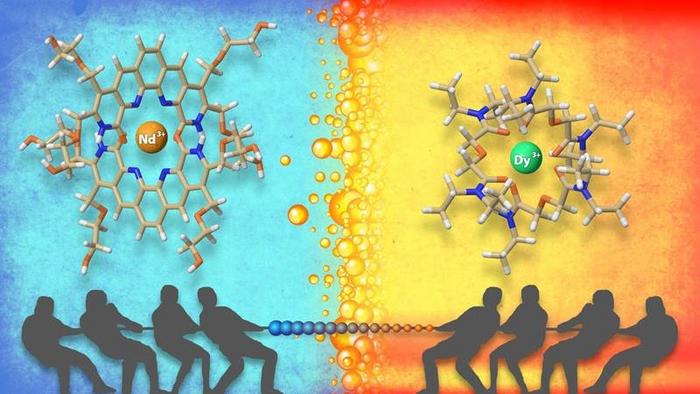
The metals called lanthanides have valuable properties for clean energy technologies such as electric vehicles and wind turbines and for many other applications. These elements include several critical materials. In nature, lanthanides are often found mixed together. Industry must separate them to take advantage of their individual properties. But conventional approaches to this separation are time consuming and costly and generate waste. Scientists have developed an efficient new method that can be tailored to select specific lanthanides. The technique combines two substances. One is water-loving and catches lighter lanthanides, while the other prefers oil and grabs heavier lanthanides.

“Tug of War” Tactic Enhances Chemical Separations for Critical Materials

Credit: Image courtesy of Adam Malin (with contributions from Santa Jansone-Popova and Alexander Ivanov), Oak Ridge National Laboratory

The Science

The metals called lanthanides have valuable properties for clean energy technologies such as electric vehicles and wind turbines and for many other applications. These elements include several critical materials. In nature, lanthanides are often found mixed together. Industry must separate them to take advantage of their individual properties. But conventional approaches to this separation are time consuming and costly and generate waste. Scientists have developed an efficient new method that can be tailored to select specific lanthanides. The technique combines two substances. One is water-loving and catches lighter lanthanides, while the other prefers oil and grabs heavier lanthanides.

The Impact

Blending an oil-loving and a water-loving compound together to pull specific valuable elements from a chemical mixture is feasible on an industrial scale. Scaled up, the process would allow for smaller equipment, less use of chemicals, and less waste production. This would make the new process more efficient and environmentally friendly than conventional methods.

Summary

The most challenging and expensive aspect of making pure rare earth materials — the 14 lanthanides as well as yttrium and scandium — for clean energy technologies is separating individual rare earth elements from one another. Scientists from Oak Ridge National Laboratory combined two types of organic substances: one water loving, and the other oil loving. These organic substances have preferences for different rare earth elements. For instance, one interacts strongly with the lighter rare earth elements, while the other prefers the heavier ones.

The scientists tested this technique using two different liquids that do not mix — oil and water. In water, they dissolved the water-loving substance; in oil, they added the oil-loving one. They found that the two-substance approach helped separate the lightest and heaviest rare earth elements better than the one-substance method applied previously. They used various methods to study how these organic chemicals and rare earth elements interact. The outcome was valuable information about how the process works and insights concerning how the separation system could be further improved.


Funding

This work was supported by the Department of Energy Office of Science, Office of Basic Energy Sciences, Separation Science program and Materials Chemistry program.


Journal

JACS Au

DOI

10.1021/jacsau.2c00671

Method of Research

Experimental study

Article Title

Size Selective Ligand Tug of War Strategy to Separate Rare Earth Elements

Article Publication Date

23-Jan-2023

Tags: /Applied sciences and engineering/Engineering/Materials engineering/Materials processing/Chemical separation/Applied sciences and engineering/Engineering/Materials engineering/Metallurgy/Metals/Rare earth elements/Lanthanides/Physical sciences/Chemistry/Chemical engineering/Biochemical engineering/Separation methods/Research methods/Separation techniques
Share26Tweet17
Previous Post

Researchers at UMass Amherst are listening in on the world’s rulers—insects—to better gauge environmental health

Next Post

UTA chemist acclaimed as up-and-coming scientist

Related Posts

Smart Contact Lens Monitors Eye Blood Oxygen Levels — Technology and Engineering
Technology and Engineering

Smart Contact Lens Monitors Eye Blood Oxygen Levels

July 1, 2026
Coarse-Grained Modeling of Hydrated Proton Transport — Technology and Engineering
Technology and Engineering

Coarse-Grained Modeling of Hydrated Proton Transport

July 1, 2026
Agentic AI Revolutionizes X-Ray Science — Technology and Engineering
Technology and Engineering

Agentic AI Revolutionizes X-Ray Science

July 1, 2026
Study Reveals Older Adults Can Reliably Assess Their Cognitive Sharpness Using Smartwatches in Everyday Life — Technology and Engineering
Technology and Engineering

Study Reveals Older Adults Can Reliably Assess Their Cognitive Sharpness Using Smartwatches in Everyday Life

July 1, 2026
Goal-Driven Communications in Future Cyber-Physical Systems — Technology and Engineering
Technology and Engineering

Goal-Driven Communications in Future Cyber-Physical Systems

July 1, 2026
Polymers Adapt Their Structure to Prevent Failure and Maintain Elastomer Toughness — Technology and Engineering
Technology and Engineering

Polymers Adapt Their Structure to Prevent Failure and Maintain Elastomer Toughness

July 1, 2026
Next Post
Kevin Schug

UTA chemist acclaimed as up-and-coming scientist

  • Mothers who receive childcare support from maternal grandparents show more parental warmth, finds NTU Singapore study

    Mothers who receive childcare support from maternal grandparents show more parental warmth, finds NTU Singapore study

    27656 shares
    Share 11059 Tweet 6912
  • University of Seville Breaks 120-Year-Old Mystery, Revises a Key Einstein Concept

    1061 shares
    Share 424 Tweet 265
  • Bee body mass, pathogens and local climate influence heat tolerance

    682 shares
    Share 273 Tweet 171
  • Researchers record first-ever images and data of a shark experiencing a boat strike

    546 shares
    Share 218 Tweet 137
  • Groundbreaking Clinical Trial Reveals Lubiprostone Enhances Kidney Function

    531 shares
    Share 212 Tweet 133
Science

Embark on a thrilling journey of discovery with Scienmag.com—your ultimate source for cutting-edge breakthroughs. Immerse yourself in a world where curiosity knows no limits and tomorrow’s possibilities become today’s reality!

RECENT NEWS

  • Northwestern Tibetan Plateau: Late Eocene–Oligocene Intracontinental Deformation
  • XMM-Newton Sheds New Light on Distances to Outer Spiral Arms
  • 3 New Discoveries Illuminate Fireworks’ Environmental Impact
  • Innovative UH Technology Uncovers New Targets for Disease Treatment

Categories

  • Agriculture
  • Anthropology
  • Archaeology
  • Athmospheric
  • Biology
  • Biotechnology
  • Blog
  • Bussines
  • Cancer
  • Chemistry
  • Climate
  • Earth Science
  • Editorial Policy
  • Marine
  • Mathematics
  • Medicine
  • Pediatry
  • Policy
  • Psychology & Psychiatry
  • Science Education
  • Social Science
  • Space
  • Technology and Engineering

Subscribe to Blog via Email

Enter your email address to subscribe to this blog and receive notifications of new posts by email.

Join 5,147 other subscribers

© 2025 Scienmag - Science Magazine

Welcome Back!

Login to your account below

Forgotten Password?

Retrieve your password

Please enter your username or email address to reset your password.

Log In
No Result
View All Result
  • HOME
  • SCIENCE NEWS
  • CONTACT US

© 2025 Scienmag - Science Magazine

Discover more from Science

Subscribe now to keep reading and get access to the full archive.

Continue reading
