


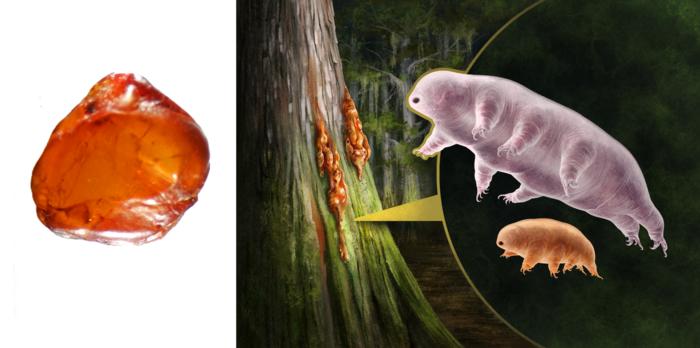
Tardigrades, often called “water bears”, are fascinating microscopic organisms known for their incredible resilience—they can survive anything from deadly radiation to arctic temperatures to the vacuum of space. And though today they can be found anywhere on Earth where there’s water, the evolutionary history of these eight-legged micro-animals remains relatively mysterious because of their sparse fossil record.

Credit: Marc Mapalo (amber); Franz Anthony (artistic reconstruction)
Tardigrades, often called “water bears”, are fascinating microscopic organisms known for their incredible resilience—they can survive anything from deadly radiation to arctic temperatures to the vacuum of space. And though today they can be found anywhere on Earth where there’s water, the evolutionary history of these eight-legged micro-animals remains relatively mysterious because of their sparse fossil record.
Now, in an important study published in the journal Communications Biology, Associate Professor Javier Ortega-Hernández and PhD candidate Marc Mapalo (both in the Department of Organismic and Evolutionary Biology at Harvard) were able to shed some light on that history—as well as confirm another entry in the fossil record, which now stands at a mere four specimens.
In their study, the team took another look at a piece of amber found in Canada in the 1960s that contains the known fossil tardigrade Beorn leggi and another presumed tardigrade that couldn’t be substantively described at the time. Using confocal laser microscopy, a method usually employed for studying cell biology, the researchers were able to examine the tiny structures of the fossil tardigrades in stunning detail.
Ortega-Hernández and Mapalo’s study provides not only a definitive classification of B. leggi in the tardigrade family tree, but the identification of a new species of tardigrade as well.
“Both of them are found in the same piece of amber that dates to the Cretaceous Period, which means that these water bears lived alongside dinosaurs,” Ortega-Hernández said. “The images of B. leggi show seven well-preserved claws, with the claws that curve toward the body being smaller than those curving away from it, a pattern found in modern-day tardigrades.”
The second, previously unidentified specimen, had claws of similar length on each of its first three pairs of legs, but longer outer claws on its fourth set of legs. The team named it Aerobius dactylus, from “aero” meaning relating to air—because the fossil appears to be floating on air in the amber—and “dactylo”, or finger, after its one long claw.
The impetus for applying this new technology t0 known fossils came when Mapalo, a self-described “paleo-tardigradologist,” came across the 2019 book, Water Bears: The Biology of Tardigrades.
“In one of the chapters, they had a photo of the oldest fossil tardigrade that was visualized using both normal microscopy and confocal laser microscopy,” Mapalo said. “And that gave me the idea to use that with the fossil that I’m working with right now.”
That fossil, encased in a piece of amber from the Dominican Republic, turned out to be a new species of tardigrade. Mapalo, along with Ortega-Hernández and researchers from the New Jersey Institute of Technology, published their findings in a 2021 paper in the Proceedings of the Royal Society B.
Ortega-Hernández said that, in their latest study, both fossils serve as critical calibration points for what’s called molecular clock analysis, which help scientists estimate the timing of key evolutionary events.
For example, the latest findings suggest that modern tardigrades likely diverged during the Cambrian Period over 500 million years ago. The research also sheds light on the origin of cryptobiosis, the technical name for the remarkable ability of tardigrades to survive extreme conditions by entering a state of stasis.
”The study estimates that this survival mechanism likely evolved during the mid to late Paleozoic, which may have played a crucial role in helping tardigrades endure the end-Permian mass extinction, one of the most severe extinction events in Earth’s history,” Ortega-Hernández said.
Ortega-Hernández and Mapalo’s research represents a significant advancement in the field of paleontology because it offers new avenues for exploring the evolutionary history of one of the most resilient life forms on the planet.
“Before I started my PhD, there were only three known fossil tardigrades, and now there’s four,” Mapalo said. “Most, if not all, of the fossil tardigrades were really discovered by chance. With the Dominican amber, researchers were looking for fossil ants, and they happened to see a fossil tardigrade there.
“That’s why, whenever I have a chance, I always tell researchers who are working with amber fossils to check if maybe there’s another tardigrade in there, waiting to be found.”
Journal
Communications Biology
Article Title
Cretaceous amber inclusions illuminate the evolutionary origin of tardigrades
Cite Scienmag News
Drew Townsend. (August 22, 2024). Trying to understand the water bear body plan. Scienmag. https://scienmag.com/trying-to-understand-the-water-bear-body-plan/
Drew Townsend. "Trying to understand the water bear body plan." Scienmag, 22 August 2024, https://scienmag.com/trying-to-understand-the-water-bear-body-plan/. Accessed 5 September 2026.
Drew Townsend. "Trying to understand the water bear body plan." Scienmag. August 22, 2024. https://scienmag.com/trying-to-understand-the-water-bear-body-plan/

