

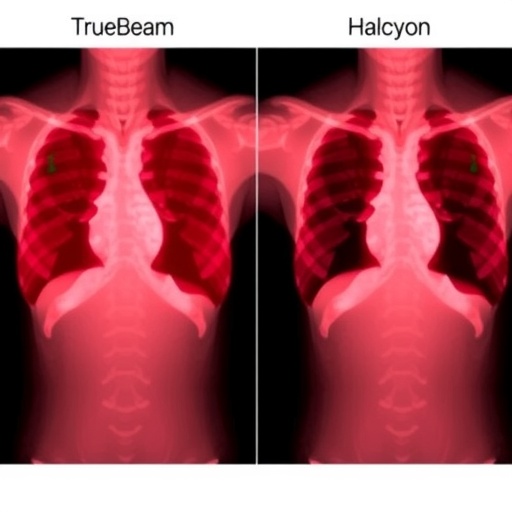
In a groundbreaking exploration into the optimization of radiotherapy techniques for postoperative left-sided breast cancer, a recent study sheds pivotal light on delineating the dosimetric advantages and practical efficiencies of advanced Volumetric Modulated Arc Therapy (VMAT) modalities. Researchers from Zhejiang Cancer Hospital embarked on a precise comparative analysis between two state-of-the-art linear accelerator systems: the TrueBeam single-isocenter and the Halcyon dual-isocenter platforms. This investigation poignantly addresses not only the dosimetric quality but also the interpretive balance between treatment efficacy and logistical feasibility in clinical radiotherapy applications.
Harnessing the full computational capabilities of the RayStation 9 A system, the study meticulously constructed and evaluated radiotherapy plans for twenty patients, each surgically treated for left-sided breast cancer. This patient cohort, selected and treated between 2020 and 2022, provided a robust foundation for scrutinizing the nuanced differences between the two VMAT strategies, focusing on critical planning parameters such as Planning Target Volume (PTV) dose conformity and homogeneity, plus sparing of surrounding organs at risk (OAR).
The meticulous dosimetric evaluation revealed compelling outcomes. Plans leveraging the Halcyon dual-isocenter technique demonstrated statistically significant superiority in maintaining lower maximum dose (D_max), mean dose (D_mean), and median dose (D_50) values within the PTV, suggesting enhanced dose uniformity and protection against hotspots. Contrasting with the TrueBeam single-isocenter plans, these findings underscore the Halcyon system’s sophisticated modulation capabilities that translate into more consistent and precise radiation delivery.
Delving deeper, homogeneity index (HI) and conformity index (CI)—parameters fundamental to assessing dose distribution quality within the target volume—did not differ significantly between the two techniques. This parity indicates both systems effectively shape the therapeutic dose around the tumor bed, adhering to clinical requisites for optimal tumor coverage while maintaining safety margins.
However, it is in the domain of organ-at-risk dosimetry that the Halcyon plans revealed their distinct clinical promise. Statistically significant reductions were observed in the mean dose to the heart and left lung, pivotal organs vulnerable to radiation-induced toxicities. Additionally, dose-volume metrics such as V_5, V_20, and V_30 for the lungs showed substantial sparing benefits with the Halcyon technique, aligning with current best practices aimed at minimizing late cardiovascular and pulmonary complications.
Despite these dosimetric advantages, the Halcyon’s technological architecture also presented certain operational trade-offs. The total monitor units (MU)—reflecting the machine output needed to deliver the prescribed dose—were markedly higher for the Halcyon plans. This increase in MU correlates with a statistically significant extension in beam-on time, indicating longer treatment durations compared to the TrueBeam system. Additionally, plan complexity parameters, expressing the intricacy of multileaf collimator movements and dose modulation, were elevated for Halcyon, suggesting greater demands on treatment planning and quality assurance processes.
From a clinical workflow perspective, these characteristics pose important considerations. While increased treatment time and plan complexity could potentially translate into resource allocation challenges, they also hint at enhanced precision and fine-tuning capabilities. Notably, the Halcyon’s dual-isocenter design potentially mitigates manual patient repositioning errors, enhancing reproducibility and safety for postoperative breast cancer patients who often require meticulous targeting of irregularly shaped anatomical regions.
The study’s findings open compelling avenues for tailoring radiotherapy strategies based on individual patient anatomy, tumor characteristics, and institutional resource profiles. The ability of the Halcyon system to deliver superior dosimetric outcomes, particularly in sparing critical structures like the heart and lungs, could have lasting implications for reducing secondary toxicities and improving long-term survivorship quality.
Intriguingly, this investigation also signals the growing sophistication of VMAT planning algorithms and hardware integration, critical for advancing personalized oncology care. With breast cancer remaining among the most prevalent cancers worldwide, enhancing radiotherapy efficacy while reducing collateral tissue damage remains a foremost clinical objective.
Further implications extend to the implementation of dual-isocenter approaches in broader oncologic contexts where complex tumor geometries challenge uniform dose delivery. As technology continues to evolve, optimizing the interplay between system capabilities, treatment planning accuracy, and patient throughput will be essential for maximizing therapeutic windows.
Moreover, this study serves as a testament to the evolving role of comprehensive dosimetric analyses in driving evidence-based clinical decision-making. By quantitatively delineating the merits and limitations of cutting-edge radiotherapy platforms, oncologists and medical physicists are better equipped to customize treatment regimens aligned with patient-specific needs and technological proficiencies.
The practical impact of these findings may encourage radiation oncology centers to re-evaluate existing protocols, particularly where the balance between dosimetric precision and workflow efficiency is critical. The Halcyon’s enhanced OAR sparing capabilities advocate for its consideration as a frontline tool in managing postoperative breast cancer, with the caveat of balancing extended treatment times against clinical benefits.
Looking ahead, integrating real-time imaging, adaptive radiotherapy, and artificial intelligence-driven planning may further refine dual-isocenter VMAT strategies, enhancing both accuracy and efficiency. The Halcyon’s modular design and inherent flexibility position it favorably for future technological augmentations.
In summation, this rigorous dosimetric study defines a nuanced landscape where radiotherapy innovation meets patient-centered clinical practice. By elucidating the intricate trade-offs between advanced single- and dual-isocenter VMAT systems, it charts a promising path forward for enhancing postoperative breast cancer care, blending technical sophistication with tangible improvements in treatment safety and efficacy.
Subject of Research: Dosimetric comparison of TrueBeam single-isocenter versus Halcyon dual-isocenter VMAT radiotherapy plans for postoperative left-sided breast cancer.
Article Title: Dosimetric study of TrueBeam single-isocenter vs. Halcyon dual-isocenter VMAT radiotherapy plans for postoperative left-sided breast cancer.
Article References:
Chai, C., Shao, K., Shan, G. et al. Dosimetric study of TrueBeam single-isocenter vs. Halcyon dual-isocenter VMAT radiotherapy plans for postoperative left-sided breast cancer. BMC Cancer 25, 1214 (2025). https://doi.org/10.1186/s12885-025-14574-2
Image Credits: Scienmag.com


