


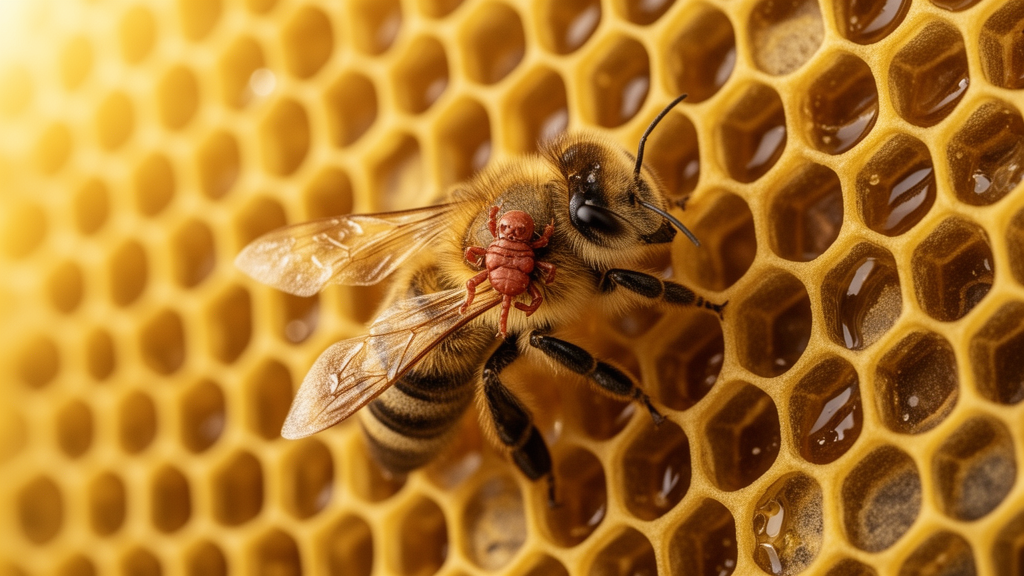
For decades, beekeepers have focused their vigilance on one enemy above all: the Varroa mite. Now, evidence is mounting that a second, equally dangerous parasite is spreading across the world’s managed honey bee colonies. A comprehensive review published in the journal Experimental and Applied Acarology, drawing on decades of research from across Eurasia, makes the case that the Tropilaelaps mite is not a minor threat but a major one, and that its global expansion is accelerating.
The Tropilaelaps mite, first described in the 1960s from colonies of the giant honey bee Apis dorsata in Asia, has historically been confined to the tropics. Its life cycle is tightly linked to the brood of its native host, and it cannot survive long on adult bees. This biological constraint kept it out of the temperate zones for decades. But the review, led by researchers at the University of Georgia and drawing on collaborators across Asia and Europe, argues that this barrier is now breaking down, and that the mite is expanding into new climatic zones at an accelerating pace.
The scale of the threat is considerable. Tropilaelaps mites reproduce rapidly within sealed brood cells, completing a generation in as little as six days, roughly twice the rate of Varroa. This allows populations to build up quickly and cause severe damage to colonies. The mites feed on developing bees, causing deformities, reduced lifespan, and colony collapse. Even low infestation levels can escalate into serious colony-level problems within a single season, because the mites’ rapid reproduction outpaces the bees’ ability to compensate.
The review highlights the biological constraints that have kept Tropilaelaps out of temperate zones. The mite cannot survive more than a few days on adult bees, because it needs to enter sealed brood cells to reproduce. This means that colonies in regions with long brood breaks, such as those in northern Europe where bees stop rearing brood in winter, should theoretically be resistant. But the researchers argue that this resistance is not absolute, and that the mite can persist in regions with continuous brood rearing, such as those with managed colonies that are kept warm and fed through the winter.
The scale of the threat is considerable. Tropilaelaps mites reproduce rapidly within sealed brood cells, completing a generation in as little as six days, roughly twice the rate of Varroa. This allows populations to build up quickly and cause severe damage to colonies. The mites feed on developing bees, causing deformities, reduced lifespan, and colony collapse. Even low infestation levels can escalate into serious colony-level problems within a single season, because the mites’ rapid reproduction outpaces the bees’ ability to compensate.
The review highlights the biological constraints that have kept Tropilaelaps out of temperate zones. The mite cannot survive more than a few days on adult bees, because it needs to enter sealed brood cells to reproduce. This means that colonies in regions with long brood breaks, such as those in northern Europe where bees stop rearing brood in winter, should theoretically be resistant. But the researchers argue that this resistance is not absolute, and that the mite can persist in regions with continuous brood rearing, such as those with managed colonies that are kept warm and fed through the winter.
The scale of the threat is considerable. Tropilaelaps mites reproduce rapidly within sealed brood cells, completing a generation in as little as six days, roughly twice the rate of Varroa. This allows populations to build up quickly and cause severe damage to colonies. The mites feed on developing bees, causing deformities, reduced lifespan, and colony collapse. Even low infestation levels can escalate into serious colony-level problems within a single season, because the mites’ rapid reproduction outpaces the bees’ ability to compensate.
The review highlights the biological constraints that have kept Tropilaelaps out of temperate zones. The mite cannot survive more than a few days on adult bees, because it needs to enter sealed brood cells to reproduce. This means that colonies in regions with long brood breaks, such as those in northern Europe where bees stop rearing brood in winter, should theoretically be resistant. But the researchers argue that this resistance is not absolute, and that the mite can persist in regions with continuous brood rearing, such as those with managed colonies that are kept warm and fed through the winter.
The scale of the threat is considerable. Tropilaelaps mites reproduce rapidly within sealed brood cells, completing a generation in as little as six days, roughly twice the rate of Varroa. This allows populations to build up quickly and cause severe damage to colonies. The mites feed on developing bees, causing deformities, reduced lifespan, and colony collapse. Even low infestation levels can escalate into serious colony-level problems within a single season, because the mites’ rapid reproduction outpaces the bees’ ability to compensate.
The review highlights the biological constraints that have kept Tropilaelaps out of temperate zones. The mite cannot survive more than a few days on adult bees, because it needs to enter sealed brood cells to reproduce. This means that colonies in regions with long brood breaks, such as those in northern Europe where bees stop rearing brood in winter, should theoretically be resistant. But the researchers argue that this resistance is not absolute, and that the mite can persist in regions with continuous brood rearing, such as those with managed colonies that are kept warm and fed through the winter.
Subject of Research: Tropilaelaps mercedesae: an emerging global threat to apiculture – a comprehensive review
Article Title: Tropilaelaps mercedesae: an emerging global threat to apiculture – a comprehensive review
Article References: Esmaeily, M., Kwon, S., Babaeian, E., & Jung, C. (2026). Tropilaelaps mercedesae: an emerging global threat to apiculture – a comprehensive review. Frontiers in Insect Science, 6, Article 1871985. https://doi.org/10.3389/finsc.2026.1871985
Image Credits: AI Generated
DOI: 10.3389/finsc.2026.1871985
Keywords: Tropilaelaps, mercedesae, emerging, global, threat, apiculture, comprehensive, review, scientific research
Cite Scienmag News
Gavin Prescott. (October 17, 2026). Tropilaelaps mercedesae: an emerging global threat to apiculture – a comprehensive review. Scienmag. https://scienmag.com/tropilaelaps-mercedesae-an-emerging-global-threat-to-apiculture-a-comprehensive-review/
Gavin Prescott. "Tropilaelaps mercedesae: an emerging global threat to apiculture – a comprehensive review." Scienmag, 17 October 2026, https://scienmag.com/tropilaelaps-mercedesae-an-emerging-global-threat-to-apiculture-a-comprehensive-review/. Accessed 17 October 2026.
Gavin Prescott. "Tropilaelaps mercedesae: an emerging global threat to apiculture – a comprehensive review." Scienmag. October 17, 2026. https://scienmag.com/tropilaelaps-mercedesae-an-emerging-global-threat-to-apiculture-a-comprehensive-review/


