


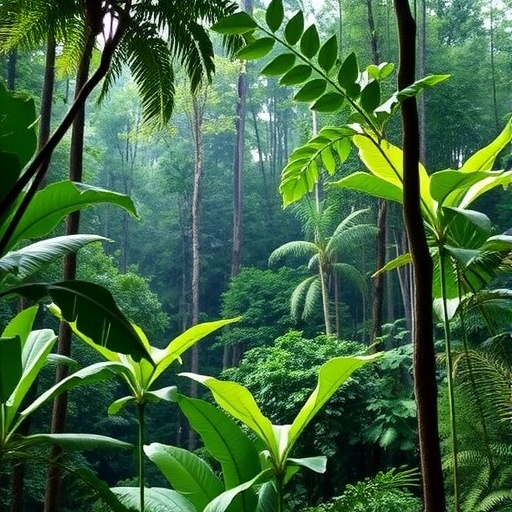
Tropical forests may be able to return naturally across millions of square kilometres of degraded land, offering a powerful but unevenly distributed opportunity to fight climate change and slow biodiversity loss, according to a new global analysis. The study, published in Nature Ecology & Evolution, identifies where natural forest regeneration could deliver the greatest ecological benefits for the lowest costs. Rather than focusing exclusively on planting trees, the researchers examined landscapes where forests could recover through the growth and spread of existing vegetation, seeds and wildlife. Their results suggest that allowing forests to regenerate on suitable land could become one of the most efficient restoration strategies available, but only if investment is directed toward locations where carbon storage, species protection and economic feasibility overlap.
Natural regeneration occurs when forests re-establish without the intensive planting of large numbers of seedlings. In some landscapes, surviving trees, underground roots, seed banks and nearby forest fragments provide the biological material needed for recovery. Birds, bats, primates and other animals can disperse seeds into abandoned fields, logged areas and other degraded sites. Over time, pioneer plants create shade and improve soil conditions, allowing slower-growing forest species to return. The process can be supported by removing barriers such as fire, grazing, invasive plants and repeated clearing, but it may require far fewer financial resources than planting and maintaining trees across the same area. Its success, however, depends strongly on local climate, land-use history, surrounding forests and the ability of communities to protect recovering vegetation.
The researchers assessed tropical regions with biophysical potential for natural forest regeneration, covering approximately 7.49 million square kilometres. This area represents land where environmental conditions could support the return of forest, although not every location would regenerate at the same speed or with the same ecological quality. The analysis combined information on the costs of enabling or protecting regeneration with estimates of two major benefits: the amount of carbon forests could accumulate and the potential reduction in extinction risk for forest-dependent species. By bringing these dimensions together, the study moves beyond simple maps of where trees might grow. It asks a more practical question for governments, conservation organisations and land managers: where can restoration produce the largest combined gains for nature and climate without demanding excessive investment?
If the full area identified in the assessment were to regenerate, the additional forests could accumulate about 9.57 gigatonnes of carbon during the next 30 years. Carbon accumulation refers to the removal of carbon dioxide from the atmosphere and its storage in living trees, roots, dead wood and soils. The figure is not a prediction that every hectare will be restored, nor does it imply that all stored carbon would remain permanently protected. Instead, it represents the scale of the opportunity if suitable landscapes were allowed to recover under favourable conditions. The climate benefit would depend on long-term forest survival, because fires, drought, logging and future land conversion could release stored carbon back into the atmosphere. Even so, the estimate shows why natural regeneration is increasingly viewed as a major component of nature-based climate strategies.
The biodiversity implications are equally striking. Complete regeneration across the identified region could reduce the overall extinction risk of forest-dependent species by approximately 31% relative to the study’s baseline. This does not mean that nearly one-third of threatened species would immediately be removed from danger. Rather, the estimate reflects a modelled reduction in the combined risk faced by species whose survival depends on forest habitat. As recovering forests mature, they can reconnect isolated habitat fragments, expand the area available for wildlife and create movement corridors across human-dominated landscapes. The benefits would likely vary among species: animals requiring old-growth conditions might take decades or centuries to recover, while generalist species and organisms able to use regenerating forest could respond more rapidly.
The most important finding may be that carbon and biodiversity benefits do not always point to the same places. A landscape can offer exceptional potential for carbon accumulation but provide limited value for species conservation, while another may be crucial for threatened wildlife yet store relatively modest amounts of carbon. Costs also vary widely. Some areas may regenerate naturally with limited intervention, whereas others require fencing, fire control, invasive-species management, land-tenure agreements or long-term enforcement. When the researchers searched for locations that combined high carbon benefits, high biodiversity benefits and low costs, they identified a much smaller group of priority areas. These locations were described as “holistic hotspots” for natural regeneration.
Indonesia, Madagascar, the Philippines, Mexico and Malaysia emerged as countries containing the largest areas of these holistic hotspots. Their importance reflects the convergence of several factors, including extensive opportunities for forest recovery, high concentrations of forest-dependent species and locations where regeneration can be comparatively cost-effective. These countries also contain some of the world’s most biologically significant tropical landscapes, where forest loss has fragmented habitats and placed pressure on species with restricted ranges. Restoring forest in such areas could therefore create multiple benefits at once: storing atmospheric carbon, improving habitat connectivity, supporting ecological processes and potentially strengthening local resilience to extreme heat, erosion and disrupted rainfall.
The study also shows why a single global restoration target can be misleading. If planners rank land only by carbon storage, they may direct funds toward areas that absorb large quantities of carbon but do little to protect the most vulnerable species. If they focus solely on biodiversity, they may overlook sites where restoration could provide unusually strong climate benefits at low cost. The researchers found that areas with high carbon benefits alone and those with high biodiversity benefits alone formed spatial patterns that differed from the holistic hotspots. Requiring all three conditions—high carbon value, high biodiversity value and low cost—reduced the hotspot area to 9.67% of the entire study region. That reduction is not a failure of restoration; it is a measure of how difficult it can be to optimise several goals simultaneously.
The maps produced by the researchers are intended to help decision-makers make those tradeoffs visible before restoration projects begin. Governments could use them to compare national restoration commitments with local ecological priorities, while conservation groups could identify landscapes where limited funds might generate the greatest combined impact. The maps may also support more targeted policies, such as payments for ecosystem services, community forest programmes, protected-area expansion and incentives for landowners to allow natural recovery. Yet spatial prioritisation cannot replace local knowledge. Successful regeneration depends on land rights, food production needs, community participation and the conditions that determine whether recovering forests will be protected over time. A map can identify opportunity, but institutions and communities determine whether that opportunity becomes a living forest.
The findings arrive as countries and organisations search for restoration approaches capable of operating at a scale large enough to influence the climate and biodiversity crises. Tree planting remains valuable in places where forests cannot return unaided, but natural regeneration offers a complementary pathway that may be cheaper, more ecologically diverse and better adapted to local conditions. Its potential is not unlimited: some landscapes have crossed ecological thresholds, soil conditions may be severely damaged, and competing demands for agriculture or development can prevent recovery. The new analysis nevertheless suggests that natural regeneration should no longer be treated as an incidental consequence of abandoned land. Across the tropics, it represents a measurable global opportunity—one whose greatest rewards will come from choosing carefully where forests are given the chance to return.
Cite Scienmag News
Margaret Porter. (August 25, 2026). Tropical Forest Regeneration Costs and Ecological Benefits Vary Widely. Scienmag. https://scienmag.com/tropical-forest-regeneration-costs-and-ecological-benefits-vary-widely/
Margaret Porter. "Tropical Forest Regeneration Costs and Ecological Benefits Vary Widely." Scienmag, 25 August 2026, https://scienmag.com/tropical-forest-regeneration-costs-and-ecological-benefits-vary-widely/. Accessed 4 September 2026.
Margaret Porter. "Tropical Forest Regeneration Costs and Ecological Benefits Vary Widely." Scienmag. August 25, 2026. https://scienmag.com/tropical-forest-regeneration-costs-and-ecological-benefits-vary-widely/


