Sunday, October 25, 2026
Science
No Result
View All Result
  • Login
  • HOME
  • SCIENCE NEWS
  • CONTACT US
  • HOME
  • SCIENCE NEWS
  • CONTACT US
No Result
View All Result
Scienmag
No Result
View All Result
Home Science News Technology and Engineering

Triple oxide nanoparticles boost PVDF films for flexible electronics

October 25, 2026
in Technology and Engineering
Denise Maddox
By Denise Maddox Scienmag Editorial Profile - Mechanical Engineering
Reading Time: 3 mins read
0
Triple oxide nanoparticles boost PVDF films for flexible electronics

Triple oxide nanoparticles boost PVDF films for flexible electronics

65
SHARES
587
VIEWS
Share on FacebookShare on Twitter
ADVERTISEMENT

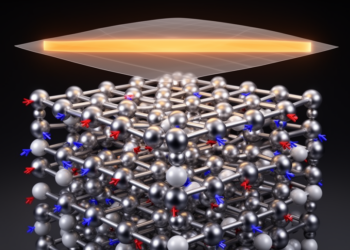
Researchers have fabricated flexible polymer films that blend a three-way mix of metal oxide nanoparticles—zinc oxide, copper oxide and nickel oxide—into polyvinylidene fluoride (PVDF), a polymer valued for its electroactive behaviour. The team, publishing in the Journal of Materials Science, reports that the ternary nanocomposite films, made by a straightforward solution casting route, show enhanced crystallinity, stronger dielectric and polarization responses, and improved flexibility compared with the neat polymer, pointing toward applications in wearable sensors, energy harvesters and next-generation flexible electronics.

The structural analysis rested on a battery of characterization techniques. X-ray diffraction revealed that adding the nanoparticles increased the crystallinity of the films and stabilized the electroactive β-phase of PVDF, the crystal form responsible for the polymer’s piezoelectric and ferroelectric behaviour. Fourier transform infrared spectroscopy and Raman spectroscopy both confirmed strong interfacial interactions between the metal oxide particles and the surrounding polymer matrix—evidence that the fillers are not simply dispersed as inert inclusions but engaged with their host.

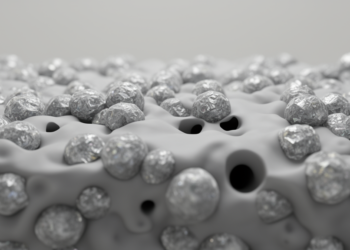
Morphological examination backed up that picture. Scanning electron microscopy images showed a homogeneous distribution of the ZnO, CuO and NiO nanoparticles throughout the films, while energy-dispersive X-ray elemental mapping verified their uniform dispersion and the compositional purity of the composites.

Dielectric measurements carried out across a frequency span from 60 hertz to 10 megahertz showed increased dielectric permittivity alongside low dielectric loss at the higher frequencies. The authors attribute this primarily to enhanced interfacial and dipolar polarization mechanisms—the combined effect of charges accumulating at the boundaries between the oxide particles and the polymer, and of dipole reorientation within the PVDF chains themselves.

Polarization–electric field (P–E) analysis revealed an enhanced polarization response, with polarization rising nonlinearly as the applied electric field increased. Notably, however, the hysteresis loops were neither fully saturated nor closed. The researchers interpret this as a sign that the measured response arises from the combined contributions of PVDF dipolar polarization, Maxwell–Wagner–Sillars interfacial polarization, and field-dependent charge transport, rather than from a single, well-behaved ferroelectric mechanism.

At higher applied voltages, the picture grew messier still: charge injection, leakage conduction and space-charge effects contributed to the observed open and lossy P–E characteristics. The team reports this limitation directly, noting that the composites respond strongly to electric fields even though the polarization response is not that of a fully saturated ferroelectric.

Mechanical testing added a nuance to the story. Tensile testing showed that incorporating the multi-oxide fillers improved the flexibility of the composite films—an attractive property for wearable and bendable devices—although the tensile strength decreased relative to pristine PVDF. The authors present the result as a measured observation rather than an unqualified advantage.

Taken together, the findings support the central claim of the study: that the synergistic combination of ZnO, CuO and NiO nanoparticles significantly improves the structural, dielectric, polarization and functional properties of PVDF. The work positions these ternary nanocomposite films as candidates for advanced flexible sensors, energy harvesting and next-generation flexible electronic applications, while the open questions around hysteresis behaviour and conduction losses mark out the territory for further refinement.

Subject of Research: Ternary metal oxide reinforced PVDF nanocomposite films for flexible electronics

Article Title: Ternary metal oxide (ZnO/CuO/NiO) reinforced PVDF nanocomposites for high-performance flexible electronics

Article References: Selvam, S., Ravisankar, M. S., Balasubramani, V., & Perumal, M. (2026). Ternary metal oxide (ZnO/CuO/NiO) reinforced PVDF nanocomposites for high-performance flexible electronics. Journal of Materials Science. https://doi.org/10.1007/s10853-026-13853-y

Image Credits: AI Generated

DOI: 10.1007/s10853-026-13853-y

Keywords: PVDF, nanocomposites, zinc oxide, copper oxide, nickel oxide, dielectric properties, flexible electronics, energy harvesting, wearable sensors, β-phase, polarization, solution casting

Cite Scienmag News

Denise Maddox. (October 25, 2026). Triple oxide nanoparticles boost PVDF films for flexible electronics. Scienmag. https://scienmag.com/triple-oxide-nanoparticles-boost-pvdf-films-for-flexible-electronics/

Denise Maddox. "Triple oxide nanoparticles boost PVDF films for flexible electronics." Scienmag, 25 October 2026, https://scienmag.com/triple-oxide-nanoparticles-boost-pvdf-films-for-flexible-electronics/. Accessed 25 October 2026.

Denise Maddox. "Triple oxide nanoparticles boost PVDF films for flexible electronics." Scienmag. October 25, 2026. https://scienmag.com/triple-oxide-nanoparticles-boost-pvdf-films-for-flexible-electronics/

Tags: advanced materials for flexible electronicscharacterization techniques for nanocompositescopper oxidedielectric and polarization response improvementsdielectric propertiesenergy harvestingenergy harvesting wearable sensorsenhanced crystallinity in PVDFflexible electronicsFlexible polymer nanocomposite filmshomogeneous nanoparticle dispersion in polymer matricesinterfacial interactions in polymer nanomaterialsmetal oxide nanoparticles in PVDFnanocompositesnickel oxidepiezoelectric and ferroelectric propertiespolarizationPVDFsolution castingsolution casting fabrication of nanocompositeswearable sensorszinc oxidezinc oxide copper oxide nickel oxide compositesβ-phase
Share26Tweet16
Previous Post

Better hospital work environments linked to stronger nurse time management, study finds

Next Post

Hydrogen-Rich Water: From Electrolysis Chemistry to Farms, Food and Clinics

Related Posts

Hidden Contact Loss Between Cathode Particles Drives Fading in All-Solid-State Batteries
Technology and Engineering

Hidden Contact Loss Between Cathode Particles Drives Fading in All-Solid-State Batteries

October 25, 2026
Job satisfaction eases mental workload in obstetrics staff, but hardiness mediation unsupported
Technology and Engineering

Job satisfaction eases mental workload in obstetrics staff, but hardiness mediation unsupported

October 25, 2026
Reinforcement learning upgrade helps robots stay steady in chaotic environments
Technology and Engineering

Reinforcement learning upgrade helps robots stay steady in chaotic environments

October 24, 2026
Human Disturbance Is Eroding Climate-Driven Greening Across the Arctic
Technology and Engineering

Human Disturbance Is Eroding Climate-Driven Greening Across the Arctic

October 24, 2026
Research report: A myriad of mysteries on many legs: Disentangling the systematics of Myriapoda with UCEs
Technology and Engineering

Research report: A myriad of mysteries on many legs: Disentangling the systematics of Myriapoda with UCEs

October 24, 2026
Non-Collinear Magnetism Creates Flat Electronic Bands in Predicted Topological Material CoBi2Te4
Technology and Engineering

Non-Collinear Magnetism Creates Flat Electronic Bands in Predicted Topological Material CoBi2Te4

October 24, 2026
Next Post
Hydrogen-Rich Water: From Electrolysis Chemistry to Farms, Food and Clinics

Hydrogen-Rich Water: From Electrolysis Chemistry to Farms, Food and Clinics

  • Mothers who receive childcare support from maternal grandparents show more optimized

    Mothers who receive childcare support from maternal grandparents show more parental warmth, finds NTU Singapore study

    27656 shares
    Share 11059 Tweet 6912
  • University of Seville Breaks 120-Year-Old Mystery, Revises a Key Einstein Concept

    1061 shares
    Share 424 Tweet 265
  • Bee body mass, pathogens and local climate influence heat tolerance

    682 shares
    Share 273 Tweet 171
  • Researchers record first-ever images and data of a shark experiencing a boat strike

    546 shares
    Share 218 Tweet 137
  • Groundbreaking Clinical Trial Reveals Lubiprostone Enhances Kidney Function

    531 shares
    Share 212 Tweet 133
Science

Embark on a thrilling journey of discovery with Scienmag.com—your ultimate source for cutting-edge breakthroughs. Immerse yourself in a world where curiosity knows no limits and tomorrow’s possibilities become today’s reality!

RECENT NEWS

  • Combining Liver Artery Therapies With Immunotherapy Shows Survival Gains in Advanced Liver Cancer Review
  • Lung cancer in Martinique shows high never-smoker share and frequent EGFR mutations
  • Eight Board Games Bring Oral Pathology and Microbiology into Dental Classrooms
  • Crystal detectors reveal cosmic radiation doses near the Moon on Artemis I

Categories

  • Agriculture
  • Anthropology
  • Archaeology
  • Athmospheric
  • Biology
  • Biotechnology
  • Blog
  • Bussines
  • Cancer
  • Chemistry
  • Climate
  • Earth Science
  • Editorial Policy
  • Marine
  • Mathematics
  • Medicine
  • Pediatry
  • Policy
  • Psychology & Psychiatry
  • Science Education
  • Science News
  • Social Science
  • Space
  • Technology and Engineering

Subscribe to Blog via Email

Enter your email address to subscribe to this blog and receive notifications of new posts by email.

Join 5,152 other subscribers

© 2025 Scienmag - Science Magazine

Welcome Back!

Login to your account below

Forgotten Password?

Retrieve your password

Please enter your username or email address to reset your password.

Log In
No Result
View All Result
  • HOME
  • SCIENCE NEWS
  • CONTACT US

© 2025 Scienmag - Science Magazine

Discover more from Science

Subscribe now to keep reading and get access to the full archive.

Continue reading