


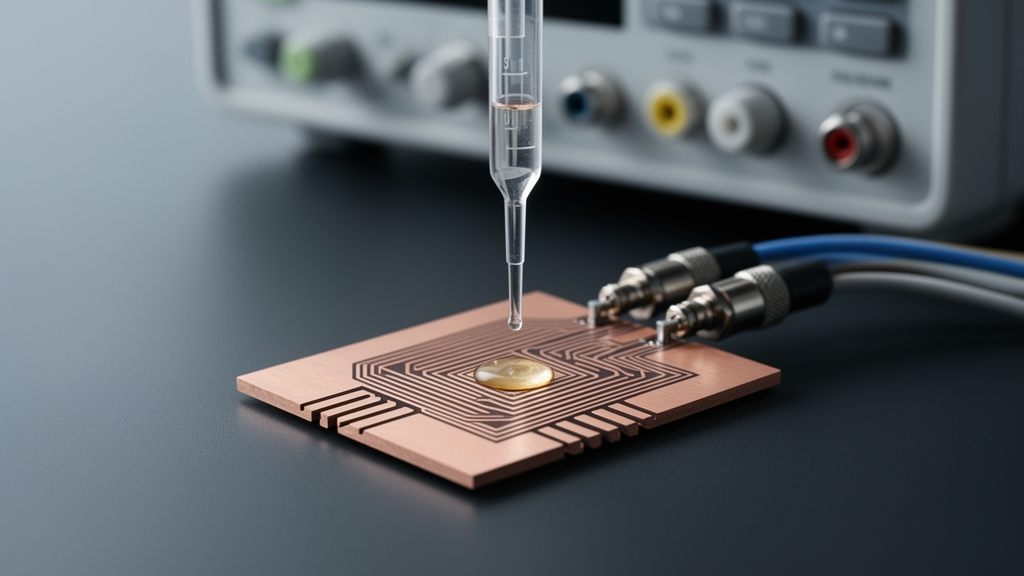
A simple act of subtraction has turned out to be one of the most effective upgrades a microwave chemical sensor can receive. Researchers at Jawaharlal Nehru University in New Delhi have shown that cutting away part of the metal ground plane behind a planar glucose sensor boosts its sensitivity dramatically, even though the same change degrades the device’s performance as an antenna. The finding, published in Frontiers in Antennas and Propagation, offers a quantified answer to a question that has lingered in microwave sensor design for years: does a sensor really need a full ground conductor beneath its sensing area?
The device at the center of the study is a Circular InterDigital Capacitor Sensor, or CIDCS, a one-port microwave component that doubles as both a resonator and a radiator. Its sensing element is a circular array of interlocking metal fingers, the interdigital capacitor, printed on one side of an FR4 substrate, with a ground conductor on the reverse. Interdigital capacitors are prized in microwave sensing because their tightly spaced fingers confine strong electric fields into a compact footprint, making them acutely responsive to whatever material is brought near them. In this design, a microstrip transmission line feeds the structure electromagnetically, and the whole sensor is tuned to resonate at a well-defined frequency.
The research team, Swati Todi and Poonam Agarwal of the university’s MicroSystems Lab, fabricated two prototypes that differed in exactly one respect. Prototype-I carried a complete metallic ground plane behind the interdigital structure, while Prototype-II had a partial ground plane, leaving the substrate exposed directly beneath the sensing fingers. Every other dimension was held constant, ensuring that any difference in performance could be attributed to the ground configuration alone. The researchers also built a rigorous electromagnetic simulation campaign in CST to quantify field distributions, radiation patterns, directivity, gain, and radiation efficiency for both versions before any liquid ever touched the devices.
The simulations told a story of trade-offs. Removing the ground beneath the IDC pushed the resonant frequency down dramatically, from 6.345 gigahertz to 2.149 gigahertz, while simultaneously raising the electric field strength around the fingers, boosting surface current, and increasing both electric and magnetic energy densities. The physical explanation is intuitive: with a full ground plane present, most of the electromagnetic field is trapped between the patch and the ground, locked inside the dielectric substrate, and only weak fringing fields extend upward toward the sample. Strip that ground away and the fringing fields surge, spilling out of the surface where they can interact with whatever liquid sits above the fingers. The catch was radiative: radiation efficiency collapsed from 26 percent in the fully grounded prototype to just 5 percent in the partially grounded one, and the front-to-back ratio fell from 15.91 to 2.08.
To contain liquid samples during testing, the team bonded small circular wells carved from polydimethylsiloxane, the flexible biocompatible polymer known as PDMS, onto the sensor surface. Cavity size mattered more than one might expect. Because most of the sensing action occurs in the fringing fields between adjacent fingers, the researchers systematically tested cavities with diameters of 4, 6, and 8 millimeters, filling each with carefully measured volumes of glucose dissolved in deionized water at concentrations spanning 0.0 to 0.5 grams per milliliter. The 6-millimeter cavity proved optimal, and it was there that the contrast between the two prototypes reached its peak.
The experimental results were striking. With the 6-millimeter cavity, the partially grounded Prototype-II outperformed its fully grounded sibling by 20.3 percent in sensitivity measured through resonant frequency shifts and by a remarkable 49.41 percent in sensitivity measured through return loss changes. The linearity of the sensor’s response also improved, with the linear regression coefficient rising by 2.26 percent for frequency-based readings and 0.324 percent for return-loss-based readings. As glucose concentration climbed across the tested range, the partially grounded sensor tracked the changes with a consistency that the fully grounded version could not match.
Reliability was put to the test as well. The team repeated their measurements three times for each configuration and computed standard deviations, mean absolute deviations, coefficients of variation, and limits of detection. The coefficients of variation came out at 1.68 percent and 0.16 percent for the fully grounded device and 5.64 percent and 0.26 percent for the partially grounded one, indicating high precision with negligible relative variability. The estimated limits of detection confirmed that both prototypes could resolve low glucose concentrations, with the partially grounded design again holding the edge in raw responsiveness.
The physics behind the improvement can be understood through perturbation theory, the framework that governs how resonant frequencies shift when a dielectric material perturbs an electromagnetic field. The stronger the electric field in the sensing region, the larger the perturbation caused by the sample, and the bigger the resulting frequency shift. Removing the ground conductor beneath the interdigital capacitor simultaneously strengthens the fringing fields, reduces parasitic capacitance between the fingers and the ground, and alters the effective capacitance and inductance of the structure, all of which conspire to amplify the sensor’s reaction to subtle permittivity changes. The fully grounded prototype, by contrast, buries its field energy in the substrate where the sample cannot reach it.
What distinguishes this work from earlier studies is the rigor of the comparison. Partial and defected ground planes have been used liberally across the microwave sensor literature to shrink devices, widen bandwidths, and improve impedance matching, but most reports optimize a single design without quantifying what the ground modification actually bought. Here, both prototypes share identical sensing geometry on identical FR4 substrates, so the measured sensitivity gains are a direct, controlled measurement of the ground plane’s role. The authors note that most prior glucose sensors also rely on FR4, reinforcing the practical relevance of their approach for low-cost implementations.
The broader implication is a design principle rather than a single device. When a one-port microwave structure must serve primarily as a sensor, sacrificing antenna metrics such as directivity, gain, and radiation efficiency is a worthwhile price for a device that responds more sharply to the dielectric fingerprint of the liquid it examines. The researchers point toward future work refining the sensing geometry, exploring alternative sample placement, and extracting additional parameters such as Q-factor, phase, and signal-to-noise ratio for multi-dimensional analysis. For applications like glucose monitoring, where detecting minute variations in permittivity is the whole point, the message is clear: sometimes the ground beneath a sensor is better left partly removed.
Subject of Research: Effect of complete versus partial backside ground conductors on the sensitivity of a microstrip-fed circular interdigital capacitor microwave glucose sensor
Article Title: Sensitivity analysis of the microstrip-fed circular InterDigital capacitor sensor with complete and partial backside ground conductor
Article References: Sensitivity analysis of the microstrip-fed circular InterDigital capacitor sensor with complete and partial backside ground conductor. (n.d.). https://doi.org/10.3389/fanpr.2026.1813732
Image Credits: AI Generated
DOI: 10.3389/fanpr.2026.1813732
Keywords: microwave sensor, interdigital capacitor, partial ground plane, glucose sensing, permittivity, resonant frequency, PDMS microfluidics, FR4 substrate, sensitivity analysis, electromagnetic simulation, biosensor, antenna trade-off
Cite Scienmag News
Sylvia Mullen. (October 15, 2026). Trimming the Ground Plane Makes Microwave Glucose Sensors Sharper, Study Finds. Scienmag. https://scienmag.com/trimming-the-ground-plane-makes-microwave-glucose-sensors-sharper-study-finds/
Sylvia Mullen. "Trimming the Ground Plane Makes Microwave Glucose Sensors Sharper, Study Finds." Scienmag, 15 October 2026, https://scienmag.com/trimming-the-ground-plane-makes-microwave-glucose-sensors-sharper-study-finds/. Accessed 15 October 2026.
Sylvia Mullen. "Trimming the Ground Plane Makes Microwave Glucose Sensors Sharper, Study Finds." Scienmag. October 15, 2026. https://scienmag.com/trimming-the-ground-plane-makes-microwave-glucose-sensors-sharper-study-finds/


