


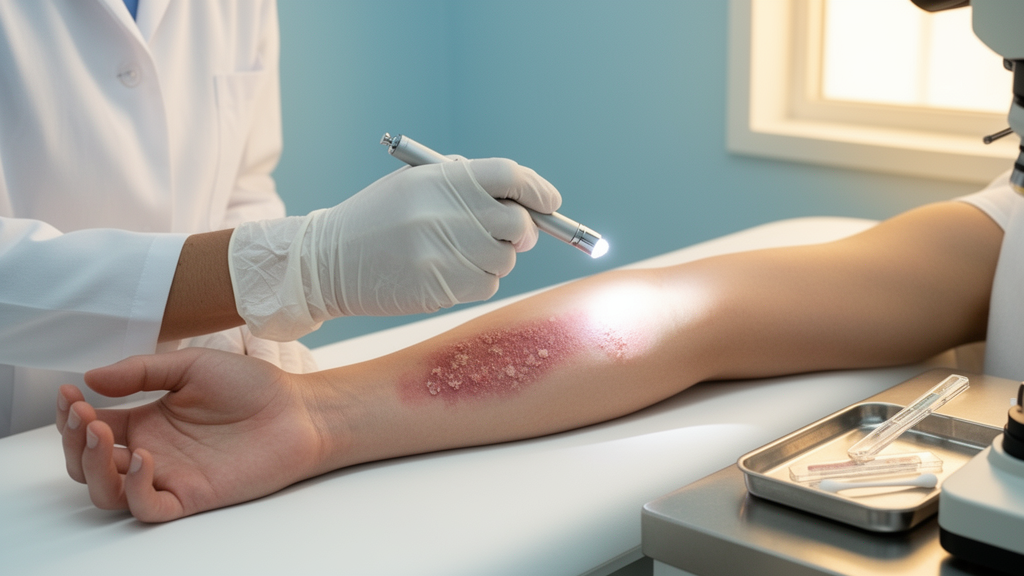
A fungus that scientists had previously encountered only once in nature, clinging to decaying wood in a freshwater stream in Thailand, has now been identified as the cause of a stubborn, decades-long skin infection in a woman from eastern China. The discovery, published in Frontiers in Fungal Biology, marks the first time Brunneofusispora hyalina has been linked to human disease, and it offers a striking illustration of how environmental fungi that are harmless to most people can become persistent pathogens when a host’s antifungal immunity is quietly compromised. The case began roughly thirty years ago, when the patient suffered facial trauma involving exposure to coal and wood and subsequently developed small, dark purplish-red papules on her cheek. Over the ensuing decades, the lesions slowly enlarged, merged, and darkened, eventually spreading to her ear, neck, and right thigh, all without ever ulcerating or breaching the skin barrier to cause systemic disease.
The clinical course was as baffling as it was prolonged. Earlier biopsies had revealed pigmented fungal elements, including thick-walled budding spores, but cultures repeatedly failed to identify a culprit. Multiple rounds of intravenous and oral antifungal therapy produced only partial and temporary improvement. One clue proved especially telling: the infection waxed and waned with the seasons, worsening in winter and partially receding in summer. That pattern would later make biological sense, because laboratory testing showed that the fungus is psychrotolerant, growing best at 26 degrees Celsius, poorly above 30 degrees, and not at all at 37 or 40 degrees. In other words, the organism thrives at temperatures closer to a cool room than to human core body temperature, which may explain why the infection stayed confined to the cooler surfaces of the skin for more than three decades.
To crack the case, researchers at the Institute of Dermatology of the Chinese Academy of Medical Sciences in Nanjing and their collaborators turned to molecular tools. Because the isolate refused to produce conidia, the spore-like reproductive structures that mycologists normally use for identification, on any of six different culture media or under any lighting condition, the team sequenced four genetic barcodes: the internal transcribed spacer region, the large subunit ribosomal RNA gene, translation elongation factor 1-alpha, and RNA polymerase II’s second largest subunit. Sequence comparisons and phylogenetic analysis placed the clinical isolate firmly within the Brunneofusispora hyalina clade, matching the ex-type strain of a species described only in 2021. The isolate has been designated strain CAMS-CCPM-D 05816 and its sequences deposited in GenBank, giving future clinicians a reference point for recognizing similar infections.
The patient’s own genome held the other half of the explanation. Whole-exome sequencing revealed two heterozygous variants in the CARD9 gene, which encodes an adaptor protein central to antifungal immunity. One was a frameshift variant classified as pathogenic, the other a synonymous change of uncertain significance. CARD9 deficiency is a well-established inborn error of immunity that impairs interleukin-17-mediated responses, the arm of the immune system that guards skin and mucosa against fungi, and it predisposes carriers to invasive infections by both yeasts and melanized molds. Previous research has shown that CARD9 mutations are linked to subcutaneous phaeohyphomycosis and deficits in Th17 cell function, and a striking concentration of such infections has been documented in East Asia, where a founder mutation is prevalent and where environmental exposure to diverse dematiaceous fungi may add further risk.
Whole-genome sequencing of the fungus itself added a layer of technical depth to the story. The assembly, built from Illumina reads at roughly 125-fold coverage, spans about 44.5 megabases with a GC content of 48.76 percent, values consistent with other black yeasts and their relatives. Gene prediction yielded 13,777 genes, and functional annotation revealed substantial metabolic versatility, with secondary metabolite biosynthesis, carbohydrate transport, and amino acid metabolism among the most heavily represented functional categories. Most intriguingly, a search against the Pathogen-Host Interactions database identified 395 homologs of known virulence or pathogenicity proteins, but more than seventy percent of the top matches came from plant-pathogenic fungi such as Magnaporthe oryzae and Fusarium graminearum, with only a small share corresponding to human pathogens. The authors caution that sequence homology alone does not confirm virulence function, since many matches involve deeply conserved housekeeping proteins, but the pattern suggests B. hyalina lacks specialized weapons for attacking humans and instead exploits weaknesses in host defenses.
Determining which drugs could actually inhibit this unusual organism posed its own methodological challenge. Because the fungus would not sporulate and grew slowly, the standard CLSI M38 broth microdilution protocol, which depends on a standardized conidial inoculum, could not be applied directly. The team instead developed a modified agar dilution test using hyphal fragments and adapted a broth dilution method, testing six antifungal agents in triplicate with quality-control strains. The results were encouraging for the newer agents: voriconazole, posaconazole, and itraconazole all showed low minimum inhibitory concentrations, and terbinafine was the most potent of all at 0.25 to 0.5 micrograms per milliliter. Fluconazole, by contrast, required a concentration of 128 micrograms per milliliter to inhibit growth, marking the isolate as effectively resistant. Amphotericin B produced a notable discrepancy, with the agar method suggesting an MIC above 16 micrograms per milliliter while the broth method yielded 2, a gap of more than three twofold dilution steps that underscores how testing methodology can reshape interpretation for slow-growing molds.
To test whether the fungus’s modest virulence truly depends on a permissive host, the researchers built an infection model in mice. Wild-type C57BL/6 mice injected subcutaneously in the footpad developed a sharp inflammatory swelling in the first week, but the inflammation subsided rapidly, and by week eight the difference between infected and control paws had shrunk to just 0.04 millimeters, indicating resolution. CARD9 knockout mice told a different story: their paws remained chronically swollen between roughly 1.08 and 1.42 millimeters throughout eight weeks of observation, with no mortality but no spontaneous recovery either. This mirrors the human case in miniature, a persistent, localized, granulomatous infection that never turns lethal but never lets go, and it contrasts with more virulent dematiaceous fungi such as Fonsecaea pedrosoi, which can kill CARD9-deficient mice.
The treatment experiments were sobering. Starting three weeks after infection, knockout mice received oral voriconazole and terbinafine at doses converted from standard adult regimens using body-surface-area calculations. Within the first week of therapy, paw swelling fell more than fourfold relative to untreated knockout controls, and fungal burden in the infected tissue dropped by more than half. Yet after six weeks of combination therapy, residual swelling persisted, and histopathology with PAS and H&E staining still revealed granulomatous inflammation and viable fungal hyphae in the skin. The drug combination reduced the disease but could not eradicate the pathogen, a finding that echoes the patient’s own experience of relapse after a full year of posaconazole monotherapy. She is currently maintained on posaconazole plus terbinafine with good control, but the fungus was re-isolated once before, after she stopped the earlier treatment.
Taken together, the study reframes how a rarely seen environmental saprotroph becomes a clinical problem. The fungus carries a plant-associated genetic toolkit, tolerates only cool temperatures, and shows no obvious capacity for deep tissue invasion or systemic spread; what it needs is an opening, which in this case came in the form of a heterozygous CARD9 variant that blunted the IL-17-dependent defenses of the skin. The authors argue that where host immunity is the weak link, antifungal drugs alone may be insufficient, and they point to two complementary strategies worth exploring: immune restoration to rebuild the defective antifungal response, and local hyperthermia, which becomes conceptually attractive given that exposure to 40 degrees Celsius irreversibly killed the organism in culture, although they emphasize that such approaches remain untested hypotheses rather than clinical recommendations. For now, the case stands as both a taxonomy milestone and a cautionary one, expanding the roster of dematiaceous fungi capable of causing phaeohyphomycosis and reminding clinicians that in patients with recurrent or atypical dark skin lesions that resist conventional therapy, the answer may lie not only in the culture dish but also in the patient’s own DNA.
Subject of Research: Opportunistic cutaneous phaeohyphomycosis caused by the newly described environmental fungus Brunneofusispora hyalina in a patient with a heterozygous CARD9 variant
Article Title: Persistent cutaneous phaeohyphomycosis caused by Brunneofusispora hyalina in a patient with a heterozygous CARD9 variant: the opportunistic potential of a newly described environmental fungus
Article References: Mei, H., Li, D., Jing, D., Wang, X., Deng, S., Daly, P., Zheng, H., She, X., Fu, M., & Liu, W. (2026). Persistent cutaneous phaeohyphomycosis caused by Brunneofusispora hyalina in a patient with a heterozygous CARD9 variant: the opportunistic potential of a newly described environmental fungus. Frontiers in Fungal Biology, 7, Article 1938341. https://doi.org/10.3389/ffunb.2026.1938341
Image Credits: AI Generated
DOI: 10.3389/ffunb.2026.1938341
Keywords: Brunneofusispora hyalina, phaeohyphomycosis, CARD9, dematiaceous fungi, antifungal susceptibility, whole-genome sequencing, murine infection model, medical mycology, immunodeficiency, triazoles, terbinafine, Pleosporales
Cite Scienmag News
Juliet Wilcox. (October 15, 2026). New Fungal Opportunist Tied to Immune Gene Flaw in Rare Skin Infection Case. Scienmag. https://scienmag.com/new-fungal-opportunist-tied-to-immune-gene-flaw-in-rare-skin-infection-case/
Juliet Wilcox. "New Fungal Opportunist Tied to Immune Gene Flaw in Rare Skin Infection Case." Scienmag, 15 October 2026, https://scienmag.com/new-fungal-opportunist-tied-to-immune-gene-flaw-in-rare-skin-infection-case/. Accessed 15 October 2026.
Juliet Wilcox. "New Fungal Opportunist Tied to Immune Gene Flaw in Rare Skin Infection Case." Scienmag. October 15, 2026. https://scienmag.com/new-fungal-opportunist-tied-to-immune-gene-flaw-in-rare-skin-infection-case/


