


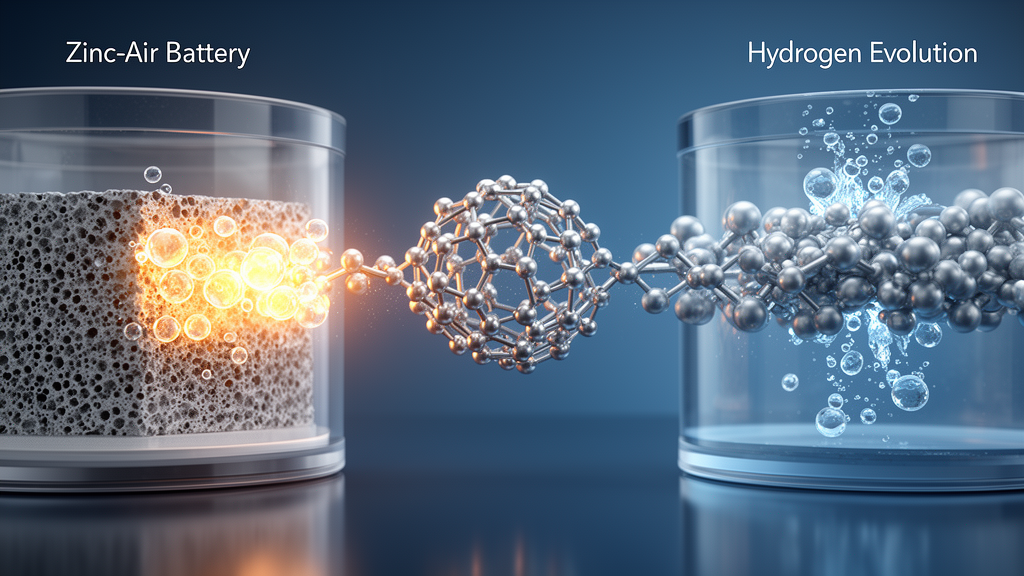
The global transition toward carbon neutrality is accelerating the development of efficient and sustainable technologies for energy conversion, storage, and clean fuel production. Among various electrochemical systems, water electrolysis for hydrogen production and rechargeable zinc–air batteries represent key directions for clean fuel production and high-energy-density energy storage, respectively. Water electrolysis can convert intermittent renewable electricity into high-energy-density hydrogen, while zinc–air batteries utilize zinc metal as the anode and oxygen from the air as the cathode reactant, offering advantages such as high theoretical energy density, good safety, and abundant raw materials.
However, the large-scale application of these two types of systems remains limited by slow reaction kinetics and insufficient catalyst stability. In the water splitting process, the cathodic hydrogen evolution reaction and the anodic oxygen evolution reaction involve complex proton and water molecule activation, hydrogen intermediate adsorption, and multistep oxygen intermediate transformation. In zinc–air batteries, the air electrode undergoes oxygen reduction reaction during discharge and oxygen evolution reaction during charge. These processes are all typical multi-electron transfer reactions with complex kinetic processes, placing high demands on the electronic structure of the catalyst, reactant adsorption strength, and its capabilities for charge and mass transport.
More importantly, the optimal active sites and reaction environments for these three reactions are not entirely consistent. Hydrogen evolution typically requires a moderate hydrogen adsorption free energy, while oxygen evolution necessitates effective regulation of oxygen-containing intermediates such as hydroxyl, oxygen, and hydroperoxyl species. Oxygen reduction requires simultaneous promotion of oxygen activation and enhancement of the selectivity of the four-electron reduction pathway. Therefore, how to balance these three activities within the same catalytic system is a core scientific challenge in the design of tri-functional electrocatalysts, which must operate efficiently across distinct electrochemical environments.
Traditionally, highly efficient catalysts have primarily relied on precious metals such as platinum, iridium, and ruthenium. However, the high cost, resource scarcity, and long-term operational stability issues associated with these materials have limited their large-scale application. To reduce reliance on precious metals, researchers have developed a variety of non-precious metal-based catalysts, including transition metal oxides, hydroxides, sulfides, phosphides, nitrides, carbides, metal–organic framework derivatives, heteroatom-doped carbon materials, and single-atom catalysts. These materials demonstrate excellent performance in individual reactions and provide a basis for the development of zinc–air battery-driven self-powered water-splitting systems.
Over the past decade, the appeal of tri-functional electrocatalysts has been fully reflected in the rapid growth in the number of publications and the dense co-occurrence network of related keywords. A large number of studies have reported optimizing material composition, controlling morphology, designing heterostructures, defect engineering, and constructing single-atom sites, thereby substantially expanding the range of material systems and design strategies. For example, metal and nitrogen co-doped carbon materials can enhance oxygen reduction activity by adjusting the charge distribution of the carbon framework, while transition metal phosphides and sulfides demonstrate excellent catalytic potential in hydrogen and oxygen evolution reactions.
Many studies primarily employ three-electrode systems or rotating disk electrodes to assess the intrinsic activity of catalysts, investigating metrics such as overpotentials, half-wave potential, and Tafel slope. While these half-cell-derived parameters are essential for understanding the intrinsic activity of materials, they are inadequate for predicting catalyst performance in actual devices. Excellent half-cell performance does not necessarily imply excellent device performance, a challenge that becomes even more pronounced when zinc–air batteries are coupled with water electrolysis systems for self-powered hydrogen production.
In rechargeable zinc–air batteries, the air electrode must remain stable under alternating conditions of discharge and charge, during which the catalyst may undergo cyclic redox reactions, carbon support corrosion, active phase restructuring, and three-phase interface degradation. For water electrolysis systems, the cathode and anode must operate stably over extended periods in the same electrolyte while withstanding effects such as bubble scouring, electrolyte corrosion, and local pH fluctuations. When zinc–air batteries are utilized to drive water electrolysis, system performance depends on the dynamic matching between the discharge curve of the battery and the polarization curve of the electrolyzer, making voltage plateaus, output power, and long-term operational stability key factors.
Design strategies for tri-functional catalysts essentially rely on the synergistic enhancement of intrinsic activity and structural characteristics. Rational design follows two main pathways: tuning the electronic structure to boost the intrinsic catalytic capability of active sites, and creating an ideal reaction microenvironment through structural engineering to maximize active site utilization and facilitate mass transfer. Electronic regulation focuses on optimizing the adsorption strength of reaction intermediates on active sites through strategies such as metal doping, heteroatom doping, heterostructure construction, and defect engineering. Structural engineering aims to construct an efficient physical framework involving multi-scale pore structures, hollow core-shell structures, carbon-based composites, and array structures to ensure conductivity and mechanical robustness.
Recent advances in metal-free, noble metal-based, transition metal-based, heterojunction, and single-atom catalysts have provided new insights into tri-functional catalysis. Metal-free catalysts, such as nitrogen, phosphorus, and fluorine tridoped graphene, have demonstrated the ability to simultaneously catalyze all three reactions, although the roles of individual dopants remain a subject of ongoing mechanistic investigation. Noble metal-based catalysts, including alloys, phosphides, and heterojunctions, excel in single reactions but struggle to achieve tri-functionality in one system due to cost and scarcity. Transition metal-based catalysts offer a balance between cost and activity, yet their dynamic reconstruction and metal dissolution can trigger triple-phase boundary degradation, leading to stability challenges in practical applications.
Operando spectroscopy provides direct experimental evidence for dynamic reversibility and degradation mechanisms, revealing that the true active phase under operating conditions often deviates from the as-synthesized one. Quantitative analysis has shown that selective dissolution of inactive framework elements can compromise mechanical integrity and electronic transport pathways, constituting a fundamental driving force for rapid catalyst deactivation under frequent operational cycling. Looking ahead, the development of tri-functional electrocatalysts should be advanced through coordinated efforts in atomically precise synthesis, integration of in situ characterization with theoretical calculations, and the establishment of standardized device testing protocols. The ultimate metric for success is not merely catalyst overpotential but overall system energy efficiency under dynamic load in integrated energy applications.
Subject of Research: Tri-functional electrocatalysts for zinc-air batteries and water splitting
Article Title: Tri‐Functional Electrocatalysis for Zinc–Air Battery Coupled Water Splitting: A Catalyst‐Electrode‐Device‐System Perspective
Article References: Di, X., Duan, C., Li, S., Che, Y., Liu, X., Xiong, C., Shen, M., Wang, Y., Hao, D., & Ni, Y. (2026). Tri‐Functional Electrocatalysis for Zinc–Air Battery Coupled Water Splitting: A Catalyst‐Electrode‐Device‐System Perspective. Advanced Science, 13(58), Article e77619. https://doi.org/10.1002/advs.77619
Image Credits: AI Generated
DOI: 10.1002/advs.77619
Keywords: electrocatalysis, zinc-air battery, water splitting, hydrogen production, energy storage, catalyst design, electrochemistry, renewable energy, material science, operando spectroscopy, Functional, Zinc
Cite Scienmag News
Faith Mcneil. (October 21, 2026). Tri-Functional Catalysts Bridge Zinc-Air Batteries and Hydrogen Production. Scienmag. https://scienmag.com/tri-functional-catalysts-bridge-zinc-air-batteries-and-hydrogen-production/
Faith Mcneil. "Tri-Functional Catalysts Bridge Zinc-Air Batteries and Hydrogen Production." Scienmag, 21 October 2026, https://scienmag.com/tri-functional-catalysts-bridge-zinc-air-batteries-and-hydrogen-production/. Accessed 21 October 2026.
Faith Mcneil. "Tri-Functional Catalysts Bridge Zinc-Air Batteries and Hydrogen Production." Scienmag. October 21, 2026. https://scienmag.com/tri-functional-catalysts-bridge-zinc-air-batteries-and-hydrogen-production/


