


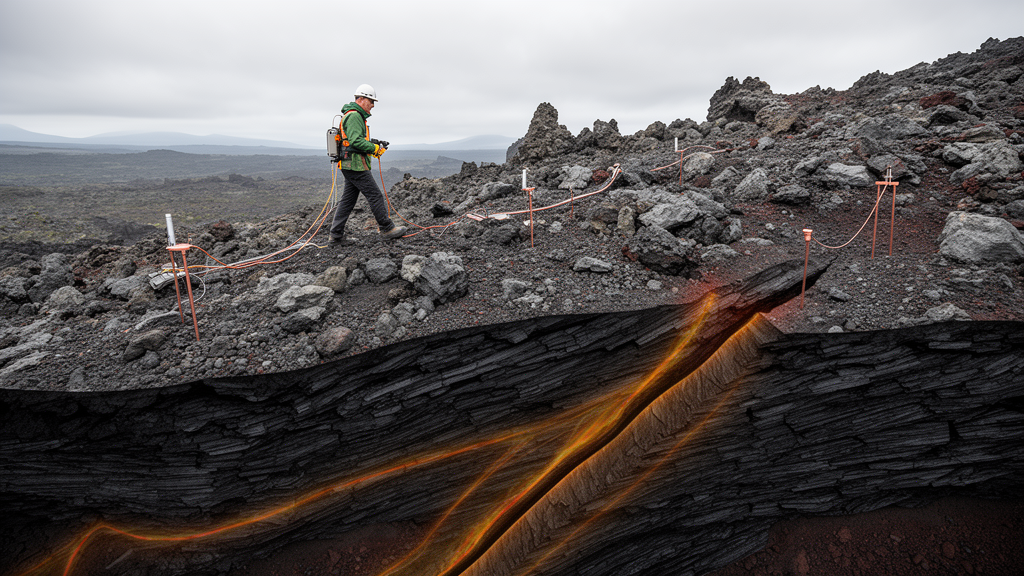
A regularized inversion of self-potential measurements has mapped a shallow, hydraulically active segment of an active reverse fault beneath Pinggirsari in West Java, Indonesia. The study modeled the fault as a two-dimensional finite inclined sheet and applied a Fruit Fly Optimization Algorithm, or FOA, to a 1,000-metre field profile. The resulting estimates place the upper fault tip at about 14.7 metres depth, identify a steep structural dip of about 138 degrees, and locate the anomaly near profile station 472 metres. These are model-based estimates from a single field line rather than direct observations of the fault, and the authors caution that the two-dimensional approach assumes a pseudo-flat ground surface.
Self-potential surveying offers a non-invasive way to investigate faults because migrating hydrothermal or meteoric fluids can produce measurable electrical potentials as they move through fractured rock. The effect combines electrokinetic and electrochemical processes, allowing a surface anomaly to serve as an indicator of a fluid-bearing discontinuity. Such surveys are particularly useful in steep or environmentally sensitive volcanic terrain, where drilling and trenching may be expensive, disruptive or impractical. The method, however, does not directly image a fault. An observed potential must be converted into estimates of source depth, dip, polarization, length and position through a non-linear and ill-posed inverse problem.
The research team addressed that ambiguity by combining an analytical finite-sheet model with bounded, weighted Tikhonov-style regularization. The forward calculation predicts the surface response from six parameters: an amplitude coefficient, the vertical depth of the sheet’s upper edge, polarization angle, dip angle, dip length and horizontal origin. The objective combines normalized root mean square error between observed and calculated potentials with a penalty for deviation from a reference model. A diagonal weighting matrix scales parameters with different physical units, and a regularization weight of 5 × 10⁻³ balances data fitting against repeatability. The penalty does not establish that every recovered geometry is unique, but the tests indicate that it can reduce dispersion in poorly constrained parameters.
FOA supplies the global-search component. Modeled on the foraging behavior of fruit flies, the algorithm perturbs a population of candidate fault models, evaluates their self-potential responses and contracts the population toward the best model found so far. The study used 50 agents and 250 iterations, clipping candidates to their allowable parameter ranges at every evaluation. Particle Swarm Optimization, or PSO, and a Genetic Algorithm, or GA, were tested with the same population size, iteration budget, search bounds and regularization settings. The researchers also ran 50 independent FOA inversions for each regularization weight at 10% and 20% synthetic noise, allowing them to isolate the penalty’s contribution rather than attribute every improvement to the search algorithm alone.
On a noise-free 150-metre synthetic profile, where the true model had an amplitude of 400 millivolts, an upper-edge depth of 15 metres, a polarization angle of 30 degrees, a dip of 50 degrees, a dip length of 40 metres and a horizontal origin of 65 metres, regularized FOA recovered values close to those targets. The normalized root mean square error was 0.00158 and the coefficient of determination was 1.00. With 20% zero-mean Gaussian white noise, the estimates remained near the reference model: 15.67 metres for depth, 30.12 degrees for polarization, 51.26 degrees for dip, 40.75 metres for length and 64.21 metres for origin. The fit weakened to an NRMSE of 0.06435 and an R² of 0.9633, illustrating both the method’s tolerance to noise and the increasing uncertainty under degraded signal quality.
The regularization sweep showed that data fit was comparatively insensitive to the penalty within the tested range. At 10% noise, the data-misfit term remained near 0.0322; at 20% noise, it varied only from 0.0696 to 0.0707. Parameter repeatability was more responsive. At 20% noise, the ensemble standard deviations of polarization angle and dip fell by 61% at a regularization weight of 5 × 10⁻³, while polarization-angle error decreased from 8.0% without regularization to 5.5% with it. A larger weight produced further improvement in some estimates but also a small increase in data misfit. No run in this controlled experiment produced an inadmissible dip angle, but the authors note that the search bounds were already narrow; their ablation therefore demonstrates improved repeatability and accuracy more clearly than protection against gross geometric errors in a wide search space.
In a separate comparison using 20 independent runs on a synthetic profile, all three methods fitted a noise-free anomaly, but their convergence and repeatability differed. FOA reached an NRMSE of 0.00503 and an R² of 0.9998, while GA achieved a slightly lower final NRMSE of 0.00401 and PSO reached 0.00832. FOA converged faster than GA and produced narrower parameter distributions. Under 15% Gaussian noise, FOA attained the lowest final misfit among the three, 0.04379, followed closely by GA at 0.04383 and PSO at 0.04425. Its R² was 0.9773, and the inversion took about 0.86 seconds in the reported benchmark. These results support the regularized FOA’s performance under the specified conditions, but they do not establish that the differences would persist across different source geometries, survey layouts or noisier field settings.
For the Pinggirsari case, researchers collected self-potential observations along a 1,000-metre north–south line crossing the dominant geological strike at 25-metre station spacing. The profile crossed volcanic units comprising Old Malabar Andesite, a relatively dense and resistive lava-and-breccia unit, and the more permeable, conductive Malabar Volcanics. Their contact was associated with northwest–southeast-striking active reverse faults and interpreted as a preferential pathway for upward fluid migration. After a first-order regional trend was removed, the remaining profile retained a pronounced bipolar anomaly, reaching approximately +203 millivolts near station 500 metres and −110 millivolts near station 430 metres. The team treated the target as a finite inclined sheet and used the regularized FOA inversion to estimate its geometry.
The field solution gave K = 421.32 ± 52.81 millivolts, an upper-edge depth of 14.71 ± 4.69 metres, a polarization angle of 28.22 ± 8.91 degrees, a dip of 138.01 ± 5.48 degrees, a dip length of 32.22 ± 8.89 metres and a horizontal origin of 472.42 ± 7.89 metres. FOA produced an NRMSE of 0.0810 and an R² of 0.8349, with an execution time of about 0.90 seconds. PSO achieved a marginally lower NRMSE of 0.0806 and GA a slightly higher value of 0.0818, so the field data did not show a decisive fit advantage for FOA. Instead, the study emphasizes its comparatively narrow, unimodal parameter distributions and interpretation of a shallow fault segment near station 472 metres, finer than the 700–800-metre discontinuity previously mapped by regional VLF-EM surveying. Severe terrain relief remains an important limitation: the authors state that digital-elevation-model corrections or boundary-element modelling may be needed before applying the inversion in high-relief settings.
The Pinggirsari results demonstrate how a physics-informed computational method can convert a noisy surface electrical signal into a quantitative structural interpretation without drilling or trenching. The inferred depth is broadly consistent with previously reported estimates of about 14.6–16.0 metres for the same structure, although other published methods placed the fault center more shallowly or deeply. The result is a promising tool for mapping fluid-bearing faults in volcanic terrain, where weathered tuffaceous cover can conceal structures and groundwater paths relevant to slope behavior. Its practical value nevertheless comes with explicit boundaries: the evidence is based on one field profile and a finite-sheet model, the observed data do not uniquely determine subsurface geometry, and severe topography was not fully modeled. The authors propose extending the approach to three-dimensional, multi-source inversions and combining it with electrical resistivity tomography and VLF electromagnetics, rather than treating the estimated fault geometry as a complete hydro-mechanical model.
Subject of Research: Regularized self-potential inversion for non-invasive characterization of a shallow active reverse fault in volcanic terrain
Article Title: Non-invasive structural characterization of an active reverse fault in volcanic terrain via regularized self-potential inversion: A case study from Pinggirsari, Indonesia
Article References: Essa, K. S. (2026). Non-invasive structural characterization of an active reverse fault in volcanic terrain via regularized self-potential inversion: A case study from Pinggirsari, Indonesia. Results in Engineering, 32, Article 113584. https://doi.org/10.1016/j.rineng.2026.113584
Image Credits: AI Generated
DOI: 10.1016/j.rineng.2026.113584
Keywords: self-potential surveying, fault characterization, Pinggirsari, reverse fault, Fruit Fly Optimization, Tikhonov regularization, volcanic terrain, geophysical inversion, Indonesia, Non-invasive, structural, characterization
Cite Scienmag News
Denise Maddox. (October 21, 2026). Regularized self-potential inversion maps shallow reverse fault in volcanic terrain. Scienmag. https://scienmag.com/regularized-self-potential-inversion-maps-shallow-reverse-fault-in-volcanic-terrain/
Denise Maddox. "Regularized self-potential inversion maps shallow reverse fault in volcanic terrain." Scienmag, 21 October 2026, https://scienmag.com/regularized-self-potential-inversion-maps-shallow-reverse-fault-in-volcanic-terrain/. Accessed 21 October 2026.
Denise Maddox. "Regularized self-potential inversion maps shallow reverse fault in volcanic terrain." Scienmag. October 21, 2026. https://scienmag.com/regularized-self-potential-inversion-maps-shallow-reverse-fault-in-volcanic-terrain/


