Targeted lysosomal degradation can eliminate extracellular and cell-surface proteins, but a review of the field concludes that internalization is only the beginning of a successful therapeutic strategy. These molecular systems must selectively capture a target, recruit or exploit a cellular uptake route, and then steer the resulting complex away from recycling and toward late endosomes and lysosomes. The review presents targeted degradation not simply as receptor hijacking, but as programmable routing: success depends on destruction of total target protein, evidence of lysosomal dependence, and the target biology and cellular context in which each interaction occurs.
The approach extends targeted protein degradation beyond the intracellular proteins commonly directed to the ubiquitin–proteasome system by PROTACs and molecular glues. The proteasome acts principally in the cytosol and nucleus, making it poorly suited to many secreted factors, extracellular proteins and membrane receptors, including cytokines, growth factors, immune checkpoints, receptor tyrosine kinases, adhesion receptors and transporters. Neutralizing or inhibiting these proteins can leave catalytic, scaffolding, ligand-independent or recycling-dependent functions intact, whereas eliminating them may provide a distinct pharmacological profile. Lysosome-targeting degraders, including LYTAC-like chimaeras, exploit cellular entry pathways naturally connected to extracellular and membrane cargo.
Early LYTAC designs linked a target-binding antibody to mannose-6-phosphate ligands that recruit the cation-independent mannose-6-phosphate receptor, CI-M6PR, also known as IGF2R. Later systems used the hepatocyte-enriched asialoglycoprotein receptor, ASGPR, often with triantennary N-acetylgalactosamine ligands, to direct uptake toward the liver. These approaches established the central principle of induced proximity: a bifunctional molecule can connect an extracellular or cell-surface target to an endogenous receptor and thereby bring it into the endolysosomal system. The field has since expanded to bispecific biologics, antibody fragments, ligand- and cytokine-guided chimaeras, compact synthetic degraders, aptamers, nucleic-acid scaffolds, polymers, nanoparticles, vesicles and genetically encoded systems.
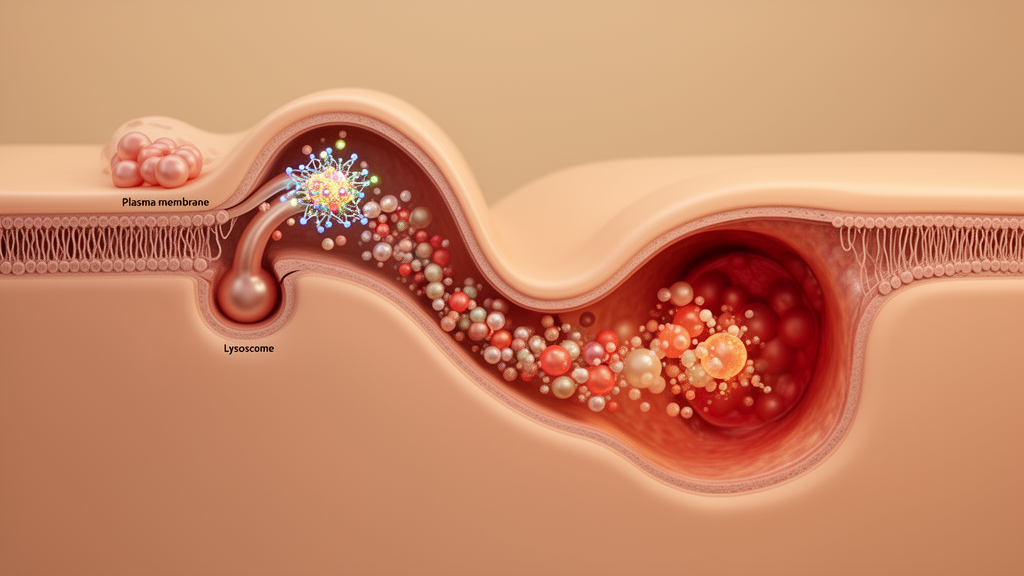
Internalization, however, does not prove degradation. Once a target–degrader complex enters an endosome, it may be recycled to the plasma membrane, transported retrogradely, moved across a cell by transcytosis, retained in a non-degradative compartment or delivered to a lysosome. The review therefore treats receptor identity, binding kinetics, valency, geometry, linker length and rigidity, and complex lifetime as tools for controlling post-endocytic fate. Multivalent engagement can enhance avidity and, in suitable systems, promote receptor clustering, while pH-responsive interactions may release a recruited receptor in an acidifying endosome without releasing the target. Receptors already inclined toward lysosomal delivery may offer an advantage over handles chosen solely for rapid uptake.
Membrane proteins face an additional hurdle. After internalization, a transmembrane protein generally remains within the limiting membrane of an endosome and must enter intraluminal vesicles of multivesicular bodies before the full-length protein can be efficiently destroyed. Sorting of this kind can depend on receptor clustering, ubiquitination, membrane context, adaptor recruitment and the ESCRT machinery. For receptors such as EGFR, immune checkpoints, adhesion proteins and transporters, the design question is therefore not simply whether target and receptor can be internalized together, but whether the complex is committed to a degradative vesicular pathway. Recycling, retrograde transport, transcytosis and non-degradative endosomal retention are distinct failure modes rather than interchangeable evidence of activity.
The review proposes a five-tier evidence framework to distinguish binding and uptake from genuine destruction. Tier 1 covers target engagement and cellular uptake, establishing only that capture and delivery are feasible. Tier 2 requires reproducible, dose- and time-dependent reduction in total target protein, supported by orthogonal assays and controls for viability, assay interference and major changes in expression. Tier 3 is the decisive step: the reduction in total target must be reversed or substantially attenuated by an appropriate perturbation of lysosomal acidification or proteolysis. Tier 4 adds mechanistic evidence involving receptor dependence, trafficking, recycling, receptor fate and, for membrane proteins, multivesicular-body sorting, ubiquitination or ESCRT involvement. Tier 5 concerns translation, requiring target reduction in relevant tissues or cell populations alongside exposure, pharmacokinetic–pharmacodynamic relationships, selectivity and tolerability. The tiers assess a particular target, construct and biological context rather than assigning an intrinsic maturity level to an entire platform.
Surface flow cytometry, fluorescence uptake, microscopy and reduced surface staining can support target engagement or altered accessibility, but they cannot independently establish degradation. Apparent signal loss may result from epitope masking, target shedding, redistribution, conformational change, assay interference or receptor clustering. Quantitative immunoblotting, proteomics, targeted mass spectrometry, non-competing immunoassays, permeabilized flow cytometry and other orthogonal methods can help establish loss of the full target. Lysosomal inhibitors such as bafilomycin A1, concanamycin A, chloroquine, hydroxychloroquine and lysosomal protease inhibitors can test dependence, but they also affect endosomal trafficking, secretion, autophagic flux, signaling and cell fitness. Their use therefore requires viability controls and, where appropriate, target RNA measurements and complementary protein assays. Dose-response, time-course, washout and recovery experiments further distinguish durable depletion followed by resynthesis from redistribution or persistent assay interference.
Receptor selection creates opportunities but also imposes distinct liabilities. Broadly expressed CI-M6PR can provide access to lysosomal trafficking machinery, whereas ASGPR offers a liver-biased clearance sink for plasma-accessible targets. Sortilin and members of the low-density lipoprotein receptor-related protein family may suit extracellular clearance, aggregate removal or barrier transport, depending on cell context. Transferrin receptor 1 is widely used for uptake and blood–brain-barrier transport, but its recycling and transcytosis behavior must be redirected if degradation is intended. Disease-enriched handles, including prostate-specific membrane antigen, glypican-3, carbonic anhydrase IX and folate receptor alpha, can improve tissue selectivity, although their expression is often heterogeneous among patients, lesions and anatomical regions. Signaling-active cytokine, chemokine and hormone receptors may distinguish cell populations, but they can also alter pathways including JAK–STAT, PI3K–AKT, MAPK, calcium signaling, chemotaxis, desensitization and receptor downregulation. Attenuated ligands, antagonist-like binders, affinity tuning, altered subunit selectivity and geometric control may preserve uptake while reducing unwanted biological effects.
Molecular format adds another layer of control. Antibodies and other modular biologics offer high affinity, epitope selection and adjustable valency, but their size can limit penetration into solid tumors, dense extracellular matrices and protected compartments. For IgG-based constructs, Fc-receptor engagement, immune-complex behavior and neonatal Fc receptor recycling can also influence biodistribution, persistence and uptake independently of the intended mechanism. Compact small molecules or peptides may diffuse more readily and permit precise control of linker polarity, rigidity, plasma stability and pH sensitivity, yet many extracellular proteins lack suitable compact binders, and small constructs may be rapidly filtered, degraded or otherwise cleared before sufficient target capture occurs. Multivalent polymers, nucleic-acid assemblies, nanocages and vesicles can control ligand spacing and local concentration, but excessive size or valency may promote nonspecific uptake, clearance-organ accumulation, receptor sequestration or unstable endosomal complexes. Architectural novelty is not itself evidence of degradation; formats must be compared by sustained total target loss, lysosomal dependence, mechanistic clarity and translational performance.
Translating this strategy will require matching the dominant biological bottleneck to the design. Plasma-accessible soluble proteins may suit repeated systemic capture through a high-capacity clearance route, whereas tissue-resident membrane targets require penetration, selective cell access and sustained post-endocytic commitment. Targets behind anatomical barriers present two separate problems: crossing the barrier and achieving lysosomal degradation within the intended cell. Immune, inflammatory and endocrine applications also require monitoring of feedback, target resynthesis and receptor signaling. Safety assessments must examine competition with endogenous ligands, receptor capacity, off-tissue loss, inflammatory activation, immunogenicity and biodistribution, while manufacturing must control conjugation, valency, particle size, stability and batch consistency. Spatial proteomics, surface proteomics, multiplex imaging and single-cell profiling may help identify where target, recruited handle and degradative machinery coexist and distinguish delivery failure from routing failure. The review’s central conclusion is that the field must advance from demonstrating uptake to controlling intracellular fate, because only verified lysosomal destruction—not binding, disappearance from the cell surface or fluorescent uptake—establishes successful targeted lysosomal degradation.
Subject of Research: Design and validation of targeted lysosomal degraders for extracellular and membrane proteins
Article Title: Targeted Lysosomal Degradation of Extracellular and Membrane Proteins: From Receptor Hijacking to Programmable Endolysosomal Routing
Article References: Liu, K., Wang, X., Liu, X., He, C., Qian, D., Meng, X., & Zhu, L. (2026). Targeted Lysosomal Degradation of Extracellular and Membrane Proteins: From Receptor Hijacking to Programmable Endolysosomal Routing. Advanced Science, 13(58), Article e77675. https://doi.org/10.1002/advs.77675
Image Credits: AI Generated
DOI: 10.1002/advs.77675
Keywords: targeted protein degradation, lysosomal degradation, LYTACs, endolysosomal routing, membrane proteins, receptor recruitment, protein therapeutics, molecular design, drug discovery, extracellular proteins, Targeted, Lysosomal
Cite Scienmag News
Drew Townsend. (October 21, 2026). Targeted Lysosomal Degradation: From Receptor Hijacking to Endolysosomal Routing. Scienmag. https://scienmag.com/targeted-lysosomal-degradation-from-receptor-hijacking-to-endolysosomal-routing/
Drew Townsend. "Targeted Lysosomal Degradation: From Receptor Hijacking to Endolysosomal Routing." Scienmag, 21 October 2026, https://scienmag.com/targeted-lysosomal-degradation-from-receptor-hijacking-to-endolysosomal-routing/. Accessed 21 October 2026.
Drew Townsend. "Targeted Lysosomal Degradation: From Receptor Hijacking to Endolysosomal Routing." Scienmag. October 21, 2026. https://scienmag.com/targeted-lysosomal-degradation-from-receptor-hijacking-to-endolysosomal-routing/