


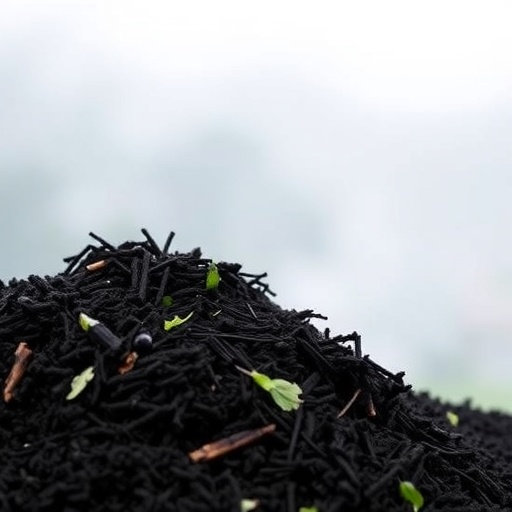
A revolutionary approach to sustainable agriculture has emerged, leveraging cutting-edge machine learning technology to optimize the production of biochar—a carbon-rich substance formed through the pyrolysis of organic biomass. This innovative method not only promises to enhance agricultural productivity but also offers a solution for waste management, turning agricultural residue into valuable soil enhancers. At the forefront of this research is Dr. Lan Mu from the School of Mechanical Engineering at Tianjin University of Commerce, whose recent study details how machine learning can accurately predict the yield and nutrient composition of biochar.
Biochar has long been hailed as a miracle material in confrontations against climate change, particularly for its ability to improve soil health and sequester carbon. Though its benefits are well-known within scientific circles, traditional methods of producing biochar have relied heavily on trial-and-error, leaving a significant gap in precision and predictability. The new method developed by Dr. Mu’s team signals a transformative shift away from these imprecise approaches, instead utilizing complex algorithms that incorporate numerous variables that influence biochar production.
The researchers based their work on an extensive analysis of 271 experimental datasets collected from around the globe. This rich dataset enabled the team to train four advanced machine learning models: Support Vector Regression, Random Forest, Artificial Neural Networks, and XGBoost. Each model was evaluated for its predictive accuracy in determining both the yield of biochar and its nutrient composition, particularly focusing on nitrogen, phosphorus, and potassium—elements crucial for soil fertility. This comprehensive method ensured that the predictions were not only data-driven but also scientifically sound.
Among the four models tested, XGBoost emerged as the most effective tool, achieving an impressive accuracy performance with an average R² value of 0.97. This near-perfect reliability underscores the potential for machine learning to redefine how scientists and agricultural professionals approach biochar production. By providing accurate predictions based on specific types of biomass and pyrolysis conditions, decision-makers can make informed choices that enhance both efficiency and sustainability.
Dr. Mu’s team introduced an innovative twist to their methodology by employing data augmentation techniques. By injecting random noise into the existing datasets, they significantly improved the robustness and generalization capabilities of their predictive models. This ingenious solution not only refined the predictions but also enriched the underlying data, opening the door to further explorations in biochar research.
The implications of this research are far-reaching. The findings suggest that the pyrolysis temperature and feedstock composition are the primary drivers of biochar yield and nutrient retention. In practical terms, this means that farmers and environmental engineers can reduce guesswork by tailoring their biochar production processes—specifically the temperature settings and types of biomass used—to meet particular agricultural objectives and soil requirements.
To democratize this powerful technology and make it accessible to a wider audience, Dr. Mu’s team developed a user-friendly graphical interface, a digital platform that allows even those without technical skills to input their biomass data and receive instant predictions on biochar outputs. This user-centric approach sets the stage for extensive application across various sectors, ensuring that all stakeholders—from smallholder farmers to large agribusinesses—can benefit from advanced data analytics.
As sustainability becomes an increasingly urgent global priority, advancements like these stand to redefine traditional agricultural practices. By converting organic waste into high-value products like biochar, not only can we tackle the issue of agricultural residue management, but we can also mitigate the reliance on chemical fertilizers, ultimately leading to healthier ecosystems and more sustainable farming practices.
Tianjin University of Commerce has positioned itself as a leader in sustainable engineering research, spearheading initiatives that blend mechanical engineering, artificial intelligence, and environmental sciences. The work of Dr. Mu and his colleagues is a stellar example of how interdisciplinary collaborations can pave the way for innovative solutions to some of today’s most pressing challenges, such as climate change and soil degradation.
The significance of these findings extends beyond academia and into the realm of global agricultural policy. Policymakers looking to enhance food security while addressing environmental issues could greatly benefit from the insights gained through this research. By embracing data-driven farming techniques, the agricultural sector can shift towards a model that prioritizes sustainability and resilience, ensuring that future generations inherit a healthier planet.
Moreover, the broader message behind this research advocates for a shift in how we view agricultural waste. Instead of considering it a nuisance, we can reframe it as a valuable asset—data-rich biomass with the potential to revolutionize soil health and agricultural productivity. This perspective change is crucial for maturing practices in resource management and environmental stewardship.
In conclusion, the interplay between machine learning and sustainable agriculture, exemplified by Dr. Mu’s research on biochar, paints a bright future for the global agricultural landscape. As technological advancements continue to synergize with ecological responsibility, we move closer to an era where agricultural practices do not just extract from the environment but actively contribute to its health and vitality.
The path towards sustainability is challenging yet achievable, and innovations like those emerging from Tianjin University of Commerce inspire hope and action across the agricultural community. With collective efforts harnessed through technology and data, we stand at a threshold of improved food systems, enriched soils, and, ultimately, a more resilient world.
Keywords
Biochar; Biomass pyrolysis; Machine learning; NPK prediction; Data augmentation
Cite Scienmag News
Alan Morgan. (October 22, 2025). Transforming Waste into Wealth: Tianjin University of Commerce Leads AI-Driven Innovations in Sustainable Biochar Production. Scienmag. https://scienmag.com/transforming-waste-into-wealth-tianjin-university-of-commerce-leads-ai-driven-innovations-in-sustainable-biochar-production/
Alan Morgan. "Transforming Waste into Wealth: Tianjin University of Commerce Leads AI-Driven Innovations in Sustainable Biochar Production." Scienmag, 22 October 2025, https://scienmag.com/transforming-waste-into-wealth-tianjin-university-of-commerce-leads-ai-driven-innovations-in-sustainable-biochar-production/. Accessed 6 September 2026.
Alan Morgan. "Transforming Waste into Wealth: Tianjin University of Commerce Leads AI-Driven Innovations in Sustainable Biochar Production." Scienmag. October 22, 2025. https://scienmag.com/transforming-waste-into-wealth-tianjin-university-of-commerce-leads-ai-driven-innovations-in-sustainable-biochar-production/


