


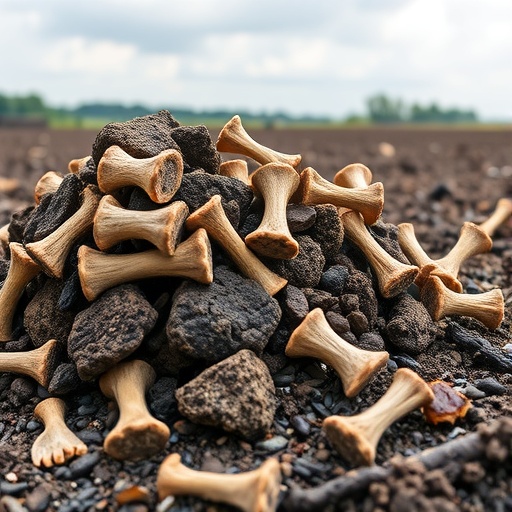
In an era marked by escalating environmental challenges and the urgent need for sustainable agricultural practices, a novel approach has emerged that could redefine how we manage essential nutrients and waste. A recent comprehensive review, published in the journal Biochar, illuminates the promising potential of bone char—a material derived from the pyrolysis of animal bones—as a sustainable resource for enhancing soil health and recycling phosphorus, a critical but finite nutrient for plant growth.
Phosphorus is indispensable for plant development, playing a pivotal role in energy transfer, photosynthesis, and nutrient movement within the plant system. However, the global reliance on mined phosphate rock for phosphorus fertilizers faces significant sustainability issues due to its finite reserves and environmental ramifications. Concurrently, agriculture suffers substantial phosphorus losses through runoff, erosion, and leaching, leading to water body eutrophication and degraded aquatic ecosystems. The study underscores bone char as a strategic intervention to close these nutrient loops and mitigate environmental pollution simultaneously.
Globally, slaughterhouses produce an immense volume of animal bone waste, estimated between 95 and 126 million tonnes annually. Until now, these residues have largely been considered waste, often disposed of through incineration or landfilling, processes that inadvertently squander valuable nutrients and contribute to pollution. The transformative process of pyrolysis converts these bones into bone char—a porous, carbonaceous material endowed with substantial concentrations of phosphorus, calcium, and magnesium, all vital for soil fertility and crop nutrition.
Bone char differs fundamentally from conventional fertilizers in its capacity to release nutrients gradually over time. This slow-release mechanism ensures sustained nutrient availability to plants, reduces the frequency of fertilizer application, and curtails nutrient runoff, thereby protecting adjacent ecosystems. The porous architecture of bone char not only facilitates this gradual nutrient release but also enhances soil water retention, a property critical for improving crop resilience under drought stress conditions. Moreover, its structural complexity fosters the colonization of beneficial soil microorganisms, organisms that play a vital role in nutrient cycling and overall soil vitality.
The physicochemical properties of bone char are intrinsically linked to its production parameters, primarily the pyrolysis temperature. Lower temperatures tend to favor the preservation of nutrient bioavailability, especially phosphorus, making the char more immediately effective as a fertilizer. Conversely, higher pyrolysis temperatures expand the surface area and adsorption capabilities of bone char, amplifying its potential to immobilize toxic elements, such as lead, cadmium, and zinc, thus serving as an environmental remediation agent in polluted soils.
The researchers propose that the global conversion of animal bone waste into bone char could theoretically replace between 13 and 32 percent of the worldwide phosphorus fertilizer market. This substitution has profound implications for promoting circular economies and reducing dependency on nonrenewable phosphate rock mining. Transitioning toward such sustainable practices could decrease the environmental footprint of agriculture, bolster food security, and contribute to long-term soil conservation.
Despite these auspicious prospects, the review delineates several critical knowledge gaps that warrant further scientific exploration. Long-term field studies are sparse, leaving uncertainties regarding bone char’s impact on soil microbial ecosystems, its influence on greenhouse gas emissions, and the intricate dynamics of nutrient cycling over extended periods. Understanding these factors is essential to optimize bone char formulations, determine appropriate application rates, and assess their cumulative environmental effects.
The interdisciplinary nature of this research, bridging agronomy, environmental science, and material science, highlights the complexity of developing bone char as a versatile agricultural input. It demands a nuanced approach to reconcile the trade-offs between maximizing nutrient availability and enhancing soil remediation properties. Consequently, fine-tuning pyrolysis conditions and characterizing the resultant bone char at a molecular and structural level will be paramount to harness its full potential.
As the global population surges and food demand intensifies, innovative solutions to sustainable agriculture are imperative. Bone char exemplifies a strategic resource recovery method, transforming what was once considered waste into a highly functional product that supports nutrient recycling, soil health enhancement, and pollution mitigation. The integration of bone char into mainstream agricultural practices could represent a watershed moment in achieving environmental sustainability and nutrient stewardship.
The authors conclude with a call for supportive policy frameworks that incentivize the production and application of bone char, alongside robust investment in research to elucidate its long-term agronomic and environmental impacts. They envision bone char as an integral part of future sustainable farming systems, contributing to resilient agriculture and a reduced ecological footprint.
The journey from animal bone waste to revitalized soils is emblematic of the broader shift towards circular resource management, where waste streams are harnessed as valuable inputs rather than discarded liabilities. As science continues to unravel the complexities of bone char and its role in agroecosystems, this promising material offers a compelling pathway to reconcile agricultural productivity with environmental conservation in the decades ahead.
News Publication Date: 28-Feb-2026
Web References:
- Journal Biochar: https://link.springer.com/journal/42773
- Article DOI: http://dx.doi.org/10.1007/s42773-025-00550-3
References:
Ghorbani, M., Azarnejad, N., Brown, R.W. et al. Sustainable resource management with bone char—challenges and opportunities for enhancing soil health and phosphorus stocks. Biochar 8, 34 (2026). https://doi.org/10.1007/s42773-025-00550-3
Cite Scienmag News
Alan Morgan. (March 13, 2026). Transforming Slaughterhouse Waste into Sustainable Fertilizer: How Bone Char Can Revolutionize Global Phosphorus Recycling. Scienmag. https://scienmag.com/transforming-slaughterhouse-waste-into-sustainable-fertilizer-how-bone-char-can-revolutionize-global-phosphorus-recycling/
Alan Morgan. "Transforming Slaughterhouse Waste into Sustainable Fertilizer: How Bone Char Can Revolutionize Global Phosphorus Recycling." Scienmag, 13 March 2026, https://scienmag.com/transforming-slaughterhouse-waste-into-sustainable-fertilizer-how-bone-char-can-revolutionize-global-phosphorus-recycling/. Accessed 4 September 2026.
Alan Morgan. "Transforming Slaughterhouse Waste into Sustainable Fertilizer: How Bone Char Can Revolutionize Global Phosphorus Recycling." Scienmag. March 13, 2026. https://scienmag.com/transforming-slaughterhouse-waste-into-sustainable-fertilizer-how-bone-char-can-revolutionize-global-phosphorus-recycling/


