


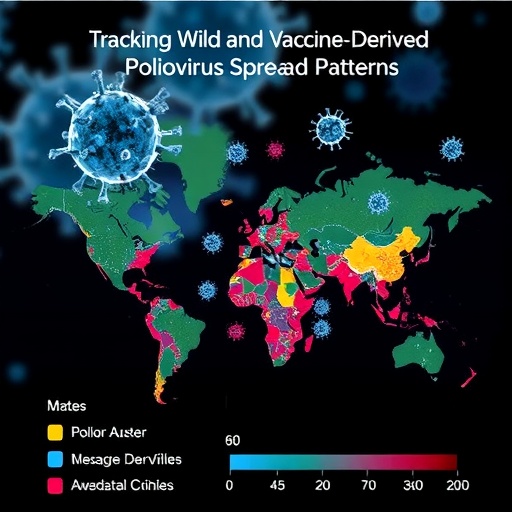
In an illuminating breakthrough that reshapes our understanding of poliovirus dynamics, a collaborative research effort led by Candido, Dellicour, Cooper, and colleagues has mapped the historical and contemporary spread of both wild and vaccine-derived polioviruses across the globe. Published recently in Nature Microbiology, this extensive spatiotemporal study provides unprecedented insights into the virus’s transmission pathways, revealing complex patterns influenced by vaccination strategies and population movement.
The poliovirus, a historically devastating pathogen responsible for paralytic poliomyelitis, has been the target of an aggressive global eradication campaign spanning decades. While the incidence of wild poliovirus has plummeted, new challenges have arisen in the form of vaccine-derived polioviruses (VDPVs), which emerge in populations with suboptimal immunization coverage. The study meticulously dissects the evolutionary trajectory of these viral forms, juxtaposing their spread through both geographic and temporal lenses, thereby underscoring the nuanced interplay between viral evolution and public health interventions.
Leveraging advanced phylogenetic techniques and integrating an extensive dataset of poliovirus genetic sequences collected worldwide, the researchers reconstructed transmission chains and clusters with remarkable resolution. Their analyses unveiled how wild poliovirus, once endemic in diverse regions, has retreated yet sporadically resurges in hotspots where immunization falters. Conversely, vaccine-derived strains appear to exploit immune gaps, circulating in communities with incomplete vaccine coverage, which ironically results from efforts intended to curb the disease.
The study employs a sophisticated Bayesian framework to model the evolution and spatial dissemination of the poliovirus, which allows for probabilistic mapping of viral lineage movements through time. This methodological innovation provides critical foresight into outbreak risks by identifying regions vulnerable to virus importation and the potential for re-emergence. Notably, the spatiotemporal dynamics depicted in this research emphasize the heterogeneity of poliovirus spread versus the simplistic narratives of linear viral decline.
Crucially, the research highlights the dichotomy between wild and vaccine-derived poliovirus strains regarding their genetic diversity and transmission velocity. Wild polioviruses exhibit a pattern of geographically restricted clusters with intermittent long-distance jumps—indicative of human-mediated transport. In contrast, VDPVs show prolonged circulation within localized populations before sporadically expanding their reach, signaling the insidious nature of transmission where vaccination lapses persist.
Beyond purely genetic and epidemiological perspectives, the findings shed light on the socio-political determinants influencing poliovirus dissemination. Regions grappling with conflict, population displacement, or healthcare infrastructure disruptions consistently appear as persistent reservoirs or sources of spillover infections. This realization underscores that effective eradication demands not only biomedical advances but also geopolitical stability and sustained public health engagement.
The authors emphasize that vaccination strategies must evolve to contend with the dual challenge of wild and vaccine-derived poliovirus circulation. The emergence of novel VDPV strains demands enhanced surveillance, including environmental sampling in addition to clinical case monitoring. Moreover, optimizing oral and inactivated poliovirus vaccine formulations will be pivotal in reducing the risk of reversion to neurovirulence while maintaining community immunity.
Further insights from this spatiotemporal analysis suggest that global eradication efforts require a recalibrated, data-driven approach integrating genetic surveillance, human mobility data, and real-time epidemiological forecasting. This comprehensive surveillance architecture can preemptively flag viral expansions before clinical cases amplify, serving as a cornerstone for rapid response initiatives, vaccine deployment, and resource allocation.
The study also calls attention to the diverse evolutionary pressures exerted on polioviruses across different settings. For instance, population immunity landscapes shift evolutionary trajectories, with vaccine-derived strains acquiring mutations facilitating survival and spread in partially immune hosts. Such adaptive complexity highlights the importance of continued genetic monitoring to anticipate and thwart emerging viral variants.
Importantly, the researchers underscore that the global polio endgame is not a sole function of vaccine coverage percentages but hinges on achieving equitable vaccination access, robust health systems, and resilient surveillance networks. The geographic mapping presented in the study demonstrates that even small pockets of low immunity can serve as ignition points for outbreaks that threaten progress made over decades.
This research offers a vital roadmap that informs policy decisions and strengthens global health security infrastructure. By delineating the historical spread of poliovirus alongside contemporary transmission pathways, the study provides actionable intelligence critical for transitioning from control to complete eradication. It dispels complacency born from declining case counts and cautions that vigilance remains paramount as the virus exploits vulnerabilities within human populations.
In summary, this comprehensive spatiotemporal analysis redefines our conceptualization of poliovirus spread, synthesizing genetic, epidemiological, and social dimensions into a coherent narrative. The revelations about vaccine-derived polioviruses’ persistence and dispersal patterns necessitate strategic recalibrations in vaccination policies, surveillance strategies, and outbreak preparedness programs. As polio edges closer to eradication, such integrative research becomes indispensable in navigating the final hurdles on this historic public health journey.
The implications extend beyond poliovirus alone, serving as a model for managing other infectious diseases where vaccine-derived or attenuated pathogens complicate eradication efforts. By embracing cutting-edge genomic epidemiology and integrating multidisciplinary data, the global health community stands better positioned to preempt, detect, and contain viral threats in an increasingly interconnected world.
Ultimately, this landmark research epitomizes the power of collaborative science in decoding pathogen dynamics and advancing toward a polio-free world. It stands as a testament to resilience, innovation, and relentless pursuit of knowledge against one of humanity’s oldest scourges.
Cite Scienmag News
Kristina Jarvis. (November 27, 2025). Tracking Wild and Vaccine-Derived Poliovirus Spread Patterns. Scienmag. https://scienmag.com/tracking-wild-and-vaccine-derived-poliovirus-spread-patterns/
Kristina Jarvis. "Tracking Wild and Vaccine-Derived Poliovirus Spread Patterns." Scienmag, 27 November 2025, https://scienmag.com/tracking-wild-and-vaccine-derived-poliovirus-spread-patterns/. Accessed 4 September 2026.
Kristina Jarvis. "Tracking Wild and Vaccine-Derived Poliovirus Spread Patterns." Scienmag. November 27, 2025. https://scienmag.com/tracking-wild-and-vaccine-derived-poliovirus-spread-patterns/


