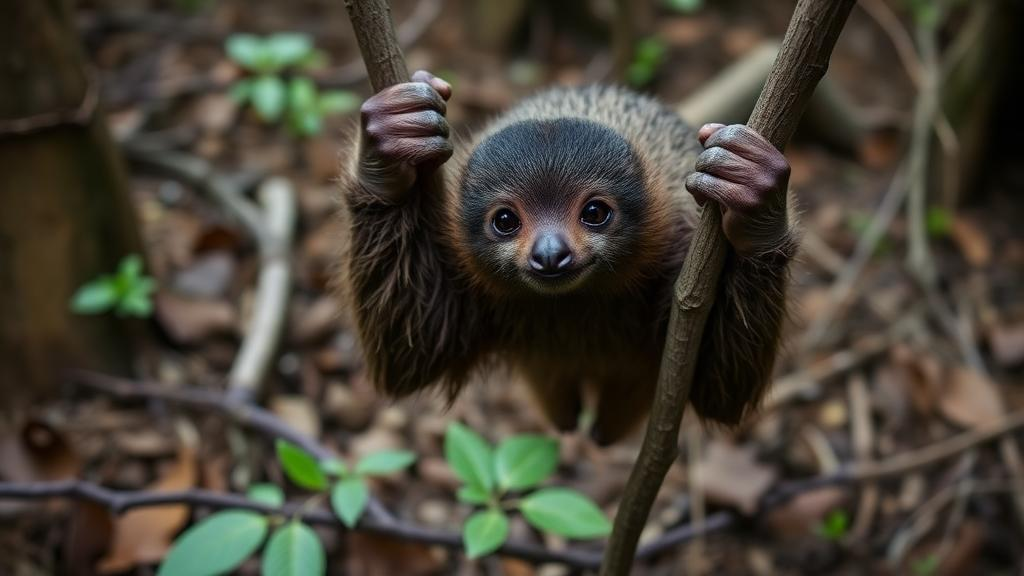
A rehabilitated two-toed sloth released into a tropical dry forest in Ecuador remained apparently healthy during an intensive 13-day follow-up, offering one of the first detailed records of how such a nocturnal, tree-dwelling mammal adjusts to life in the wild. The animal, named Bravo, was equipped with a low-cost Bluetooth tracker in a handmade biodegradable backpack, allowing wildlife carers to locate him even when he was difficult to see. The case, reported in Neotropical Biology and Conservation, shows how combining direct observation, local knowledge and inexpensive technology can improve the vulnerable first days after an animal is returned to its habitat.
Two-toed sloths are nocturnal and arboreal mammals whose survival depends on remaining inconspicuous. Their slow movement, energy-conserving metabolism and mottled coloration help them blend into trees, while their associated communities of algae, insects and other organisms can further disguise their bodies against a forest background. Yet this stealth offers little protection from terrestrial predators if a sloth comes down to the ground. Coastal Ecuador is also home to potential predators such as pumas, ocelots and tayras. Consequently, a released animal faces unfamiliar dangers including predation, human activity, accidents and behavioral deficits during the period when it must learn to feed, navigate and remain hidden effectively.
Bravo entered the Mansión Mascota wildlife clinic in Guayaquil in March 2021, weighing only 750 grams at one to two months of age. He received intensive care, individual support from a caregiver and veterinary treatment when unusual behavior or reduced food intake required it. Rehabilitation also involved exposing the young sloth to a complex enclosure containing branches and small trees, feeding him native leaves with their attached invertebrates, allowing controlled contact with other two-toed sloths, and assessing his responses to people and dogs at a safe distance. By the time he was evaluated for release, Bravo weighed 3.8 kilograms, moved competently through trees, could occasionally crawl on the ground, sought food in both arboreal and terrestrial settings, interacted with other sloths and avoided predator-like stimuli.
Independent veterinarians concluded that Bravo was fit for release. The site selected was the 323-hectave Bosque Protector Prosperina, a restored dry tropical forest within the Polytechnic University of Guayaquil. The reserve is connected to the much larger Cerro Blanco Protected Forest Reserve and contains mature patches linked to secondary growth. The release took place during the rainy season, when leaf abundance and food availability are higher than during the dry period. Surveys covering 11 kilometers led to the selection of a release point with important food trees, including bototillo, ceibo, saman and jocote, as well as canopy layers ranging from about six to 22 meters and routes connecting the area to taller surrounding forest.
Because the release site lies within a university precinct, the team also prepared the people who might encounter the sloth. Security personnel received a six-hour course on empathy-based wildlife management, with about one-third of the instruction devoted to two-toed sloths. These guards already handled around two sloth rescues or translocations each year in collaboration with the university’s Biodiversity Unit, and they participated in the release. Their familiarity with the project meant they could respond appropriately if they located Bravo. The sloth was transported 11.1 kilometers from the clinic in a kennel fitted with a transverse branch that he could grasp, a measure intended to reduce stress during the journey.
The field team monitored Bravo every night, generally beginning between 17:30 and 18:00 and continuing until 04:00 to 06:00. Direct observation was used to record movement, feeding, posture, vocalizations and unusual events. When he could not be found, teams searched the forest in daylight and darkness, sometimes for as long as seven hours, while resting during periods when sloths are generally less active. Torches were used sparingly and at standardized intervals to limit disturbance to Bravo and other wildlife. Over 167 hours of observation, the sloth was directly detected for 62 hours. He began moving at 20:00 and 21:00 on the first two nights, then usually began around 19:00 to 19:30, with 75% of the remaining records showing this pattern.
Bravo’s movements covered approximately 0.12 hectares during the first 10 days and involved 19 trees. He fed on bototillo leaves, saman leaves or insects and the leaves of lianas. The number of trees used each day increased after the first five days, suggesting that he was beginning to explore a wider portion of the forest. On the eighth day, carers placed feeding support about one meter from his resting position, but he ignored it. Analysis also identified a relationship between movement and the likelihood that the monitoring team could detect him. The highest combined rates of movement and detection occurred around 19:00, while a smaller movement peak appeared between 02:00 and 04:00. The movement and detection data were normally distributed, and their Pearson correlation was positive and statistically suggestive, with a reported value of p = 0.06.
Despite the favorable results, the sixth night brought a dramatic and potentially dangerous encounter. A masked owl, Pulsatrix perspicillata, called from within roughly 10 meters of Bravo. The sloth became motionless in a defensive posture and fell from the tree, but a caregiver reached him quickly. After resting briefly, he became highly active, moved rapidly toward the source of the owl calls and then returned to the canopy on his own. The researchers inferred antagonistic behavior involving the owl, although they could not establish whether the bird attempted predation, was displaced by Bravo, or was reacting to him. The encounter is notable because motionless defense had not previously been reported in this context for Choloepus hoffmanni. Bravo also descended to the ground to feed that night, highlighting the vulnerability faced by a sloth away from the canopy.
The Bluetooth tracker supplied an additional layer of support. The 34-gram device was carried in a flexible, semi-leather backpack sealed with a cardboard slide and four Velcro junctions designed to decay without manual removal. Bravo underwent five habituation sessions with the apparatus, although he detached it on three earlier occasions after one to four days. The pack eventually remained on his body for 54 days until humidity degraded its cardboard components, and it was successfully refitted 14 days before release. On the sixth night after liberation, heavy moisture caused the same junctions to fail and the tracker slipped away. While attached, the device’s nominal open-range reach was 120 meters, and its signal was used to identify the tree holding the strongest signal, with positions checked using a Garmin GPS receiver of about three-meter accuracy. The tracker allowed the team to find Bravo during searches, including a low-visibility encounter on day 10, when observers had difficulty seeing the motionless animal in the forest.
The episode highlights both the promise and the limits of inexpensive wildlife monitoring. Bluetooth devices cannot provide the continuous movement tracks available from satellite or radio telemetry, and Bravo’s observation period was too short to prove permanent establishment. Previous work on other arboreal mammals suggests that a follow-up period of about a month, combined with several months of tracking, would provide stronger evidence that an animal has settled successfully. Nevertheless, Bravo fed on several tree species, moved through the forest, left feces, recovered from his fall and climbed back into the canopy unaided. The study’s central lesson is that successful rehabilitation cannot be demonstrated by releasing an animal alone: its health, behavior, feeding and ability to avoid detection must be checked afterward. For scarce and difficult-to-observe species, biodegradable Bluetooth packs offer an affordable way to combine field support with direct observation, while more extensive evaluation is needed to establish their limits and improve post-release survival.
Subject of Research: Post-release monitoring of a rehabilitated two-toed sloth using direct observation and Bluetooth tracking
Article Title: Release and follow-up of a rehabilitated two-toed sloth ( Choloepus hoffmanni ) in a tropical dry forest in Ecuador
Article References: Villalba-Briones, R., Jiménez, E. R., & Monros, J. S. (2022). Release and follow-up of a rehabilitated two-toed sloth (Choloepus hoffmanni) in a tropical dry forest in Ecuador. Neotropical Biology and Conservation, 17(4), 253-267. https://doi.org/10.3897/neotropical.17.e91332
Image Credits: AI Generated
DOI: 10.3897/neotropical.17.e91332
Keywords: two-toed sloth, animal rehabilitation, post-release monitoring, Bluetooth tracking, wildlife conservation, tropical dry forest, Choloepus hoffmanni, masked owl, Ecuador, animal telemetry, Release, follow-up
Cite Scienmag News
Margaret Porter. (October 19, 2026). Tracked Sloth Survives Release in Ecuadorian Dry Forest. Scienmag. https://scienmag.com/tracked-sloth-survives-release-in-ecuadorian-dry-forest/
Margaret Porter. "Tracked Sloth Survives Release in Ecuadorian Dry Forest." Scienmag, 19 October 2026, https://scienmag.com/tracked-sloth-survives-release-in-ecuadorian-dry-forest/. Accessed 19 October 2026.
Margaret Porter. "Tracked Sloth Survives Release in Ecuadorian Dry Forest." Scienmag. October 19, 2026. https://scienmag.com/tracked-sloth-survives-release-in-ecuadorian-dry-forest/