


In a groundbreaking advancement bridging immunology and evolutionary biology, researchers have unveiled compelling evidence that the immune checkpoint molecule programmed cell death 1 (PD-1) is remarkably conserved across a vast range of jawed vertebrates, spanning from ancient sharks to modern humans. This discovery not only reshapes our understanding of immune system evolution but also holds promising implications for the future of immunotherapeutic strategies. The new comprehensive study, authored by a collaborative team of Japanese scientists including Dr. Yasumasa Ishida and Dr. Ryohei Kondo, provides detailed molecular insights into PD-1, its ligands PD-L1 and PD-L2, and associated phosphatases such as SHP-1 and SHP-2.
PD-1 has long been established as a pivotal immune checkpoint receptor, regulating immune responses by modulating T cell activity to prevent autoimmunity and maintain immune homeostasis. Its role as a therapeutic target in cancer immunotherapy was recognized with the awarding of the 2018 Nobel Prize in Physiology or Medicine to Professor Tasuku Honjo. Despite its medical importance, until recently, PD-1 was believed to exist only in tetrapods—vertebrates with four limbs. However, this new research challenges that paradigm by demonstrating that PD-1 and its critical molecular partners are present in a diverse spectrum of jawed vertebrates, including elusive cartilaginous and bony fishes.
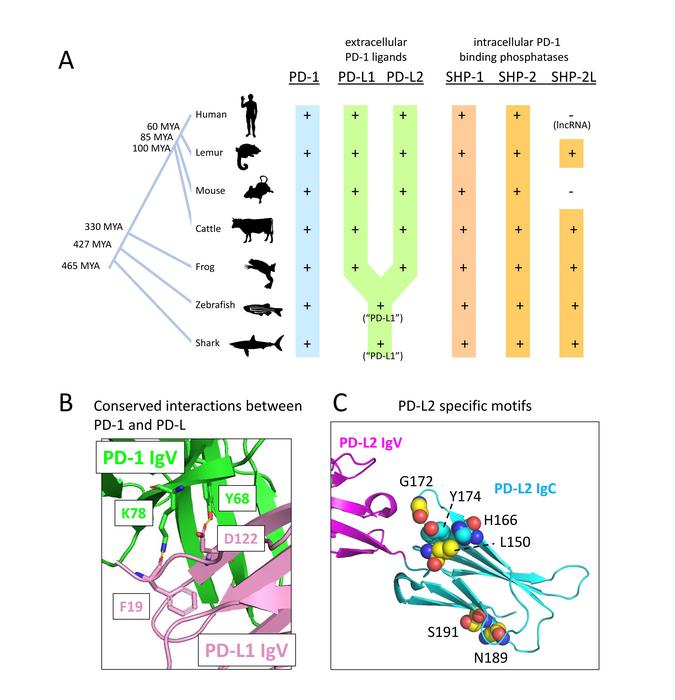
By leveraging the expanding databases of whole-genome sequences, the investigators undertook an exhaustive comparative genomic and molecular evolutionary analysis. They successfully traced the PD-1 gene and its ligands through phylogenetic lineages, revealing conserved structural features and interaction interfaces that have been maintained over hundreds of millions of years. Notably, the study highlights precise amino acid residues within the PD-1 extracellular domain, including tyrosine and lysine residues critical for ligand binding, which form conserved hydrogen bond interactions with PD-L1 across species. This molecular preservation underscores the functional importance of these interactions in immune regulation.
Further deepening the molecular narrative, the research identifies distinctive characteristics that differentiate PD-L2 from PD-L1, particularly in the immunoglobulin constant (IgC) domain. Specific amino acid motifs, including unique residues that constitute potential N-linked glycosylation sites, create a surface topology exclusive to PD-L2 in tetrapods. The precise functional consequence of this divergence remains to be elucidated, but it suggests specialized roles for PD-L2 that evolved after the split from ancestral fish lineages.
Beyond extracellular receptor-ligand dynamics, the intracellular signaling motifs of PD-1—the immunoreceptor tyrosine-based inhibitory motif (ITIM) and immunoreceptor tyrosine-based switch motif (ITSM)—also exhibit evolutionary conservation. However, the study proposes a potential redefinition of these motifs based on nuanced conservation patterns observed in various species. Such findings open avenues for refined mechanistic studies elucidating how PD-1 transmits inhibitory signals to dampen T cell activation via recruitment of SHP phosphatases.
A particularly novel aspect of this investigation is the recognition of SHP-2-like (SHP-2L), an ancient phosphatase variant preserved in most jawed vertebrates but independently lost in rodents and higher primates. This discovery adds complexity and depth to the molecular signaling landscape of PD-1, hinting at alternative or supplementary pathways modulating immune responses in diverse species.
Importantly, functional gene expression analyses reveal that in fish, PD-1 expression is predominantly enriched on regulatory T cell populations, paralleling its immunomodulatory role in mammals. This supports the premise that PD-1’s role in immune checkpoint regulation is not a recent evolutionary innovation but a foundational component of vertebrate immunity that has endured through hundreds of millions of years.
The implications of these findings are vast. Understanding the evolutionary conservation of the PD-1 axis can guide the design of next-generation immunotherapies, potentially leveraging ancestral molecular features to overcome resistance and improve efficacy. It also broadens the research scope, enabling immunologists to use diverse vertebrate models, including cartilaginous fish, to dissect PD-1 biology in novel contexts.
Dr. Ryohei Kondo, reflecting on the evolutionary trajectory, articulates the profound biological necessity of PD-1’s immune downregulation, stating, “It’s incredible to realize that immune checkpoint molecules like PD-1 are conserved across jawed vertebrates. It highlights the necessity of immune downregulation ability.” This discovery cements PD-1’s status as a central immune regulator whose function is deeply rooted within the vertebrate lineage.
Dr. Yasumasa Ishida, who originally identified PD-1 in the early 1990s, shares a poignant perspective: “It’s deeply moving to see how a molecule I helped discover connects across 450 million years of evolution. In many ways, the circle has now come full.” This continuity from a graduate student’s initial molecular discovery to an expansive evolutionary map underscores the incremental yet transformative nature of scientific inquiry.
Molecular evolution expert Dr. Johannes M. Dijkstra adds, “Conservation reveals what is important, and the novel findings of conserved motifs in PD-1’s ITIM and ITSM regions, as well as in PD-L2’s IgC domain, may ultimately lead to novel therapeutic approaches targeting the PD-1 system.” Such insights sculpt a blueprint for advancing immunotherapies rooted not only in modern medicine but also in evolutionary biology.
This comprehensive evolutionary analysis also contributes to the broader understanding that immune systems balance activation and inhibition through a dynamic interplay of molecules. While activating pathways are often discovered first, the revelation that immune restraint via PD-1 is deeply conserved highlights the evolutionary imperative of immune checkpoints in preventing excessive immune activation—and the collateral tissue damage that can ensue.
Collectively, this research not only bridges significant knowledge gaps about the immune system’s ancient origins but also redefines the PD-1 system as a universal molecular sentinel guarding immune equilibrium across jawed vertebrates. The evolutionary preservation of this pathway invites further biological and therapeutic exploration, reinforcing the integral role conserved molecular interactions play in health and disease.
The study, published in the prestigious journal Frontiers in Immunology, benefits from a multidisciplinary approach combining genomic, molecular, and evolutionary analyses. It reflects the collaborative spirit of Japanese scientific institutions committed to unraveling fundamental biological questions with direct translational potential.
As genomic technologies continue to advance, and data from an increasing diversity of species become accessible, the evolutionary landscape of immune checkpoint systems like PD-1 will undoubtedly become richer. Such knowledge will be vital in shaping the future of immuno-oncology and personalized medicine, paving the way for innovative therapies inspired by nature’s evolutionary wisdom.
News Publication Date: 28-May-2025
Web References:
- DOI: 10.3389/fimmu.2025.1573492
- PD-1 and PD-L1 structural data: PDB 4ZQK
- PD-L2 structural data: PDB 3BP5
References:
- Kondo R, Kondo K, Nabeshima K, Nishikimi A, Ishida Y, Shigeoka T, Dijkstra JM. PD-1 is conserved from sharks to humans: new insights into PD-1, PD-L1, PD-L2, and SHP-2 evolution. Frontiers in Immunology (2025).
- Ishida Y, Agata Y, Shibahara K, Honjo T. Induced expression of PD-1, a novel member of the immunoglobulin gene superfamily, upon programmed cell death. EMBO Journal (1992);11(11):3887-95.
- Quiniou SMA et al. Extraordinary diversity of the CD28/CTLA4 family across jawed vertebrates. Frontiers in Immunology (2024);15:1501934.
Cite Scienmag News
Nathaniel Bowman. (May 30, 2025). Tracing Immune Restraint Through Time: Uncovering the PD-1 Pathway Origins in Sharks. Scienmag. https://scienmag.com/tracing-immune-restraint-through-time-uncovering-the-pd-1-pathway-origins-in-sharks/
Nathaniel Bowman. "Tracing Immune Restraint Through Time: Uncovering the PD-1 Pathway Origins in Sharks." Scienmag, 30 May 2025, https://scienmag.com/tracing-immune-restraint-through-time-uncovering-the-pd-1-pathway-origins-in-sharks/. Accessed 4 September 2026.
Nathaniel Bowman. "Tracing Immune Restraint Through Time: Uncovering the PD-1 Pathway Origins in Sharks." Scienmag. May 30, 2025. https://scienmag.com/tracing-immune-restraint-through-time-uncovering-the-pd-1-pathway-origins-in-sharks/


