


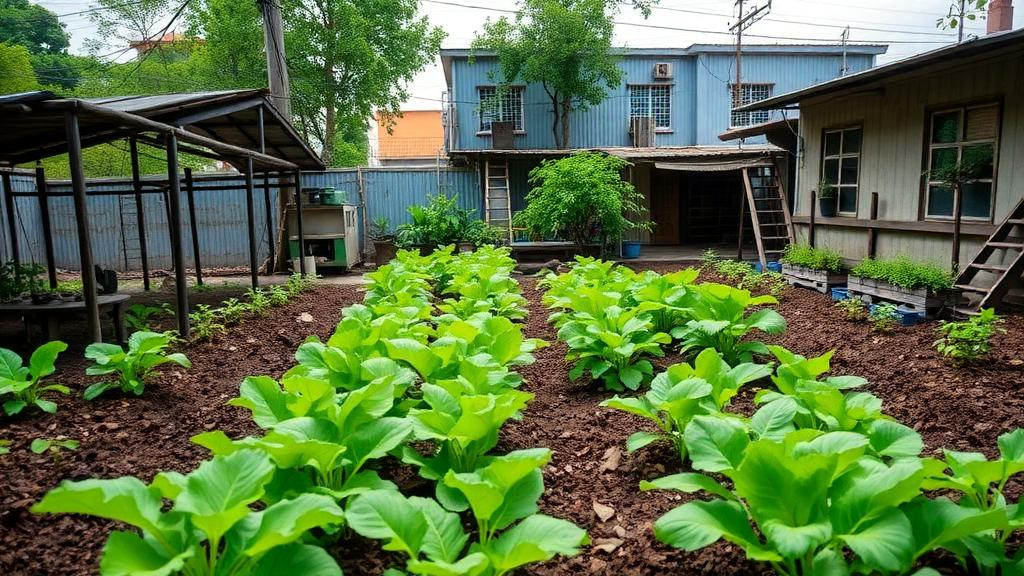
In the fast-growing outskirts of Sylhet, one of Bangladesh’s most rapidly expanding cities, the vegetables that fill local markets may be carrying an invisible cargo of toxic metals. A new study published in the journal Environmental Monitoring and Assessment has found that heavy metal contamination in peri-urban agricultural soils is transferring into commonly eaten vegetables at levels that, in some locations, exceed accepted safety thresholds for long-term consumption. The research, led by Rasendra Talukder of Sylhet Agricultural University together with colleagues from three departments at the same institution, offers one of the most detailed portraits yet of how urbanization and weak waste management are quietly reshaping the food safety landscape of northeastern Bangladesh.
The team set out to answer a deceptively simple question: how much of the cadmium, lead, nickel, zinc, copper, chromium, iron, and manganese found in peri-urban soils around Sylhet ends up in the edible parts of the vegetables grown there, and what does that mean for the people who eat them? To find out, the researchers collected a total of 60 composite soil and vegetable samples from 21 locations surrounding the city during the Rabi season, the dry winter cropping period running from January to March 2024. Sampling during a single, well-defined season helps ensure that the measurements reflect comparable growing and harvesting conditions across all sites, reducing the confounding effects of monsoon-driven dilution or flooding that complicate studies in tropical climates.
Once back in the laboratory, the samples were analyzed using inductively coupled plasma mass spectrometry, or ICP-MS, a technique widely regarded as the gold standard for trace element analysis. The method works by ionizing the sample in an extremely hot plasma torch, typically exceeding temperatures of several thousand degrees Celsius, and then separating and detecting the resulting ions according to their mass-to-charge ratio. This allows scientists to quantify metals at concentrations down to parts per billion or even lower, a level of sensitivity that is essential when dealing with elements like cadmium and lead, which are toxic to humans even at very low doses. The precision of ICP-MS matters here because the entire risk assessment hinges on small differences in concentration between sites and between crop types.
The results revealed a clear hierarchy of contamination. In both the soils and the vegetables, iron and manganese were the predominant metals, which is not unexpected given that both elements are abundant in the Earth’s crust and are natural constituents of most soils. At the opposite end of the spectrum, cadmium and lead occurred at the lowest concentrations. That pattern might sound reassuring, but the study’s most striking findings concern exactly these two scarce but dangerous elements, because their toxicity per unit of exposure is far higher than that of the more abundant metals. Low concentration does not mean low risk when the element in question is cadmium, a metal classified as a human carcinogen and a known cause of kidney damage and bone disease with chronic exposure.
To gauge how effectively each metal moves from soil into plant tissue, the researchers calculated the bioconcentration factor, or BCF, a dimensionless ratio obtained by dividing the concentration of a metal in the vegetable by its concentration in the corresponding soil. A BCF value above 1 means the plant has accumulated more of the metal than is present in the soil it grew in, a red flag for bioaccumulation. In the Sylhet study, cadmium BCF values exceeded 1 at three of the 21 sampling locations, reaching as high as 5.8. In practical terms, that means the vegetables at those sites contained nearly six times the cadmium concentration of their surrounding soil, a signal that something in the local soil chemistry, such as low pH or high organic matter, may be rendering cadmium unusually available for plant uptake. Copper, an essential micronutrient that becomes harmful in excess, showed a BCF greater than 1 at one location as well.
Among the vegetables investigated, brinjal, known internationally as eggplant and botanically as Solanum melongena, showed the highest accumulation capacity. This finding carries particular weight in Bangladesh, where brinjal is one of the most widely consumed and culturally central vegetables, appearing in countless daily dishes. The solanaceous crops, which include eggplant, tomato, and potato, are known from prior research to be relatively efficient at taking up metals from soil, and the Sylhet results are consistent with that broader pattern. For consumers who buy their brinjal from fields on the urban fringe, the study suggests that crop choice itself can meaningfully influence dietary exposure to heavy metals.
The heart of the study lies in its health risk assessment, which translated measured concentrations into estimates of potential harm. Using standard risk assessment frameworks originally developed by the United States Environmental Protection Agency, the researchers computed a hazard index for each vegetable at each site. The hazard index sums the ratios of estimated daily intake to reference doses across all metals, effectively asking whether the combined, additive exposure from a vegetable exceeds the level considered safe for a lifetime of consumption. A hazard index above 1 signals a potential non-carcinogenic health risk, meaning harm that does not involve cancer, such as damage to the kidneys, nervous system, bones, or cardiovascular system from chronic exposure.
The numbers were sobering. Hazard index values across the sampled vegetables and sites ranged from 0.44 to 2.02, and at seven of the 21 sampling sites the index exceeded the safety threshold of 1. The highest values were recorded in cabbage, which reached a hazard index of 2.02, followed by red amaranth at 1.89, with tomato and gourd samples from specific locations also showing elevated values. Red amaranth, a leafy green staple in Bengali cuisine, is particularly prone to accumulating metals in its leaves, and leafy vegetables generally show higher transfer factors than fruiting or root vegetables because of their large above-ground biomass and high transpiration rates. A hazard index of roughly 2 means the estimated combined exposure at that site is about double the safe reference level, a margin that could translate into real health consequences for people who eat locally grown vegetables over many years.
The authors attribute the contamination to a familiar trio of pressures: rapid industrialization, urban expansion, and inadequate waste management in the peri-urban belt around Sylhet city. As cities like Sylhet sprawl outward, agricultural land increasingly abuts workshops, brick kilns, roads, and informal waste dumps, all of which can release metals into soil through atmospheric deposition, contaminated irrigation water, and direct disposal. Previous studies in Bangladesh and neighboring regions have documented similar patterns, from wastewater-irrigated fields near Dhaka to industrial zones in Pakistan and India, but the Sylhet study fills an important gap because information on soil-to-crop metal transfer and associated health risks in this specific, fast-developing region had remained limited until now.
The study’s conclusions point toward two practical imperatives. First, the researchers call for regular heavy metal monitoring in the soils and vegetables of the Sylhet peri-urban area, so that contamination hotspots can be identified before they become entrenched and so that consumers and farmers have accurate information about the food they grow and eat. Second, they emphasize the need for better soil management, which could include measures to alter soil chemistry in ways that reduce metal availability to plants, crop selection strategies that favor low-accumulating species in the most contaminated sites, and stricter controls on the industrial and municipal waste streams that feed the contamination in the first place. For the residents of Sylhet’s urban fringe who depend on locally grown vegetables, the message of the study is not alarm but attention: the risk is cumulative, it is measurable, and with sustained monitoring and improved soil stewardship, it is manageable.
Subject of Research: Heavy metal contamination of peri-urban agricultural soils and vegetables and associated human health risks in Sylhet, Bangladesh
Article Title: Heavy metal contamination in soil and vegetables: a health risk assessment from urban areas of Sylhet, Bangladesh
Article References: Talukder, R., Mandal, P., Shaon, A. H., Tasnim, J., Hur, D., Swarna, S. A., Hamal, H., & Singha, A. (2026). Heavy metal contamination in soil and vegetables: a health risk assessment from urban areas of Sylhet, Bangladesh. Environmental Monitoring and Assessment, 198(11), Article 1168. https://doi.org/10.1007/s10661-026-15996-6
Image Credits: AI Generated
DOI: 10.1007/s10661-026-15996-6
Keywords: heavy metals, soil contamination, vegetables, food safety, health risk assessment, bioconcentration factor, hazard index, cadmium, Sylhet, Bangladesh, urbanization, ICP-MS
Cite Scienmag News
Violet Maxwell. (October 10, 2026). Toxic Metals Lurk in Sylhet’s Urban Vegetable Gardens, Study Warns. Scienmag. https://scienmag.com/toxic-metals-lurk-in-sylhets-urban-vegetable-gardens-study-warns/
Violet Maxwell. "Toxic Metals Lurk in Sylhet’s Urban Vegetable Gardens, Study Warns." Scienmag, 10 October 2026, https://scienmag.com/toxic-metals-lurk-in-sylhets-urban-vegetable-gardens-study-warns/. Accessed 10 October 2026.
Violet Maxwell. "Toxic Metals Lurk in Sylhet’s Urban Vegetable Gardens, Study Warns." Scienmag. October 10, 2026. https://scienmag.com/toxic-metals-lurk-in-sylhets-urban-vegetable-gardens-study-warns/

