


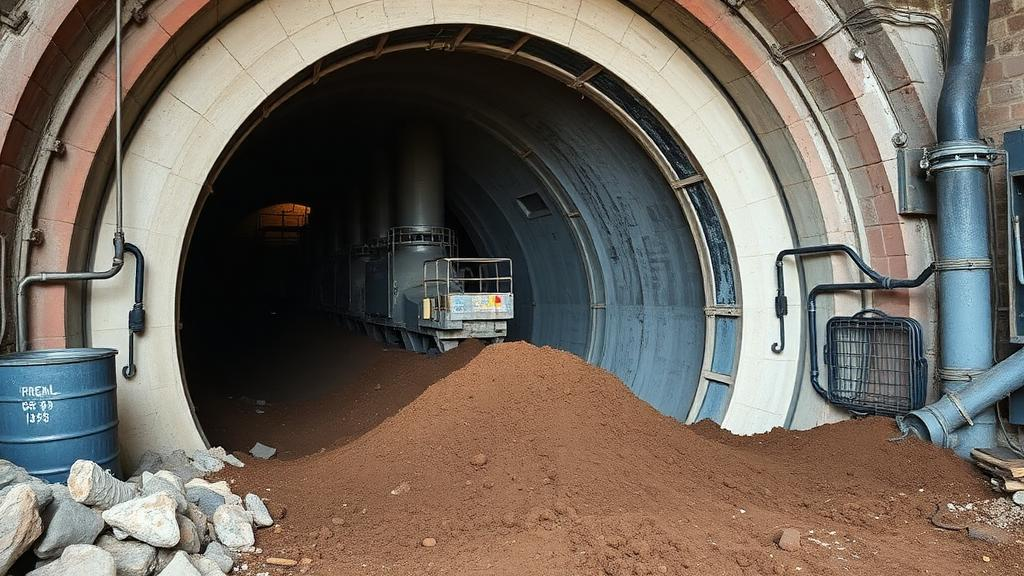
Every year, vast quantities of soil excavated from former industrial sites are classified as hazardous waste because they carry heavy metals such as chromium, lead, arsenic, cadmium, and nickel. Traditional remediation approaches, from soil washing to chemical stabilization, often merely transfer the contamination into a secondary waste stream that still needs to be disposed of somewhere. A new study published in Environmental Science and Pollution Research by Ming Gao of Southeast University and colleagues argues that the answer may already be running at high temperature in one of the world’s most ubiquitous industrial facilities: the cement kiln.
The idea of co-processing contaminated soil in cement manufacturing is not new. Cement clinker, the nodular precursor of Portland cement, is produced at temperatures around 1400 degrees Celsius in rotary kilns, where raw materials rich in calcium, silica, alumina, and iron are partially fused into the crystalline phases that give concrete its strength. Because the kiln is alkaline, hot, and long-lived as a chemical reactor, it can in principle destroy organic pollutants and lock inorganic metals into the clinker matrix itself. What has been missing, according to the researchers, is a precisely defined operating window: how much contaminated soil can be fed into the kiln, and under what temperature and residence time conditions, without degrading clinker quality or allowing metals to escape.
To answer that question, the team combined laboratory-scale calcination experiments with an unusually detailed analytical toolkit. They varied the proportion of heavy metal-contaminated soil blended into the cement raw meal, the calcination temperature, and the residence time, then examined the resulting clinker with microstructural and elemental analyses, X-ray photoelectron spectroscopy, sequential chemical extraction, and standard leaching tests. On top of the experiments, they ran thermodynamic calculations to predict which metal-bearing phases should dominate at equilibrium during calcination, giving the study its phase-resolved character.
The headline finding is a remarkably clean dosage threshold. When contaminated soil made up 7.5 percent of the raw meal, the clinker’s micromorphology and surface elemental distribution showed no obvious changes compared with a control clinker made from conventional raw materials. Even better, the available calcium oxide introduced with the soil helped promote the formation of tricalcium silicate, the C3S phase that is the primary strength-giving mineral in Portland cement. In other words, at this dosage the contaminated soil did not merely coexist with clinker production; it actively participated in it as a usable raw material.
Metal immobilization also improved measurably at that dosage. The solidification rates of chromium, nickel, lead, arsenic, and cadmium in the clinker increased by approximately 6 to 13 percent relative to the control. The thermodynamic calculations added an important nuance: the dosage of contaminated soil had only a limited influence on which metal-bearing phases were predicted to form. This suggests that once the metals enter the high-temperature system, their chemical fate is governed more by the kiln’s bulk chemistry and temperature than by how much contaminated soil is fed in, which is good news for operators who need flexibility in feed rates.
The study’s central practical result is the definition of an operating window. An addition of 7.5 percent contaminated soil, a calcination temperature of 1400 degrees Celsius, and a residence time of 10 minutes delivered effective stabilization of all the metals investigated. Notably, residence time turned out to be a minor factor, while dosage and temperature were the significant variables. That asymmetry matters for real kilns, where material residence in the sintering zone is short and tightly coupled to production throughput; if ten minutes suffices, the process is compatible with normal industrial operation rather than requiring special slow-firing regimes.
One metal behaved differently from the rest. Cadmium, lead, arsenic, and nickel retained stable valence states throughout the process, but chromium underwent valence evolution and ultimately stabilized as trivalent chromium, Cr(III). This is a critical detail for environmental safety, because hexavalent chromium, Cr(VI), is the mobile, toxic, and carcinogenic form of the element that regulators worry about in cement and in leachate. The high-temperature, calcium-rich environment of the kiln effectively drives chromium to its less dangerous trivalent state, where it can be incorporated into the clinker lattice.
Sequential extraction, a technique that chemically separates metals into fractions of increasing mobility, provided perhaps the most convincing evidence of long-term stability. After co-processing, the proportion of metals locked in the residual fraction, the fraction least available to the environment, increased by 45.56 to 123.47 percent relative to the raw contaminated soil. Leaching tests confirmed the picture: the concentrations of all investigated heavy metals released from the processed clinker remained below the applicable standard limits. The metals are not just present in the solid; they are chemically bound in forms that resist release even under aggressive extraction conditions.
The implications extend beyond a single laboratory result. Cement plants already co-process a range of alternative fuels and wastes, from sewage sludge to incinerator fly ash, and previous work has shown that kiln co-processing can outperform conventional cement-based solidification in fixing heavy metals. By establishing a quantitative dosage limit, an optimal temperature, and a mechanistic account of how metals partition into clinker phases, this study gives regulators and plant operators something previous literature lacked: a defensible, risk-controlled recipe. Contaminated soil stops being a liability requiring indefinite storage and becomes a calcium- and silica-bearing feedstock that displaces virgin raw materials.
There are, of course, caveats that the authors and the field will need to address as the approach scales up. The results derive from kiln-relevant laboratory conditions, and full-scale plants must also manage volatile emissions, since some metals can vaporize and recirculate within the kiln system before escaping in exhaust gases or kiln dust. Feedstock heterogeneity in real contaminated sites, chlorine and sulfur cycles, and local air-quality permitting all add complexity. Still, the study defines a practical operating window and provides the mechanistic support needed to treat cement manufacturing as a genuine disposal route for heavy metal-contaminated soil, one that turns one of society’s most stubborn waste problems into the literal foundations of the built environment.
Subject of Research: Immobilization of heavy metals from contaminated soil during cement kiln co-processing
Article Title: Phase‑resolved metal immobilization during co-processing of heavy metal-contaminated soil in cement kilns
Article References: Gao, M., Li, L., Liu, X., Ma, Z., Sun, G., Zhou, Z., Li, B., & Duan, L. (2026). Phase‑resolved metal immobilization during co-processing of heavy metal-contaminated soil in cement kilns. Environmental Science and Pollution Research, 33(28), 14527-14545. https://doi.org/10.1007/s11356-026-38188-8
Image Credits: AI Generated
DOI: 10.1007/s11356-026-38188-8
Keywords: cement kiln, heavy metal-contaminated soil, co-processing, clinker, heavy metal immobilization, leaching, chromium, solidification, thermodynamic calculation, soil remediation, environmental safety, Phase
Cite Scienmag News
Violet Maxwell. (October 10, 2026). Contaminated Soil Locked Inside Cement Kilns at 1400 Degrees. Scienmag. https://scienmag.com/contaminated-soil-locked-inside-cement-kilns-at-1400-degrees/
Violet Maxwell. "Contaminated Soil Locked Inside Cement Kilns at 1400 Degrees." Scienmag, 10 October 2026, https://scienmag.com/contaminated-soil-locked-inside-cement-kilns-at-1400-degrees/. Accessed 10 October 2026.
Violet Maxwell. "Contaminated Soil Locked Inside Cement Kilns at 1400 Degrees." Scienmag. October 10, 2026. https://scienmag.com/contaminated-soil-locked-inside-cement-kilns-at-1400-degrees/


