


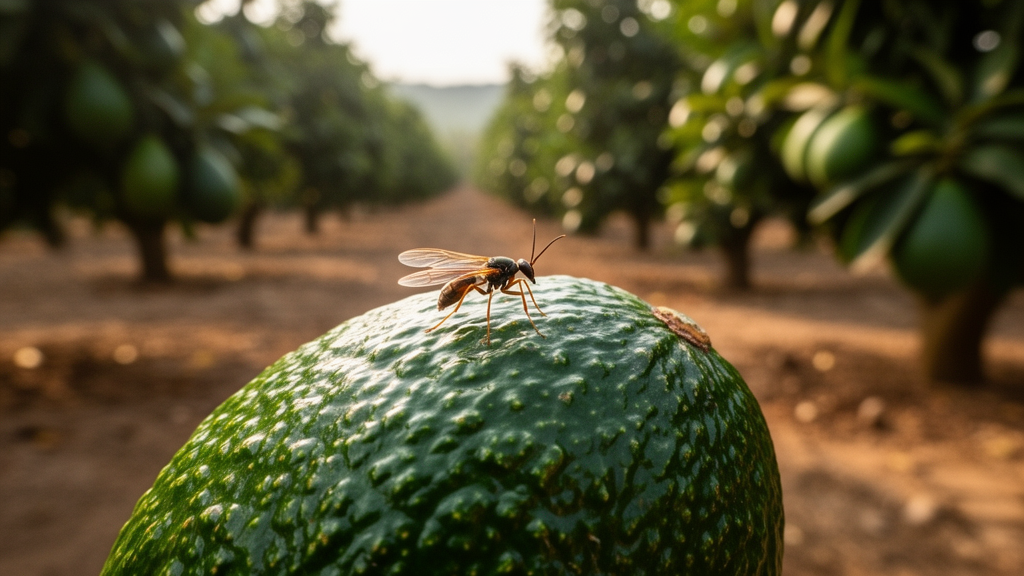
In the avocado orchards of Michoacán, Mexico, a region that anchors much of the world’s avocado supply, a small figitid wasp has quietly emerged from the puparia of a poorly understood fruit fly, offering the first confirmed glimpse of a natural enemy for a pest whose economic footprint may be far larger than anyone realized. The wasp, Lopheucoila mexicana, was recovered in May 2025 from fallen avocado fruits infested with larvae of the lance fly Neosilba batesi, a species long dismissed as a mere secondary colonizer of damaged fruit but now increasingly implicated in premature fruit drop across Mexican avocado groves. The discovery, published in the Journal of Hymenoptera Research, marks the first time scientists have linked this wasp to any host at all, and it documents the males of the species for the very first time.
Neosilba batesi belongs to the Lonchaeidae, a family of some 611 described species spread across ten genera worldwide. Most lance flies are saprophagous, with larvae developing in rotting fruit and decomposing organic matter, but several lineages have made the evolutionary leap to living plant tissue, becoming pests of figs, passion fruit, yellow pitaya, cassava, and pepper. In Colombia, N. batesi has been flagged as a potential avocado pest, and in Michoacán it has been suggested, though without rigorous phytosanitary evaluation, that the fly may account for up to 30% of avocado crop losses. Infestation is betrayed by a reddish ring-shaped discoloration around the fruit’s peduncle or by localized reddish patches on the surface, symptoms tied to accelerated ripening and premature abscission. Despite these warning signs, the fly’s natural enemies have remained almost entirely undocumented, with only a single parasitoid, Lopheucoila anastrephae, previously reported from Costa Rica.
To probe this gap, researchers collected 125 avocado fruits from an orchard in San Francisco Peribán, Michoacán, at 1,446 meters above sea level, walking systematically through the grove to gather fallen fruit known to harbor dipteran larvae. Each fruit was placed in a 500-milliliter plastic cup lined with a thin layer of vermiculite, a standardized pupation substrate, and transported to the laboratory. From these fruits, 1,933 puparia of N. batesi were recovered. Within 24 hours of pupation, each puparium was transferred individually into a cylindrical well of a 24-well tissue culture plate, a procedure that allowed researchers to unambiguously associate any emerging wasp with its host. The puparia were maintained at roughly 23.5 degrees Celsius, 50% relative humidity, and a 12:12 hour light-dark photoperiod, and monitored daily until either adult flies or parasitoids emerged.
Species identity was confirmed through both morphology and molecular barcoding. Adult male flies were identified based on genitalia characters, and COI gene sequences from three individuals showed near-complete similarity to N. batesi sequences from Veracruz, Mexico, with identity values of 99.78%, 99.35%, and 99.78%. The emerging wasps were keyed to the genus Lopheucoila using established morphological characters, including a 13-segmented female antenna with glabrous, dorsoventrally flattened flagellomeres, a complete mesoscutal keel broadened anteriorly, and a scutellar disc bearing large radially arranged areolae with distinct lateral and posterior projections. Comparison with reference specimens held at the Museo de La Plata in Argentina, previously matched against the female holotype deposited at Texas A&M University, confirmed the species as L. mexicana.
The distinction between L. mexicana and its only congener, L. anastrephae, rests on a precise combination of characters. L. mexicana has an arcuate mesonotum, a conspicuous and complete mesoscutal keel throughout its length, and a lateral syntergum posterior to the setal band lacking a strigose dorsoventral impression. In L. anastrephae, the mesonotum is more strongly arcuate, the keel is inconspicuous in the distal third, and the syntergum bears a strigose impression. Crucially, the study also describes the males of L. mexicana for the first time. These males resemble the females but carry 15-segmented antennae with a modified first flagellomere that is longer than the second, outwardly curved, and laterally excavated, and their metasoma forms an abrupt 90-degree angle between the syntergum and the remaining terga. Only a handful of females had been known since the species was originally described in 1951, making this male description a significant addition to understanding the species’ reproductive biology.
Of the 1,933 puparia recovered, 1,521 produced adult flies, split almost evenly between 762 females and 759 males. The remaining 412 puparia yielded 91 parasitoid adults, 58 females and 33 males, giving a field parasitism rate of 4.7%. Emergence followed a distinctive temporal pattern: 42 wasps emerged between 37 and 43 days after the infested fruits were collected, with daily counts of 4, 2, 5, 3, 7, 10, and 11. Day 44 brought the peak, with 20 wasps emerging in a single day. Thereafter, emergence declined, with 7, 10, 4, 5, and 1 wasps emerging on days 45 through 49 respectively. Two additional parasitoids were recovered through dissection of puparia that lacked emergence holes after 60 days. The sex ratio was notably female-biased, with females comprising 63.73% of the emerged population.
From a biogeographic standpoint, the record is striking. L. mexicana had been reported only from Córdoba in Veracruz, Mexico, and from La Gran Piedra in Cuba, each based on a single female specimen with no host association. The Michoacán collection site lies roughly 600 kilometers from Córdoba, making this the second confirmed record of the species in Mexico and the first anywhere to establish a host link. This is particularly remarkable because species of the tribe Zaeucoilini, to which L. mexicana belongs, are known primarily to parasitize leafminer flies of the family Agromyzidae. The new record suggests that the typical host family of Lopheucoila may actually be Lonchaeidae, with the tephritid hosts of L. anastrephae representing an exception to the general rule that each eucoiline genus is associated with a single host family.
Biologically, the parasitoid is a solitary larval-pupal koinobiont endoparasitoid, consistent with all eucoiline species whose biology is sufficiently documented. The egg-to-adult developmental period could not be measured directly because the timing of oviposition on host larvae was unknown, but an approximate duration of 45 to 49 days was inferred from the emergence pattern. This estimate should be interpreted with caution given the modest sample size and the indirect nature of the measurement. Comparative data from related species highlight the influence of environmental conditions on developmental rates: Aganaspis daci completes development in 33 days at 25 degrees Celsius, Leptopilina boulardi in 20 days, and Zaeucoila unicarinata in 21 days, differences attributable to species-specific traits, host quality, and temperature.
The 4.7% parasitism rate is modest compared with other eucoilines used or considered as biological control agents. Aganaspis daci parasitizes Mediterranean fruit fly at rates of 14 to 23% under laboratory conditions and up to 71% in field-collected fruits, while Leptopilina japonica reaches 44 to 48% on spotted wing drosophila larvae in summer. However, such variation is strongly shaped by host density, fruit type, and season, and the low rate observed here may reflect specific ecological conditions rather than intrinsic limitations of the parasitoid. The female-biased sex ratio could reflect favorable host conditions or adaptive sex allocation strategies as predicted by local mate competition theory, though comparable species show wide variation depending on fruit type, season, and host species.
The discovery carries real applied weight. Even moderate parasitism by L. mexicana can contribute to natural suppression of N. batesi populations, particularly when combined with other mortality factors, and the identification of a native parasitoid associated with this fly is especially relevant given mounting concern over its impact on avocado production. A preliminary attempt to rear the wasp in the laboratory using third-instar N. batesi larvae was unsuccessful due to low parasitism rates, underscoring the challenge of identifying the ecological and physiological factors that govern successful parasitism, including host stage preference, oviposition behavior, adult nutrition, and microhabitat conditions. Sampling was restricted to a single location and time point, and developmental estimates remain indirect, but the groundwork is now laid for controlled life-table experiments and broader surveys across the Neotropics. As avocado groves expand and lance fly pressure intensifies, this tiny wasp may prove to be a far more important player in the agroecosystem than its obscure taxonomic history ever suggested.
Subject of Research: First confirmed host record of the parasitoid wasp Lopheucoila mexicana attacking the lance fly Neosilba batesi in avocado orchards
Article Title: Morphological identification and biological observations of Lopheucoila mexicana ( Hymenoptera , Figitidae , Eucoilinae ), a parasitoid of Neosilba batesi ( Diptera , Lonchaeidae ) in avocado
Article References: Hipólito-López, S., Camacho-Tapia, M., Gallardo, F. E., Smagghe, G., Morales-Galván, O., Martínez-Castillo, A. M., & Pineda-Guillermo, S. (2026). Morphological identification and biological observations of Lopheucoila mexicana (Hymenoptera, Figitidae, Eucoilinae), a parasitoid of Neosilba batesi (Diptera, Lonchaeidae) in avocado. Journal of Hymenoptera Research, 99, 1095-1107. https://doi.org/10.3897/jhr.99.195208
Image Credits: AI Generated
Keywords: Lopheucoila mexicana, Neosilba batesi, avocado, parasitoid wasp, Figitidae, Eucoilinae, biological control, Michoacán, lance fly, host-parasitoid association, Morphological, identification
Cite Scienmag News
Alan Morgan. (October 15, 2026). Tiny wasp from Michoacán avocado orchards emerges as first known enemy of lance fly pest. Scienmag. https://scienmag.com/tiny-wasp-from-michoacan-avocado-orchards-emerges-as-first-known-enemy-of-lance-fly-pest/
Alan Morgan. "Tiny wasp from Michoacán avocado orchards emerges as first known enemy of lance fly pest." Scienmag, 15 October 2026, https://scienmag.com/tiny-wasp-from-michoacan-avocado-orchards-emerges-as-first-known-enemy-of-lance-fly-pest/. Accessed 15 October 2026.
Alan Morgan. "Tiny wasp from Michoacán avocado orchards emerges as first known enemy of lance fly pest." Scienmag. October 15, 2026. https://scienmag.com/tiny-wasp-from-michoacan-avocado-orchards-emerges-as-first-known-enemy-of-lance-fly-pest/


