


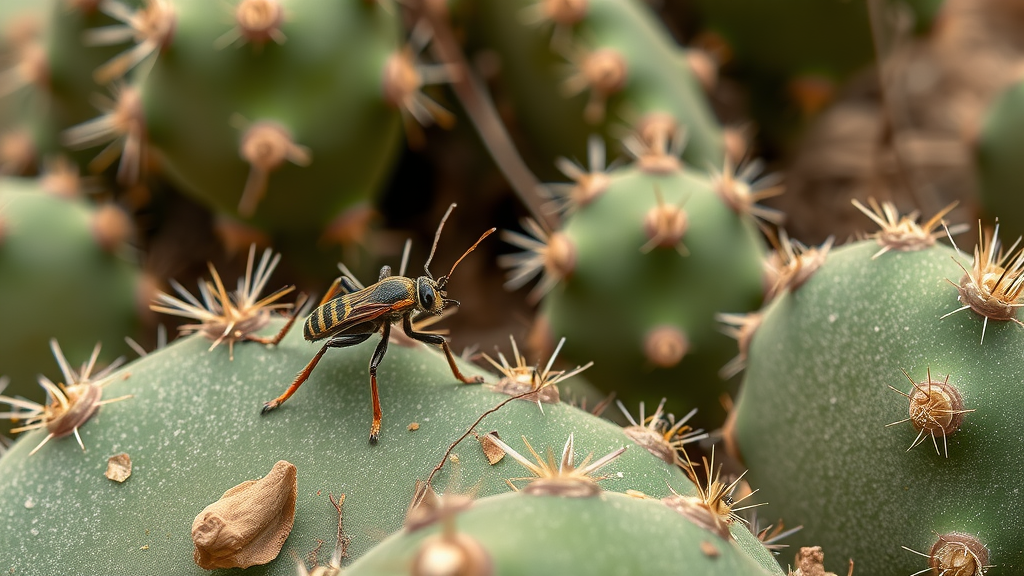
A devastating biological invasion is unfolding across the semi-arid highlands of northern Ethiopia, and its consequences reach far beyond the farms it has ruined. The carmine cochineal insect (Dactylopius coccus Costa), a sap-sucking scale insect deliberately introduced to Tigray in the mid-2000s for dye production, has destroyed more than 96,000 hectares of cactus pear (Opuntia ficus-indica), a plant that local communities call the crop that never abandons them. A new study published in BMC Environmental Science quantifies, for the first time at regional scale, how this single pest outbreak has unraveled food security, degraded soils, undermined carbon storage, and cost the region an estimated USD 1.08 billion every year.
The research team, led by scientists at Adigrat University, combined a PRISMA-informed systematic review of 59 peer-reviewed and institutional sources with extensive primary fieldwork. Between 2021 and 2024, the researchers carried out 42 key informant interviews and 12 focus group discussions across six districts and 80 villages in the Eastern Zone of Tigray, supplementing these with participatory rural appraisal exercises, transect walks, community mapping, and soil analyses. This triangulated design, the authors emphasize, was chosen deliberately: because no baseline measurements of cactus biomass or stand structure existed before the invasion, the team prioritized converging lines of evidence over over-confident single estimates, and they flag all numerical results as indicative extrapolations rather than precise measurements.
The historical record uncovered by the study reads as a cautionary tale of institutional failure. Cochineal was intentionally introduced between 2004 and 2007 at three sites near Mekelle, Wajarat, and Mehoni, with the goal of producing carminic acid, a valuable crimson dye. The experimental project was abruptly abandoned, however, without post-release monitoring, containment measures, or technical support to farmers. Infested cladodes were distributed across multiple districts, and the insect, which has no natural predators in the region and a high reproductive rate, spread unchecked. Community members in Raya Azebo could reconstruct the pest’s arrival years before it appeared in official reports, suggesting formal surveillance underestimated the true rate of expansion from the very beginning.
The numbers chart an accelerating catastrophe. By 2015, roughly 16,000 hectares were infested; the figure nearly doubled to 31,184 hectares within a single year, reached 75,570 hectares by 2018, and climbed to about 91,000 hectares by 2020, with cumulative damage now exceeding 96,000 hectares. In the southern and southeastern zones of Tigray, cactus pear production has collapsed entirely. Notably, the eastern zone had managed to contain the pest to just 2,676 hectares, about 5.7 percent of its cactus cover, through coordinated cultural, mechanical, and chemical control. That progress was undone when the Tigray war erupted in late 2020: community mobilization, monitoring, and control programs collapsed amid displacement and institutional destruction, and by May 2024 the infested area in the eastern zone had nearly doubled to 5,239 hectares, surpassing 11 percent of the zone’s cactus coverage.
The ecological stakes are considerable because cactus pear functions as a keystone dryland species. Using Crassulacean Acid Metabolism (CAM) photosynthesis, the plant opens its stomata at night to absorb carbon dioxide, dramatically reducing water loss and allowing it to thrive on degraded, saline, and drought-prone land where conventional crops fail. Under favorable conditions it can sequester up to 30 tons of CO2 per hectare per year, and literature values suggest roughly 12,500 kilograms of carbon stored per hectare. Extrapolating across the destroyed area yields an estimated 1.2 million tons of carbon whose sequestration capacity has been compromised, though the authors caution that, given the absence of baseline biomass data in wild stands, such figures should be read as indicative of foregone capacity rather than verified emissions.
The soil evidence is more concrete. Laboratory analyses showed that soils beneath cactus canopies hold substantially more organic carbon (2.48 percent versus 1.82 percent), organic matter (5.45 percent versus 3.23 percent), and total nitrogen (0.25 percent versus 0.19 percent) than adjacent open ground, with available phosphorus reaching 161 ppm compared with just 22 ppm. Canopy soils were also moister (9.49 percent versus 6.74 percent) and less compacted (bulk density of 1.28 versus 1.46 g/cm3). In effect, each cactus stand acted as a nutrient island, stabilizing slopes, dampening runoff, and sheltering understory vegetation. Farmers interviewed for the study described the aftermath bluntly: after the cactus died, the land began to erode away even with small rains. Field observations confirm increased gully formation, topsoil loss, reduced infiltration, and expanding barren patches across affected hillsides.
The loss has rippled through biodiversity as well. Residents reported declines in bird species that once nested on cactus branches and in small mammals that depended on cactus fruits, alongside the disappearance of the protective microenvironments that had allowed native shrubs and grasses to persist. Yet the study also documents unexpected glimmers of recovery: in places such as Shilen in the Maichew-Mekhoni corridor, previously suppressed indigenous woody and herbaceous species have begun to regenerate where cactus died back, suggesting that with active restoration, cochineal-driven mortality could open ecological niches for native vegetation to reclaim degraded land.
The socio-economic toll has been severe. Before the outbreak, cactus pear provided three to five months of household food security annually, along with drought fodder worth 20 to 30 tons of fresh cladodes per hectare, seasonal cash income averaging roughly USD 11,272 per hectare under good management, and informal employment in harvesting and marketing for landless youth, many of them women. The study estimates annual fruit production losses of about 84,985 tons across the region, with cladode losses of roughly 1.9 to 2.9 million tons per year regionally. Combining production losses with degraded ecosystem services, the researchers calculate total economic damages of approximately USD 1.082 billion annually, a figure informants considered conservative. Focus groups described longer hunger seasons, rising livestock mortality, increased labor migration from districts such as Atsbi, Hawzien, and Irob, and the breakdown of traditional coping mechanisms that had relied on cactus reserves as drought insurance.
Current control efforts remain fragmented and largely inadequate. Communities have resorted to labor-intensive measures such as manually removing and burning infested cladodes, selective pruning, and coordinated clean-ups, but these approaches falter once infestations become severe. Chemical control has been tried only sporadically and suffers from high costs and environmental concerns, while biological control agents that have proven effective elsewhere remain untested under Tigray’s arid conditions. The authors identify weak quarantine enforcement, absent post-release monitoring, poor inter-institutional coordination, and limited funding as the systemic gaps that allowed the invasion to flourish and that now hamper its containment.
The study’s recommendations are direct: implement integrated pest management with rigorously evaluated biological control options, restore cactus pear using resistant varieties, strengthen enforceable quarantine and surveillance systems, embed community-based monitoring in extension services, and fold restoration into broader climate adaptation strategies. The researchers also call for long-term monitoring, remote sensing, and field-based biomass assessments to replace today’s uncertain extrapolations with defensible carbon and impact estimates. As the authors conclude, the Tigray cochineal crisis is not merely a pest problem but a demonstration of how ecological, climatic, and institutional fragilities interact, and how the collapse of coordinated governance, whether through abandoned projects or armed conflict, can convert a well-intentioned introduction into a regional environmental and humanitarian emergency.
Subject of Research: Ecological and socio-economic impacts of cochineal insect infestation on cactus pear ecosystems in Tigray, Northern Ethiopia
Article Title: Environmental degradation and climate implications of cochineal (dactylopius coccus Costa) infestation on cactus pear: a case study from Tigray, Northern Ethiopia
Article References: Gebrekidan, T. K., Gebreziher, H. G., Kahsay, H. T., Weldemariam, N. G., Berhane, E., & Gebrekidan, E. W. (2026). Environmental degradation and climate implications of cochineal (dactylopius coccus Costa) infestation on cactus pear: a case study from Tigray, Northern Ethiopia. BMC Environmental Science, 3(1), Article 16. https://doi.org/10.1186/s44329-026-00054-w
Image Credits: AI Generated
DOI: 10.1186/s44329-026-00054-w
Keywords: Dactylopius coccus, cochineal, cactus pear, Opuntia ficus-indica, Tigray, Ethiopia, invasive species, carbon sequestration, soil degradation, food security, integrated pest management, dryland ecosystems
Cite Scienmag News
Gavin Prescott. (September 12, 2026). Tiny Insect Has Wiped Out Nearly 100,000 Hectares of Ethiopia’s Lifesaving Cactus. Scienmag. https://scienmag.com/tiny-insect-has-wiped-out-nearly-100000-hectares-of-ethiopias-lifesaving-cactus/
Gavin Prescott. "Tiny Insect Has Wiped Out Nearly 100,000 Hectares of Ethiopia’s Lifesaving Cactus." Scienmag, 12 September 2026, https://scienmag.com/tiny-insect-has-wiped-out-nearly-100000-hectares-of-ethiopias-lifesaving-cactus/. Accessed 4 October 2026.
Gavin Prescott. "Tiny Insect Has Wiped Out Nearly 100,000 Hectares of Ethiopia’s Lifesaving Cactus." Scienmag. September 12, 2026. https://scienmag.com/tiny-insect-has-wiped-out-nearly-100000-hectares-of-ethiopias-lifesaving-cactus/


