

Thursday, September 3, 2026
Science
No Result
View All Result
  • Login
  • HOME
  • SCIENCE NEWS
  • CONTACT US
  • HOME
  • SCIENCE NEWS
  • CONTACT US
No Result
View All Result
Scienmag
No Result
View All Result
Home Science News Chemistry

Tiny Infrared Chip Boosts Gas and Heat Detection Capabilities

July 14, 2026
in Chemistry
Bethany Barker
By Bethany Barker Scienmag Editorial Profile - Catalysis
Reading Time: 2 mins read
0
Tiny Infrared Chip Boosts Gas and Heat Detection Capabilities

Tiny Infrared Chip Boosts Gas and Heat Detection Capabilities

65
SHARES
587
VIEWS
Share on FacebookShare on Twitter
ADVERTISEMENT

Infrared cameras can reveal clues the human eye misses—such as gas leaks, chemical signatures in the atmosphere, and heat escaping from buildings. Yet turning those infrared signals into crisp, targeted images typically demands optics that are either bulky or slow to reconfigure.

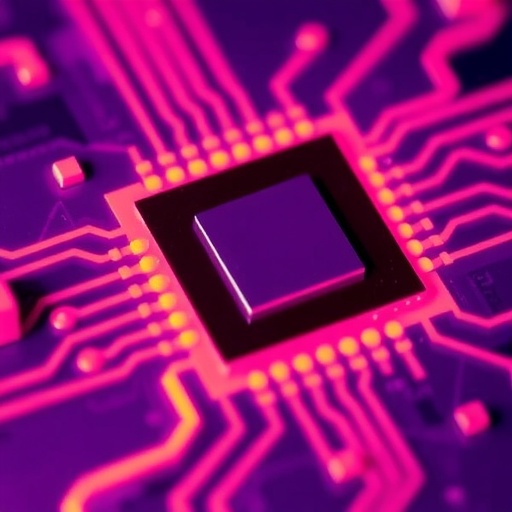
MIT researchers report a chip-based optical component that can dynamically shape incoming infrared light, effectively acting as a tunable lens without moving parts. The device is made of many microscopic pixels, each capable of controlling how it interacts with infrared radiation.

The approach targets mid-infrared wavelengths, a spectral region especially valuable for detecting molecular fingerprints from common gases and organics. Because different materials absorb mid-infrared light differently, a programmable lens can help a camera emphasize specific spectral or spatial features instead of treating the scene as one fixed imaging problem.

What’s new is the pixel-level control. Prior active “metasurface” systems often adjust focus globally or require complex wiring that grows impractical at large pixel counts. Here, the team uses a crossbar-style architecture derived from display technologies, enabling independent tuning across a two-dimensional pixel array.

Under the hood, the design stacks copper wire layers in perpendicular directions. Where the wires cross, doped silicon generates heat. That heat toggles a phase-change material between crystalline and amorphous states, shifting how each pixel modifies the infrared wavefront. A built-in diode selector helps suppress unintended electrical leakage between neighboring pixels.

By integrating the components into a semiconductor-process-friendly layout, the researchers argue the design can scale far beyond a lab prototype. They fabricated a 6-by-6 metasurface pixel array using foundry-compatible methods and verified that individual pixels switch reliably.

Durability matters for real-world imaging and sensing, so the team emphasized robust switching—aiming for many repeated operations rather than a one-time demonstration. Their lab results suggest the architecture can withstand the cycling needed for practical deployment.

Potential applications span compact thermal imaging, chemical sensing, pollution monitoring, and even optical computing concepts where light itself performs parts of neural-network-like inference. The work appears in Nature Communications, with an accompanying DOI listed for the published paper.

Keywords

Subject of Research: Chemistry

Article Title: Tiny Infrared Chip Boosts Gas and Heat Detection Capabilities

Article References: Original research article

Image Credits: AI Generated

DOI: Not provided

Keywords: infrared imaging, metasurface, tunable lens, mid-infrared, phase-change materials, pixel-level control, optical sensing, crossbar architecture, spatial light modulator, chip-scale optics

Cite Scienmag News

Bethany Barker. (July 14, 2026). Tiny Infrared Chip Boosts Gas and Heat Detection Capabilities. Scienmag. https://scienmag.com/tiny-infrared-chip-boosts-gas-and-heat-detection-capabilities/

Bethany Barker. "Tiny Infrared Chip Boosts Gas and Heat Detection Capabilities." Scienmag, 14 July 2026, https://scienmag.com/tiny-infrared-chip-boosts-gas-and-heat-detection-capabilities/. Accessed 3 September 2026.

Bethany Barker. "Tiny Infrared Chip Boosts Gas and Heat Detection Capabilities." Scienmag. July 14, 2026. https://scienmag.com/tiny-infrared-chip-boosts-gas-and-heat-detection-capabilities/


Tags: adaptive tunable infrared lenschip-based optical components for gas detectioncrossbar architecture for infrared devicesdynamic infrared imaging systemsgas and chemical signature detection with infrared camerasheat and gas leak detection using infrared camerasinfrared imaging technologymicroscopic pixel infrared light modulationmid-infrared wavelength sensorsphase-change materials in infrared sensorspixel-level control in infrared opticsprogrammable metasurface for infrared light control
Share26Tweet16
Previous Post

Karen Bernstein Elected Chair of C-Path Board, Influential Biotech Voice

Next Post

Immune Ecotypes Could Account for Multiple Myeloma Outcomes Beyond Staging

Related Posts

Layered double hydroxides in sustained antibiotic delivery: a bibliometric review
Chemistry

Layered double hydroxides in sustained antibiotic delivery: a bibliometric review

September 3, 2026
Catalysts Turn Biorefinery Waste Into Tomorrow’s Fertilisers
Chemistry

Catalysts Turn Biorefinery Waste Into Tomorrow’s Fertilisers

September 3, 2026
Yeast strains differ in dough gas cell stability and bread crumb structure
Chemistry

Yeast strains differ in dough gas cell stability and bread crumb structure

September 3, 2026
Waste Palm Seed Extract Yields Powerful Supercapacitor Electrode Material
Chemistry

Waste Palm Seed Extract Yields Powerful Supercapacitor Electrode Material

September 3, 2026
Benzophenone-Grafted Acrylic Adhesives Quadruple Shear Strength Through Post-Polymerization Modification
Chemistry

Benzophenone-Grafted Acrylic Adhesives Quadruple Shear Strength Through Post-Polymerization Modification

September 3, 2026
Acacia Gum and Bentonite Give Starch Bioplastics a Major Strength Boost
Chemistry

Acacia Gum and Bentonite Give Starch Bioplastics a Major Strength Boost

September 3, 2026
Next Post
Immune Ecotypes Could Account for Multiple Myeloma Outcomes Beyond Staging

Immune Ecotypes Could Account for Multiple Myeloma Outcomes Beyond Staging

  • Mothers who receive childcare support from maternal grandparents show more optimized

    Mothers who receive childcare support from maternal grandparents show more parental warmth, finds NTU Singapore study

    27656 shares
    Share 11059 Tweet 6912
  • University of Seville Breaks 120-Year-Old Mystery, Revises a Key Einstein Concept

    1061 shares
    Share 424 Tweet 265
  • Bee body mass, pathogens and local climate influence heat tolerance

    682 shares
    Share 273 Tweet 171
  • Researchers record first-ever images and data of a shark experiencing a boat strike

    546 shares
    Share 218 Tweet 137
  • Groundbreaking Clinical Trial Reveals Lubiprostone Enhances Kidney Function

    531 shares
    Share 212 Tweet 133
Science

Embark on a thrilling journey of discovery with Scienmag.com—your ultimate source for cutting-edge breakthroughs. Immerse yourself in a world where curiosity knows no limits and tomorrow’s possibilities become today’s reality!

RECENT NEWS

  • Physical activity may protect the heart by easing depression, study suggests
  • Phone-Based Support Shows Promise for Caregivers After Pediatric Mental Health Crises
  • Objective and Subjective Measures Differ in Rating Older Adults’ Well-Being
  • Climate Change Drives New Models for Assessing Aquifer Vulnerability Worldwide

Categories

  • Agriculture
  • Anthropology
  • Archaeology
  • Athmospheric
  • Biology
  • Biotechnology
  • Blog
  • Bussines
  • Cancer
  • Chemistry
  • Climate
  • Earth Science
  • Editorial Policy
  • Marine
  • Mathematics
  • Medicine
  • Pediatry
  • Policy
  • Psychology & Psychiatry
  • Science Education
  • Social Science
  • Space
  • Technology and Engineering

Subscribe to Blog via Email

Enter your email address to subscribe to this blog and receive notifications of new posts by email.

Join 5,151 other subscribers

© 2025 Scienmag - Science Magazine

Welcome Back!

Login to your account below

Forgotten Password?

Retrieve your password

Please enter your username or email address to reset your password.

Log In
No Result
View All Result
  • HOME
  • SCIENCE NEWS
  • CONTACT US

© 2025 Scienmag - Science Magazine

Discover more from Science

Subscribe now to keep reading and get access to the full archive.

Continue reading