


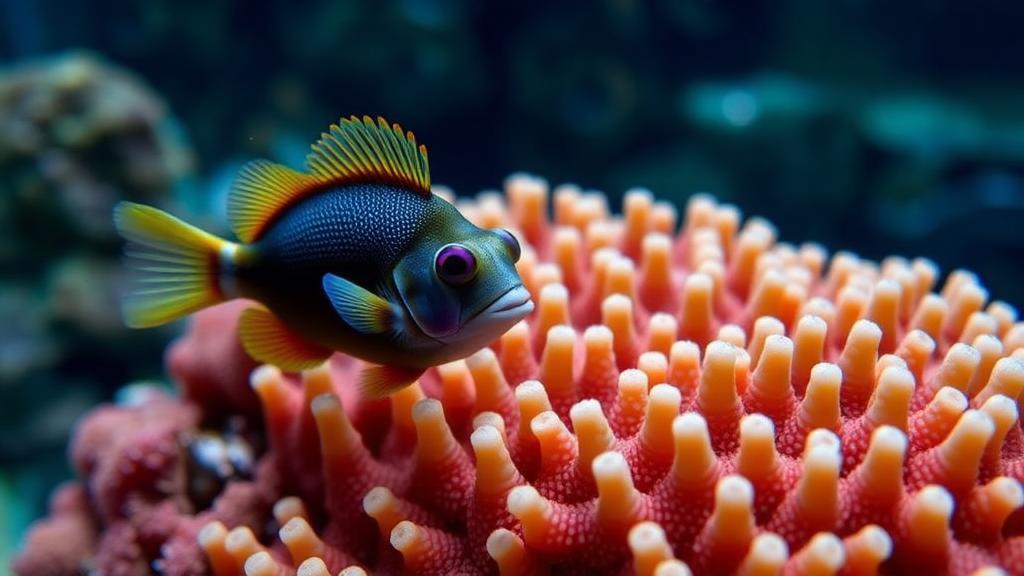
On the shallow backreef lagoons of Ningaloo Reef in Western Australia, small, territorial damselfish spend their entire lives hovering among the branches of staghorn corals. They defend their host colonies, dart between the branches at night, and fertilize the surrounding water with their waste. A new study published in the journal Coral Reefs reveals that these constant fish tenants leave a measurable imprint on the microscopic ecosystem living inside their coral hosts, and that the effect depends strikingly on which coral species the fish choose to occupy.
The research, led by Teresa Bednarek of the University of Western Australia and the Australian Institute of Marine Science, focused on two closely related corymbose corals, Acropora millepora and Acropora digitifera. Corals are not solitary organisms but holobionts, integrated ecological units comprising the animal host, its photosynthetic dinoflagellate symbionts of the family Symbiodiniaceae, and a diverse community of bacteria, archaea and fungi. The algal partners supply the bulk of the coral’s energy through photosynthesis, while the bacterial associates contribute to nutrient cycling, immune function and metabolite exchange. Understanding how external partners such as resident fish perturb this internal ecosystem is a frontier in coral biology, particularly as reefs face intensifying thermal stress.
In May 2023, the team sampled 155 healthy adult colonies across two sites near Coral Bay, at depths of two to five metres. Before collecting tissue, divers conducted visual censuses of every damselfish swimming between the branches or hovering immediately above each colony, recording species, abundance and estimated body length. Five damselfish species were documented, including Dascyllus reticulatus, Dascyllus aruanus, Dascyllus trimaculatus, Pomacentrus moluccensis and Pomacentrus coelestis. Branch tips were snapped from the centre of each colony, flash-frozen in liquid nitrogen and later processed for symbiont cell counts, chlorophyll quantification and DNA extraction from the intact coral fragment, skeleton included.
The molecular work relied on amplicon sequencing of two genetic markers. The internal transcribed spacer 2 region, or ITS2, was used to characterise the Symbiodiniaceae communities, while the V5-V6 hypervariable regions of the 16S rRNA gene profiled the bacterial and archaeal assemblages. Sequences were denoised into amplicon sequence variants using the DADA2 pipeline, taxonomy was assigned against the SILVA and GeoSymbio reference databases, and the LULU algorithm was applied to curate the highly variable ITS2 variants. Statistical models then tested whether damselfish presence, abundance or biomass explained variation in symbiont density, pigmentation and community composition, while controlling for colony size and sampling site.
The first major finding was that host identity, not fish residency, is the dominant force shaping the holobiont. A. millepora carried roughly twice the symbiont cell density of A. digitifera, at 2.36 million cells per square centimetre versus 1.25 million. Chlorophyll a per symbiont cell was similar between species, but A. digitifera packed significantly more of the accessory pigment chlorophyll c2 into each algal cell, suggesting a distinct light-harvesting strategy that extends absorption into spectral ranges where chlorophyll a performs poorly. Because chlorophyll c2 is among the first pigments lost during thermal stress, this baseline difference could influence how each species approaches bleaching thresholds.
Both corals were dominated by symbionts of the genus Cladocopium, yet at finer resolution their assemblages diverged sharply. A. millepora hosted predominantly the C21 type, which averaged 91.67 percent of its symbiont community, while A. digitifera was dominated by C3k at 85.23 percent. Bacterial communities told a parallel story. Both species were overwhelmingly dominated by members of the family Endozoicomonadaceae, bacteria often regarded as markers of coral health, but the specific strains differed. A. millepora harboured a richer and more even bacterial community, with Endozoicomonadaceae comprising 83.48 percent of its microbiome, whereas A. digitifera’s community was more narrowly concentrated, with the family accounting for 95.27 percent. Coral species alone explained nearly a quarter of the variation in bacterial community composition across all colonies.
The damselfish themselves were not evenly distributed. A. millepora colonies hosted significantly more fish than A. digitifera, averaging 11 individuals per occupied colony compared with 6, although total fish biomass was similar between the two coral species. The assemblage composition also differed, with D. reticulatus dominating on A. millepora at 73 percent of recorded individuals, while D. aruanus and P. moluccensis were proportionally more common on A. digitifera. In total, 573 damselfish were counted on A. millepora colonies and 168 on A. digitifera, underscoring how strongly fish settlement preferences track coral architecture and species identity.
When the researchers tested whether fish occupancy altered the algal symbionts, the answer was largely no. Symbiont density, chlorophyll a content and overall symbiont community composition remained essentially unaffected by damselfish presence, abundance or biomass in both coral species. The one exception was chlorophyll c2 per cell, which responded in opposite directions: increasing fish numbers were associated with higher chlorophyll c2 in A. digitifera but lower chlorophyll c2 in A. millepora. The authors suggest this divergence may reflect photoacclimation to improved light availability, as damselfish remove sediment and algae from their host colonies, or nutrient-stimulated pigment production, with the direction of the response shaped by the different symbiont types each coral harbours.
The bacterial communities, by contrast, told a more nuanced story. In A. millepora, colonies hosting damselfish showed significantly lower Shannon diversity, and both diversity and evenness declined steadily as the number of resident fish increased. Remarkably, the interspecies gap in bacterial diversity that distinguished A. millepora from A. digitifera in fish-free colonies disappeared entirely in fish-occupied ones, as though the damselfish pulled A. millepora’s microbiome down to levels comparable with its neighbour. Crucially, bacterial richness was unaffected, meaning the fish did not eliminate taxa but rather shifted their relative abundances, allowing certain bacteria to dominate. Damselfish-occupied colonies also showed significantly lower community heterogeneity, a pattern that contrasts with the erratic, high-variability microbiomes typically associated with dysbiosis under stress.
The authors propose that fish-derived nutrients, primarily ammonium and phosphate excreted directly onto the colony, act as a consistent selective pressure favouring particular bacterial taxa, while the physical agitation of water within the branches and direct microbial transfer via contact or waste deposition may further reshape the local microbial environment. Notably, Terasakiellaceae, a bacterial family associated with nitrogen fixation in coral tissue, was weakly enriched in fish-occupied A. millepora colonies, consistent with nutrient-enriched conditions. In A. digitifera, where fish were fewer and the assemblage composition differed, bacterial communities remained essentially untouched, and the authors caution that host morphology or the species’ inherently lower bacterial diversity may also contribute to its apparent resistance.
The study offers an initial snapshot rather than a definitive causal account, and the authors are explicit about its limits. The observations were made under non-stressful autumn conditions, and whether the damselfish-associated microbial shifts confer resilience benefits under thermal stress remains a critical open question. Long-term monitoring would clarify whether these community changes persist as fish populations turn over through recruitment and mortality, and experimental manipulations using clonal coral genotypes would help isolate mechanisms from the variability inherent in observational work. Still, the message is clear: the coral holobiont is not an isolated system, and the animals that live in and around a colony are active participants in its microbial architecture. For reef conservation and restoration programmes, the implication is that transplant success may depend not only on choosing the right coral species but on understanding the fish tenants that come with it.
Subject of Research: Species-specific effects of resident damselfish on the coral holobiont microbiome of Acropora corals
Article Title: Resident damselfish influence the coral holobiont: species-specific responses in Acropora millepora and Acropora digitifera
Article References: Bednarek, T., Brooker, R. M., Martin, B. C., Gleeson, D. B., & Thomas, L. (2026). Resident damselfish influence the coral holobiont: species-specific responses in Acropora millepora and Acropora digitifera. Coral Reefs. https://doi.org/10.1007/s00338-026-02938-4
Image Credits: AI Generated
DOI: 10.1007/s00338-026-02938-4
Keywords: coral holobiont, damselfish, Acropora millepora, Acropora digitifera, Symbiodiniaceae, Cladocopium, Endozoicomonadaceae, microbiome, Ningaloo Reef, coral reefs, symbiosis, 16S rRNA sequencing
Cite Scienmag News
Morgan Morrow. (September 30, 2026). Tiny Damselfish Reshape the Microbial World Inside Reef-Building Corals. Scienmag. https://scienmag.com/tiny-damselfish-reshape-the-microbial-world-inside-reef-building-corals/
Morgan Morrow. "Tiny Damselfish Reshape the Microbial World Inside Reef-Building Corals." Scienmag, 30 September 2026, https://scienmag.com/tiny-damselfish-reshape-the-microbial-world-inside-reef-building-corals/. Accessed 4 October 2026.
Morgan Morrow. "Tiny Damselfish Reshape the Microbial World Inside Reef-Building Corals." Scienmag. September 30, 2026. https://scienmag.com/tiny-damselfish-reshape-the-microbial-world-inside-reef-building-corals/


