


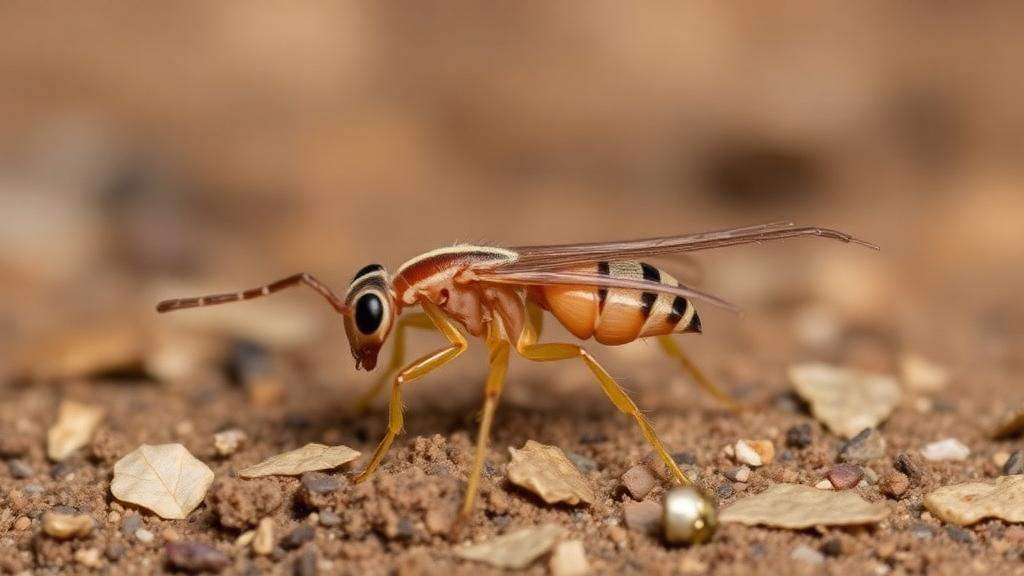
Deep beneath rotting logs and stones in the forests around Tbilisi, entomologists have uncovered a hidden lodger that most people will never see. The common ant cricket, Myrmecophilus acervorum, a minute insect barely a few millimetres long, has been recorded in Georgia for the first time, extending the known range of one of Europe’s most elusive orthopterans into the southern Caucasus ecoregion. The discovery, published in the journal Caucasiana by researchers working with Ilia State University’s Institute of Ecology, adds a new country record to the region’s insect inventory and sheds fresh light on the strange lives of crickets that spend their existence inside ant nests.
Ant crickets of the genus Myrmecophilus are among the most unusual members of the grasshopper and cricket order. Almost cosmopolitan in distribution, the genus currently comprises 63 species worldwide, of which 10 are known from Europe. These tiny, wingless insects are myrmecophilous, meaning they live in close association with ants, and in most cases they do so as kleptoparasites. Rather than building their own nests or foraging in the open, they slip into the brood chambers of ant colonies and there they feed opportunistically, often begging or stealing food from their hosts, whose formidable jaws would make short work of almost any other intruder. The details of how they evade eviction remain a subject of fascination, involving chemical camouflage and tactile mimicry that persuades the ants to tolerate, and sometimes even groom, their uninvited guests.
Until this study, the Caucasus region was known to host only a single species of ant cricket. Myrmecophilus hirticaudus, described by Fischer von Waldheim in 1846, had been reported from Armenia, from Russia, and most recently from Georgia itself, on the steep southern slopes of the Kura River valley. The second regional species, M. acervorum, had been recorded only from neighbouring Armenia. The new finding therefore doubles the number of ant cricket species known from Georgia and confirms suspicions that the region’s myrmecophilous fauna is richer than historical records suggest.
The fieldwork that led to the discovery was carried out in 2021 by the entomological team of Ilia State University’s Institute of Ecology within the framework of the Caucasus Barcode of Life Project, or CaBOL, an ambitious initiative to catalogue and DNA-barcoded the biodiversity of the Caucasus. The researchers methodically searched for ant colonies by turning stones and logs across a range of habitats. Whenever a Myrmecophilus specimen was spotted, it was caught and preserved in 96 percent ethanol for later morphological examination. Voucher material is now kept at the CaBOL collection repository at Ilia State University, ensuring that the records can be verified by future researchers.
The historic specimen, an adult female of M. acervorum, was collected on 21 September 2021 at Didgori in the Tbilisi region, at an altitude of 835 metres above sea level. Remarkably, the cricket was found under a rotting log in leaf litter within a deciduous forest dominated by oriental hornbeam, Carpinus orientalis, with no traces of ants nearby. This detail is intriguing for a species so intimately tied to ant nests, and it may indicate that the female was wandering between colonies, dispersing, or sheltering temporarily away from its hosts. Documentation of the find followed rigorous protocols: photographs of live and preserved specimens were taken with a Canon EOS 550D camera equipped with a 100 millimetre macro lens and a Raynox close-up attachment, and the resulting images were combined using focus-stacking software to produce razor-sharp figures that capture even the finest bristles and spines.
Distinguishing M. acervorum from its congener M. hirticaudus requires careful attention to subtle anatomical details, and the researchers applied the identification criteria described by Stalling and Birrer in 2013. Adults and older nymphs of M. acervorum are dark reddish-brown, with a pale ochreous posterior border on the pronotum and mesonotum, whereas M. hirticaudus shows a uniform brown body colour. Even more diagnostic are the dorsal spines on the metatarsus. M. acervorum carries two dorsal spines in the proximal and medial positions, while M. hirticaudus typically bears three, positioned in the proximal, medial and distal parts of the metatarsus, although the medial spine is occasionally absent; the proximal spine, however, is always present in M. hirticaudus. Such minute differences, invisible to the naked eye in the field, underpin the entire taxonomy of the group.
Beyond the new country record, the study amassed substantial additional data on the distribution of M. hirticaudus in Georgia, showing that the species is far more widespread than previously known. Specimens were collected at Didgori, including an adult male found in March 2021 in a nest of the ant genus Lasius under a stone, and further individuals turned up at Gori in Shida Kartli, at Telovani, at Kumisi in Kvemo Kartli on the bank of the Nagubi River, and at Ijareti in Samtskhe-Javakheti, where a female was found under a rock by Lake Triala at an altitude of 1,752 metres. The recorded elevations span from roughly 500 to nearly 1,800 metres, revealing that these crickets tolerate a striking range of mountain habitats across the Caucasus foothills and highlands.
Perhaps the most curious record in the entire dataset, however, concerns neither ants nor a new locality. In March 2017, one of the authors personally observed an individual of M. hirticaudus in the Armazi gorge in Mtskheta-Mtianeti, at 742 metres above sea level, inside a nest of the termite species Reticulitermes lucifugus, on the rocky slopes of the gorge. Associations between M. hirticaudus and this termite are not entirely without precedent: when Mařan described M. termitophilus in 1959, he noted the same association, and that species was later shown to be a junior synonym of M. hirticaudus. Yet almost nothing else is known about this relationship, and the authors stress that whether Reticulitermes lucifugus is a true host of the ant cricket, or whether the crickets were simply present by accident, remains an open question. If the association is genuine, it would suggest a flexibility in host use that challenges the assumption that these insects are strict ant associates.
The wider significance of the study lies in what it reveals about the state of biodiversity knowledge in the Caucasus, one of the world’s recognized biodiversity hotspots. Given that both M. acervorum and M. hirticaudus occur in adjacent Armenia and Russia, the researchers conclude that both species are likely to be more widespread in Georgia than current records indicate, and that many more populations await discovery. The find also underscores the value of targeted, unglamorous fieldwork: finding an animal the size of a grain of rice requires patiently overturning stones and logs, often in cold months when the crickets shelter deep within their hosts’ nests. Programs such as CaBOL, which combine classical morphology with modern DNA barcoding, are precisely the tools needed to close such gaps.
For now, the common ant cricket can officially be added to the fauna of Georgia, a small but telling addition to the country’s natural heritage. The next step will be to learn more about the species’ ecology in the region: which ant species serve as hosts, how frequently the crickets are found away from nests, and whether the termite association at Armazi represents a genuine alternative lifestyle or a one-off accident. In a region where mountains and valleys have shaped isolated pockets of biodiversity for millions of years, even the smallest inhabitants still have surprises in store for the scientists willing to look under the right stone.
Subject of Research: First record of the ant cricket Myrmecophilus acervorum in Georgia and updated distribution data for Myrmecophilus hirticaudus in the Caucasus
Article Title: The Common Ant Cricket Myrmecophilus acervorum (Panzer, [1799]), new to the fauna of Georgia, southern Caucasus ecoregion ( Orthoptera : Myrmecophilidae ), with additional data on Myrmecophilus hirticaudus Fischer von Waldheim, 1846
Article References: Stalling, T., & Seropian, A. (2022). The Common Ant Cricket Myrmecophilus acervorum (Panzer, [1799]), new to the fauna of Georgia, southern Caucasus ecoregion (Orthoptera: Myrmecophilidae), with additional data on Myrmecophilus hirticaudus Fischer von Waldheim, 1846. Caucasiana, 1, 21-23. https://doi.org/10.3897/caucasiana.1.e87210
Image Credits: AI Generated
DOI: 10.3897/caucasiana.1.e87210
Keywords: ant crickets, Myrmecophilus acervorum, Myrmecophilus hirticaudus, Georgia, Caucasus, kleptoparasitism, myrmecophily, Orthoptera, biodiversity, CaBOL, Tbilisi, Reticulitermes lucifugus
Cite Scienmag News
Gavin Prescott. (October 19, 2026). Tiny Ant Cricket Species Recorded in Georgia for the First Time. Scienmag. https://scienmag.com/tiny-ant-cricket-species-recorded-in-georgia-for-the-first-time/
Gavin Prescott. "Tiny Ant Cricket Species Recorded in Georgia for the First Time." Scienmag, 19 October 2026, https://scienmag.com/tiny-ant-cricket-species-recorded-in-georgia-for-the-first-time/. Accessed 19 October 2026.
Gavin Prescott. "Tiny Ant Cricket Species Recorded in Georgia for the First Time." Scienmag. October 19, 2026. https://scienmag.com/tiny-ant-cricket-species-recorded-in-georgia-for-the-first-time/


