

Friday, September 4, 2026
Science
No Result
View All Result
  • Login
  • HOME
  • SCIENCE NEWS
  • CONTACT US
  • HOME
  • SCIENCE NEWS
  • CONTACT US
No Result
View All Result
Scienmag
No Result
View All Result
Home Science News Agriculture

Through a new NASA grant, interdisciplinary team to measure nitrogen released from agriculture sources

April 18, 2024
in Agriculture
Alan Morgan
By Alan Morgan Scienmag Editorial Profile - Precision Agriculture
Reading Time: 3 mins read
0
Through a new NASA grant, interdisciplinary team to measure nitrogen
73
SHARES
666
VIEWS
Share on FacebookShare on Twitter
ADVERTISEMENT

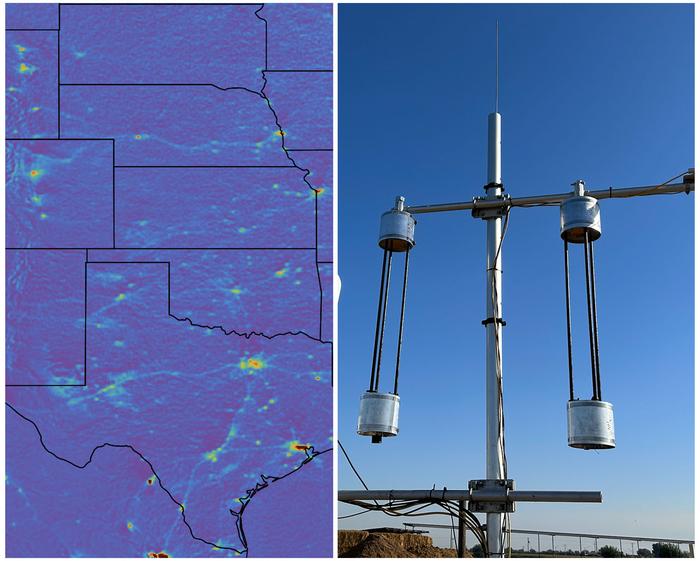
As researchers continue to understand the effects agriculture plays in climate and environment, a new research project was recently funded by the NASA Interdisciplinary Research in Earth Science (IDS) program, which includes experienced researchers from four institutions. The new project has for the first time made it possible to show the impact two nitrogen fluxes — ammonia (NH3) and nitric oxide/nitrogen dioxide (NOx) — have on agricultural productivity and air quality.

NOx-NH3 model measurements

Credit: Kang Sun/Mark Zondlo

As researchers continue to understand the effects agriculture plays in climate and environment, a new research project was recently funded by the NASA Interdisciplinary Research in Earth Science (IDS) program, which includes experienced researchers from four institutions. The new project has for the first time made it possible to show the impact two nitrogen fluxes — ammonia (NH3) and nitric oxide/nitrogen dioxide (NOx) — have on agricultural productivity and air quality.

The study led by Kaiyu Guan, Director of the Agroecosystem Sustainability Center at the University of Illinois Urbana-Champaign (UIUC), will integrate satellite remote sensing, strategic field work from commercial farmland in Central Illinois, and ecosystem biochemistry modeling to quantify these nitrogen emissions from agriculture across the U.S. Midwest. The goal is to quantify the magnitude of NOX and NH3 from these fields to the atmosphere. Being able to use approaches from both in situ measurements and satellite data in biochemical modeling will help corroborate the measurements of each.

The three-year interdisciplinary project brings together atmospheric scientists Mark Zondlo from Princeton University and Kang Sun from the University at Buffalo; ecosystem scientists  Steven Hall from the University of Wisconsin-Madison and Wendy Yang from UIUC; and agroecosystem modelers Guan and Bin Peng from UIUC.

Sun’s team will examine the latest NASA satellite data to understand how to develop new methods to estimate the emissions of these two trace gasses. Zondlo will use state-of-the-art, fast flux sensors to make continuous flux measurements of NOX and NH3 and also targeted measurements on a mobile laboratory to bridge the field and satellite scales. Hall and Yang, both field-level measurement experts, will measure NOX at the field level. Guan and Peng will take these measurements and develop the final model.

“It is exciting to work with a team on a project that bridges across vastly different scales and synthesizes across measurement and modeling. This approach is critically needed to advance our understanding of the patterns of agricultural emissions.”  Zondlo commented. 

Ultimately, the goal is to provide improved guidance to farmers on future use of nitrogen fertilizer and alleviation of nitrogen emissions from agricultural practices to improve air quality in agricultural dominated landscapes.

“This is a very unique NASA IDS project,” Guan explained. “We want to take advantage of satellite-based observation, in-situ data, as well as biochemical models to holistically understand the nitrogen cycle. This information has previously been hard to gather.”


Subject of Research: Agriculture

Article Title: Through a new NASA grant, interdisciplinary team to measure nitrogen released from agriculture sources

Article References: Original research article

Image Credits: AI Generated

DOI: Not provided

Keywords: Not provided

Cite Scienmag News

Alan Morgan. (April 18, 2024). Through a new NASA grant, interdisciplinary team to measure nitrogen released from agriculture sources. Scienmag. https://scienmag.com/through-a-new-nasa-grant-interdisciplinary-team-to-measure-nitrogen-released-from-agriculture-sources/

Alan Morgan. "Through a new NASA grant, interdisciplinary team to measure nitrogen released from agriculture sources." Scienmag, 18 April 2024, https://scienmag.com/through-a-new-nasa-grant-interdisciplinary-team-to-measure-nitrogen-released-from-agriculture-sources/. Accessed 4 September 2026.

Alan Morgan. "Through a new NASA grant, interdisciplinary team to measure nitrogen released from agriculture sources." Scienmag. April 18, 2024. https://scienmag.com/through-a-new-nasa-grant-interdisciplinary-team-to-measure-nitrogen-released-from-agriculture-sources/

Share29Tweet18
Previous Post

Occupations that are cognitively stimulating may be protective against later-life dementia

Next Post

Coal train pollution increases health risks and disparities

Related Posts

Invasive plant growth shaped by soil microbes and local leaf inputs
Agriculture

Invasive plant growth shaped by soil microbes and local leaf inputs

September 4, 2026
Scientists uncover genes controlling grain yield in harsh growing conditions
Agriculture

Scientists uncover genes controlling grain yield in harsh growing conditions

September 3, 2026
BraABCB transporter genes shed light on hormone responses in Chinese flowering cabbage
Agriculture

BraABCB transporter genes shed light on hormone responses in Chinese flowering cabbage

September 3, 2026
Dietary Polyphenols Modulate NF-κB Signaling in Inflammation-Driven Diseases Including Cancer
Agriculture

Dietary Polyphenols Modulate NF-κB Signaling in Inflammation-Driven Diseases Including Cancer

September 3, 2026
Infrared Thermometry Reveals Water Stress in Medicinal Plants Before the Eye Can See
Agriculture

Infrared Thermometry Reveals Water Stress in Medicinal Plants Before the Eye Can See

September 3, 2026
FIMBRIN2 Drives ABA-Induced Stomatal Closure via Actin Remodeling in Guard Cells
Agriculture

FIMBRIN2 Drives ABA-Induced Stomatal Closure via Actin Remodeling in Guard Cells

September 3, 2026
Next Post
Coal train pollution increases health risks and disparities

Coal train pollution increases health risks and disparities

  • Mothers who receive childcare support from maternal grandparents show more optimized

    Mothers who receive childcare support from maternal grandparents show more parental warmth, finds NTU Singapore study

    27656 shares
    Share 11059 Tweet 6912
  • University of Seville Breaks 120-Year-Old Mystery, Revises a Key Einstein Concept

    1061 shares
    Share 424 Tweet 265
  • Bee body mass, pathogens and local climate influence heat tolerance

    682 shares
    Share 273 Tweet 171
  • Researchers record first-ever images and data of a shark experiencing a boat strike

    546 shares
    Share 218 Tweet 137
  • Groundbreaking Clinical Trial Reveals Lubiprostone Enhances Kidney Function

    531 shares
    Share 212 Tweet 133
Science

Embark on a thrilling journey of discovery with Scienmag.com—your ultimate source for cutting-edge breakthroughs. Immerse yourself in a world where curiosity knows no limits and tomorrow’s possibilities become today’s reality!

RECENT NEWS

  • Physical Activity Tied to Better Physical Reasoning in Young and Older Adults
  • Previewing distractors shapes how alerting affects conflict in attention tasks
  • Rural Upbringing Linked to Childhood Mental Health Outcomes in Australia
  • Zebra finches restructure scrambled songs, revealing universal linguistic laws

Categories

  • Agriculture
  • Anthropology
  • Archaeology
  • Athmospheric
  • Biology
  • Biotechnology
  • Blog
  • Bussines
  • Cancer
  • Chemistry
  • Climate
  • Earth Science
  • Editorial Policy
  • Marine
  • Mathematics
  • Medicine
  • Pediatry
  • Policy
  • Psychology & Psychiatry
  • Science Education
  • Social Science
  • Space
  • Technology and Engineering

Subscribe to Blog via Email

Enter your email address to subscribe to this blog and receive notifications of new posts by email.

Join 5,151 other subscribers

© 2025 Scienmag - Science Magazine

Welcome Back!

Login to your account below

Forgotten Password?

Retrieve your password

Please enter your username or email address to reset your password.

Log In
No Result
View All Result
  • HOME
  • SCIENCE NEWS
  • CONTACT US

© 2025 Scienmag - Science Magazine

Discover more from Science

Subscribe now to keep reading and get access to the full archive.

Continue reading