The Arctic is one of the most connected-disconnected places on Earth: shipping lanes, fishing fleets, climate sensors, unmanned underwater vehicles and military installations all crisscross an ocean that geostationary satellites simply cannot see. Geostationary coverage stops at roughly 75 to 78 degrees north, and the mega-constellations that blanket the rest of the planet come at a price that smaller nations struggle to pay. Now a team of Norwegian engineers has proposed a strikingly economical alternative: an elliptical medium Earth orbit system with just three satellites, paired with a compact, digitally steered five-panel antenna that could give ships and fixed sites across the Nordic and Arctic region continuous, secure connectivity. The study, published in Frontiers in Antennas and Propagation, argues that the combination could deliver everything from 9.6 kbit/s voice-grade links on handheld VHF terminals to 1024 kbit/s data links at S-band, all with a link margin of 4 to 5 dB.
The driving insight behind the proposal is that the number of satellites needed for continuous coverage scales dramatically with orbital altitude and eccentricity. The authors, Terje Røste and Odd Gutteberg of the Norwegian University of Science and Technology and Hans Christian Haugli of Space Norway, calculated that a low Earth orbit constellation at altitudes between 800 and 1100 km would need between 21 and 30 satellites spread across three orbital planes to keep the Arctic covered down to 58 degrees north. A circular medium Earth orbit would still require six satellites in two planes. By contrast, an elliptical medium Earth orbit, or eMEO, with an eccentricity of 0.3 and an inclination of 63.4 degrees, achieves the same circumpolar coverage with only three satellites in a single plane, launched together on one common rocket.
The orbital geometry is carefully chosen. The argument of perigee is set to 270 degrees, which hangs the apogee over the northern hemisphere and gives the satellites long dwell times over the Arctic. The inclination of 63.4 degrees is the so-called critical inclination, which minimizes the fuel needed for orbital control by preventing the argument of perigee from drifting. The orbital period is one-sixth of a sidereal day, roughly 240 minutes, with the three satellites equally separated in time at true anomalies of 0, 144.3 and 215.7 degrees. The equatorial altitude of the orbit is 5260 km, which places it squarely in the safe zone between the inner and outer Van Allen radiation belts, protecting the spacecraft electronics and extending operational lifetime. The authors estimate that the eMEO satellites would endure about 11.4 years of temperature and battery charging cycles, more than twice the roughly 5-year lifetime of a comparable LEO satellite, meaning that a 10-year mission would need just three spacecraft instead of the 50 that a LEO system would consume through replacement.
The trade-off is physics: the longer path to a medium Earth orbit satellite means more free-space loss and more signal delay than a LEO link. Simulations of the orbit show that the distance from a site at Lindesnes, at the southern rim of coverage in Norway, varies between 8900 and 14600 km, a difference of 5700 km that translates into a delay variation of about 19 milliseconds and a free-space loss difference of 4.3 dB. The mean elevation angle to the best satellite is 39.1 degrees at Kirkenes in northern Norway and 38.4 degrees at Nuuk in Greenland, but only about 25 degrees at Lindesnes, where the minimum elevation drops to just 2 degrees. The authors used these simulated distributions of elevation and azimuth, sampled every 30 seconds over 24 hours and binned into 206 elevation-azimuth grids, as the statistical foundation for the entire antenna and link performance analysis.
That analysis leads to two very different terminal antennas for two very different frequency bands. At VHF, with an uplink at 200 MHz and a downlink at 300 MHz, electronically steered arrays are simply impractical: half a wavelength is 0.5 to 0.75 meters, so an array with useful gain would be unacceptably large. The solution is an omnidirectional antenna, simulated as a vertically polarized dipole 540 mm long with a peak gain of 2.1 dBi. A handheld VHF terminal with such an antenna achieves a link budget supporting 9.6 kbit/s with QPSK modulation and half-rate coding, sufficient for voice and low-rate telemetry from buoys, ice sensors and personnel on the ice shelf.
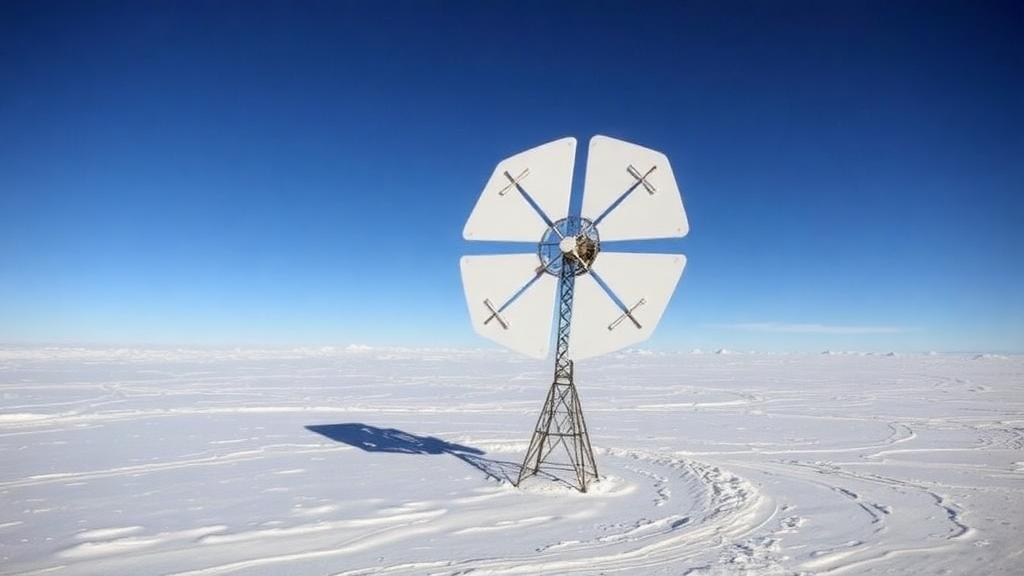
At S-band, around 2 GHz, the picture changes completely, and this is where the study’s most viral idea lives: a five-panel frustum antenna, a truncated pyramid with a flat top panel and four trapezoidal side panels, each carrying a 20 by 20 cm array of four antenna elements. The geometry is optimized so that the side face angle is 41 degrees, giving a maximum scan angle of 41 degrees for the side panels and a maximum scan loss of only 1.2 dB. Because the panels face different directions, the antenna can see satellites at any azimuth from 0 to 360 degrees and any elevation from 0 to 90 degrees without mechanical movement. In the basic concept, only the single most favorable panel is active at any moment, and the total gain, combining element gain, array gain and losses, is estimated at 9 to 12 dBi in practical implementation.
The advanced concept is where the digital revolution in radio-frequency integrated circuits pays off. Modern RF sampling chips, such as the Texas Instruments AFE7950, can digitize radio signals directly at radio frequency, handling four antenna elements per chip with high-speed converters. This makes it feasible to co-phase and digitally combine the signals from three to five panels simultaneously, rather than switching between them. When a satellite sits at an azimuth along one of the frustum’s vertices at an elevation of 41 degrees, three panels see nearly equal scan angles, and combining them yields an area gain of 3.5 dB over a single panel. When the satellite is directly overhead, the top panel sees zero scan loss while each side panel contributes with a cosine factor of 0.76, and adding all five panels boosts receive and transmit power by 6.05 dB, pushing the maximum composite gain to 17.2 dBi. With no need for panel handover, the link never breaks, and the terminal can perform seamless satellite handover as one satellite sets and another rises.
For a ship at sea, the antenna must also survive the ocean. The authors analyzed the worst case of a 10-degree tilt in any azimuth direction, consistent with international maritime radar performance standards, using linear algebra to compute the scan angle to every panel of the rotated frustum. At an elevation angle of 10 degrees with the worst-case tilt, the scan angle to the most favorable panel reaches 61.5 degrees, corresponding to a scan gain of minus 3.2 dB, but the multipanel geometry keeps the link alive where a single flat panel would fail. The analysis of area gain across all 206 elevation-azimuth grids shows excellent robustness up to the 10-degree tilt, with reduced performance only at the lowest elevations.
Propagation through the Arctic atmosphere and over the open sea adds its own challenges. Ionospheric scintillations, rapid fluctuations caused by solar-driven ionization, are modeled using the Nakagami distribution with a coherence time of 1 to 10 seconds, and the authors allocate 1 dB of margin at VHF and 0.5 dB at S-band, noting that the Arctic scintillation zone shows fading of about 2 dB peak-to-peak at 1.5 GHz in solar maximum years. At VHF, specular reflection from a calm sea at low elevation angles can produce deep fades, as much as 11 dB at a 7-degree elevation angle, which forward error correction alone cannot mitigate when fades last seconds. Circular polarization helps here, because vertical polarization is suppressed in sea reflections. At S-band, sea scattering is far less severe, and diffraction loss from the round Earth only becomes significant below the system’s minimum elevation angle.
The comprehensive link budgets tie it all together. A handheld VHF terminal on land achieves 9.6 kbit/s with a margin of 4.3 dB on the downlink and 4.8 dB on the uplink. A ship terminal with an omnidirectional S-band antenna achieves 128 kbit/s with a margin of 4.1 dB, while the same terminal with the frustum-configured four-element phased array achieves 1024 kbit/s with a margin of 5.2 dB on the downlink. These margins absorb interference, distance variation and the uncertainties of ionospheric physics. The authors conclude that the eMEO system with three satellites, combined with modern digital phased-array technology, offers the Nordic countries a realistic path to sovereign, affordable Arctic communications, covering maritime activity, climate surveillance, IoT sensing, iceberg tracking and navigation backup when GPS and its rivals are jammed, all without the crushing cost of a mega-constellation.
Subject of Research: Satellite Communications
Article Title: User terminals with multipaneled phased arrays and omnidirectional antennas applied in an elliptical medium Earth orbit satellite communication system for the Arctic
Article References: User terminals with multipaneled phased arrays and omnidirectional antennas applied in an elliptical medium Earth orbit satellite communication system for the Arctic. (n.d.). https://doi.org/10.3389/fanpr.2026.1764792
Image Credits: AI Generated
DOI: 10.3389/fanpr.2026.1764792
Keywords: satellite communications, phased arrays, Arctic, medium Earth orbit, antenna design, propagation, link budget, maritime communications, User, terminals, multipaneled, phased
Cite Scienmag News
Kristina Jarvis. (October 16, 2026). Three Satellites and a Five-Panel Antenna Could Give the Arctic Its Own Secure Communication Network. Scienmag. https://scienmag.com/three-satellites-and-a-five-panel-antenna-could-give-the-arctic-its-own-secure-communication-network/
Kristina Jarvis. "Three Satellites and a Five-Panel Antenna Could Give the Arctic Its Own Secure Communication Network." Scienmag, 16 October 2026, https://scienmag.com/three-satellites-and-a-five-panel-antenna-could-give-the-arctic-its-own-secure-communication-network/. Accessed 16 October 2026.
Kristina Jarvis. "Three Satellites and a Five-Panel Antenna Could Give the Arctic Its Own Secure Communication Network." Scienmag. October 16, 2026. https://scienmag.com/three-satellites-and-a-five-panel-antenna-could-give-the-arctic-its-own-secure-communication-network/