


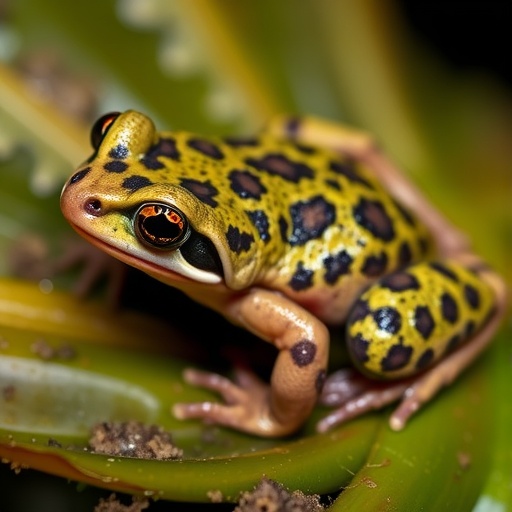
In a groundbreaking discovery that challenges the conventional understanding of amphibian reproduction, an international team of scientists has identified three new species of tree-dwelling toads in Africa capable of bypassing the classical tadpole stage entirely. These enigmatic toads, belonging to the genus Nectophrynoides, have evolved an extraordinary reproductive strategy: the females give birth to fully formed, miniature toads instead of laying eggs that hatch into swimming larvae. This remarkable form of viviparity places them among an exclusive group of amphibians capable of internal fertilization and live birth, a rarity in the animal kingdom and virtually unprecedented among frogs.
For decades, biology textbooks have emphasized the egg-to-tadpole-to-froglet metamorphosis as the definitive lifecycle of amphibians; however, the reality is far more diverse. Approximately 8,000 frog species demonstrate a myriad of reproductive modes, many straying from the classical narrative. The newly documented Nectophrynoides species exemplify this diversity in a striking fashion. Situated in Tanzania’s Eastern Arc Mountains, these tree toads have adapted to reproduce away from aquatic environments, thus circumventing the vulnerabilities associated with water-dependent embryos and larvae.
The genus Nectophrynoides has long fascinated herpetologists due to its unusual reproductive traits, but the recent integrative taxonomic work leverages both traditional morphology and cutting-edge museomics to peel back layers of hidden biodiversity. Using DNA extracted from century-old museum specimens housed in the Museum für Naturkunde in Berlin, the researchers deployed advanced sequencing techniques to link historical collections with live populations found in fragmented forest habitats. This innovative combination of museomics and field research sheds new light on the evolutionary pathways that have allowed these toads to develop internal fertilization and bear live young.
Viviparity in amphibians is an extreme evolutionary adaptation seen in less than 1% of all frog species worldwide, predominantly documented in only a few taxa from South America and Southeast Asia. The discovery of three additional viviparous species in Africa significantly broadens the known geographic and phylogenetic scope of this reproductive mode. These tree toads’ reproductive strategy not only illustrates an alternative method of amphibian development but also poses intriguing questions regarding the selective pressures and genetic mechanisms underlying this rare form of life history.
From a phylogenetic standpoint, the researchers highlight the importance of integrating molecular data with morphological examination of thousands of preserved specimens from multiple natural history museums. This integrative approach enabled the discernment of subtle morphological differences previously masked within the genus’ complex diversity. By scrutinizing traits through microscopy and genetics, the team was able to confidently describe three distinct species new to science—underscoring the power of combining traditional taxonomy with modern molecular techniques.
This discovery holds profound implications beyond theoretical biology. The Eastern Arc Mountains, the natural habitat of these toads, constitute a globally recognized biodiversity hotspot known for high levels of species endemism but are concurrently subjected to intense anthropogenic threats including deforestation, mining concessions, and climate change impacts. Fragmentation and degradation of these forest ecosystems jeopardize the survival of these rare viviparous toads, rendering them critically vulnerable. The ongoing habitat loss calls for urgent conservation interventions informed by robust species delimitation and distribution mapping.
Among the urgency of conservation concerns, it is worth noting that several members of this genus are already enduring severe population declines. Nectophrynoides asperginis, once native to Tanzanian forests and famously bred in captivity to prevent extinction, is now extinct in the wild. Another species, Nectophrynoides poyntoni, has not been observed since its initial discovery two decades ago, illustrating a precarious existence for these amphibians. The recent taxonomic resolution helps highlight conservation priorities by identifying previously unrecognized species deserving protection.
The evolutionary mechanisms driving viviparity in these toads remain an area of active research. The internal fertilization and gestation processes imply complex physiological adaptations allowing the female’s body to nourish developing embryos until birth. These adaptations might involve specialized oviduct secretions, reduced clutch size compensated by enhanced offspring survival, and selective pressures favoring terrestrial reproduction in environments where aquatic breeding sites are unstable or absent. Understanding these intricate processes can illuminate broader evolutionary patterns of reproductive diversification across vertebrates.
Adopting a historical lens, this research connects contemporary molecular insights with the pioneering fieldwork of Gustav Tornier, a German herpetologist who, over a century ago, first documented the existence of a Tanzanian toad species capable of live birth. Tornier’s specimens, preserved for over 120 years, provided a valuable genetic baseline allowing modern scientists to anchor newly identified populations firmly within a phylogenetic framework. This longitudinal continuum—from early 20th-century discovery to 21st-century genomic elucidation—highlights the indispensable role of museum collections in biodiversity research.
The publication of these findings in the open-access journal Vertebrate Zoology promises to stimulate further interest and investigation into amphibian reproductive evolution, taxonomy, and conservation. The research unravels not only a captivating biological phenomenon but also signals a call to safeguard fragile ecosystems harboring such unique evolutionary innovations. Scientists, conservationists, and policymakers alike must recognize the intertwined fates of these remarkable tree toads and their rapidly vanishing forest habitats.
This landmark study exemplifies how multidisciplinary collaboration across genetics, morphology, paleontology, and conservation biology can yield novel insights into species diversity and evolution. The integration of museomics with field research sets a benchmark for future taxonomic work, especially for cryptic species inhabiting endangered ecosystems. As humanity faces a global biodiversity crisis, uncovering and protecting extraordinary creatures such as the live-bearing Nectophrynoides toads becomes both a scientific imperative and a moral obligation.
In conclusion, the revelation of three new species of glandular viviparous tree toads expands our comprehension of amphibian reproductive strategies and accentuates the critical conservation status of Tanzania’s Eastern Arc Mountains. These tiny toads defy traditional biological narratives, embody evolutionary ingenuity, and urgently remind us of the delicate balance between life’s diversity and environmental stewardship.
News Publication Date: November 6, 2025
Web References: http://dx.doi.org/10.3897/vz.75.e167008
Cite Scienmag News
Drew Townsend. (November 6, 2025). Three Newly Discovered Toad Species Bypass Tadpole Stage, Give Birth to Live Toadlets. Scienmag. https://scienmag.com/three-newly-discovered-toad-species-bypass-tadpole-stage-give-birth-to-live-toadlets/
Drew Townsend. "Three Newly Discovered Toad Species Bypass Tadpole Stage, Give Birth to Live Toadlets." Scienmag, 6 November 2025, https://scienmag.com/three-newly-discovered-toad-species-bypass-tadpole-stage-give-birth-to-live-toadlets/. Accessed 4 September 2026.
Drew Townsend. "Three Newly Discovered Toad Species Bypass Tadpole Stage, Give Birth to Live Toadlets." Scienmag. November 6, 2025. https://scienmag.com/three-newly-discovered-toad-species-bypass-tadpole-stage-give-birth-to-live-toadlets/


