


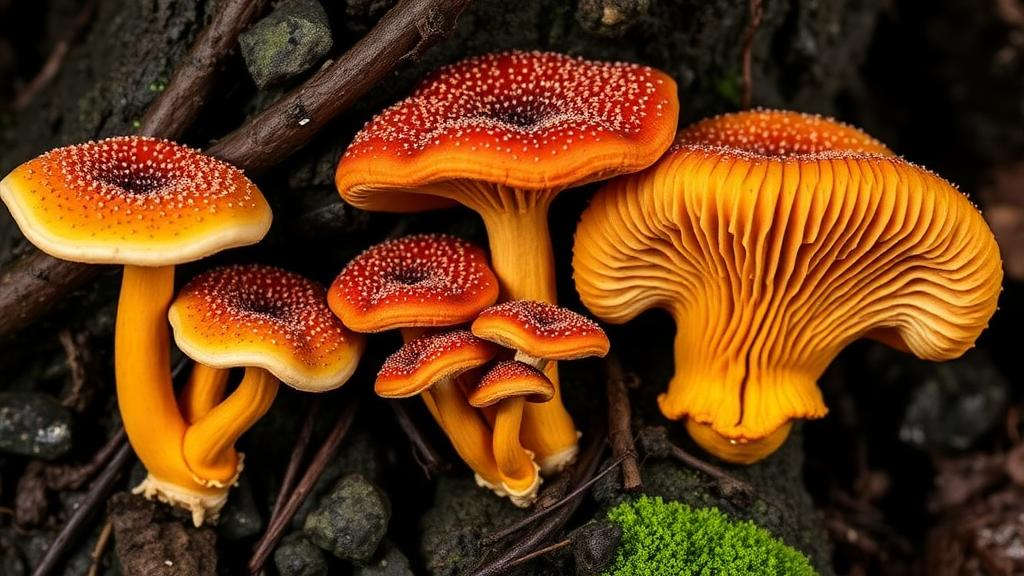
Deep in the forested karst mountains of Guizhou Province, China, a single field survey has revealed three species of fungus that science has never seen before. Researchers working in the Fodingshan Nature Reserve have described three new entomopathogenic fungi — fungal pathogens that infect and kill insects and spiders — all belonging to the family Cordycipitaceae within the order Hypocreales. The discoveries, published in the journal MycoKeys, include one new species in the spider-associated genus Arachnidicola and two new species in the genus Simplicillium, and they add fresh weight to the idea that this underexplored corner of subtropical China is a genuine hotspot for fungal diversity.
Entomopathogenic fungi are among the most remarkable organisms in nature. They infect arthropods, consume them from within, and then erupt through the body wall to disperse their spores. Beyond their macabre life cycles, these fungi play crucial ecological roles in regulating insect and spider populations, and they hold significant economic importance as biological control agents and sources of bioactive compounds. Some, such as Ophiocordyceps sinensis and Cordyceps militaris, are renowned medicinal taxa, while anamorphic genera like Beauveria and Metarizium have been confirmed as vital biocontrol agents of pest insects. In China, their use stretches back centuries, with the earliest recorded application of “white stiff silkworm” (Bái Jiāng Cán) documented in Shen Nong’s Materia Medica during the Qin and Han dynasties.
The Fodingshan Nature Reserve, located at the junction of Shiqian, Yuqing, Shibing, and Zhenyuan counties in Guizhou Province, is an underexplored region for entomopathogenic fungal diversity. With an elevation of 1,869 meters, Fodingshan is the second-highest peak in the Wuling Mountains. The reserve experiences a warm, humid mid-subtropical monsoon climate with abundant rainfall, creating favorable conditions for diverse organisms. Previous studies have documented rich insect resources in this area, but the fungi that parasitize those insects remained an understudied group — until now.
During a survey on 11 July 2025, the researchers collected dead insects and spiders by random sampling from leaf litter and from under rocks near a roadside within the reserve. The specimens were placed in sterile bags, kept separately in an ice box, and transported to the laboratory, where they were preserved at 4 °C until processing. Mycelium or conidia were picked from the specimens and placed onto plates of potato dextrose agar, some modified with peptone and antibiotics, and cultured at 25 °C for 14 days under alternating light and dark conditions. The holotype and ex-type cultures were deposited at the Institute of Fungus Resources, Guizhou University.
Preliminary identification of the isolated strains was conducted using BLASTn searches of the internal transcribed spacer (ITS) locus, followed by multigene phylogenetic analyses, morphological characterization, and a recombination test. The team extracted fungal genomic DNA and amplified five target loci: ITS, the 28S large subunit ribosomal gene (LSU), the RNA polymerase II largest and second largest subunit genes (rpb1 and rpb2), and the translation elongation factor 1-alpha gene (tef-1α). The resulting sequences were aligned and edited, and two concatenated datasets were assembled — one including all five loci to infer relationships within Arachnidicola, and the second employing four loci to ascertain the position within Simplicillium. Both datasets were subjected to identical phylogenetic analyses using Bayesian inference and maximum likelihood methods.
The phylogenetic results were striking. The new species Arachnidicola fodingshanensis, isolated from a dead spider, was recovered as a distinct lineage forming a sister relationship with the clade comprising A. kanyawimiae and A. sinensis. Meanwhile, Simplicillium fodingshanense, isolated from a lepidopteran cocoon, and S. shiqianense, isolated from another dead spider, both cluster with S. subtropicum but form distinct, well-supported independent lineages with 100 percent maximum likelihood support and 1.00 posterior probability. These statistical values indicate that the two new Simplicillium species are clearly separated from each other and from all other known species in the genus.
Morphologically, the three species are readily distinguishable from their relatives. Arachnidicola fodingshanensis differs from A. kanyawimiae and A. sinensis by having longer phialides — the flask-shaped cells that produce conidia — and ovoid to ellipsoidal conidia in culture. Simplicillium fodingshanense is characterized by longer phialides than S. shiqianense and differs further in host association, being readily distinguished from S. subtropicum by the absence of octahedral crystals and by producing cylindrical to ellipsoidal conidia. In contrast, S. shiqianense is distinguished from S. subtropicum by its shorter phialides, the absence of both octahedral crystals and conidial slime head in culture, and its distinct host and substrate.
The nucleotide base comparison demonstrates that the species differ from related taxa by measurable margins. Arachnidicola fodingshanensis differs slightly from A. kanyawimiae, whereas greater divergence is observed from A. sinensis — 1.56 percent in ITS, 0.79 percent in LSU, 3.87 percent in rpb2, and 0.91 percent in tef-1α. The two new Simplicillium species differ from related taxa by 1.03 to 1.54 percent in ITS, 0.25 to 0.90 percent in LSU, and 1.40 to 1.89 percent in tef-1α. The pairwise homoplasy index (PHI) test further supports genetic distinctness for Arachnidicola (Φw = 0.6876) and Simplicillium (Φw = 0.1587), values well above the 0.05 threshold that would indicate significant recombination and therefore no clear species boundary.
The genus Arachnidicola, established only recently to accommodate spider-associated lineages previously placed in other genera, currently comprises 16 species, almost all of which have been isolated from arachnid hosts. This strong host fidelity raises critical questions regarding the degree of host specialization within the genus. While the combined analysis supports the delineation of A. fodingshanensis as a distinct taxon, the available data do not reveal an obvious pattern of strict co-evolution with specific spider families. Instead, the host association appears to be ecologically driven — spiders as a group may provide a consistent microhabitat, such as cuticular chemistry, humidity, or nutrient profile, that favors the proliferation of this fungal lineage. In China, nine species have been reported, five of which originated from Guizhou Province, and all five Guizhou collections were derived from forest habitats.
In contrast, the genus Simplicillium exhibits a broader ecological amplitude. Established with S. lanosoniveum as the type species, it currently encompasses 36 species, with only five previously reported from spider hosts. The two novel Simplicillium species described here — one associated with a spider and the other with a lepidopteran cocoon — provide a unique opportunity to explore the dynamics of host divergence within this genus. Previous research has demonstrated that host jumping is a widespread phenomenon within Simplicillium, suggesting that some spider-associated species likely originated from insect hosts and underwent an interkingdom jump to spiders. The discovery of S. fodingshanense from a lepidopteran cocoon — a nutrient-rich, protected microhabitat functionally distinct from a spider host — raises new questions about the ecological plasticity of this genus. The isolate could be a true pathogen of the pupa, a saprobe colonizing the cocoon after host death, or even a mycoparasite.
The co-occurrence of two novel Simplicillium species in the same reserve, albeit from different hosts and microhabitats, highlights the potential role of resource partitioning and host availability in driving speciation events. The addition of three new species from a single study, alongside previously reported soil fungi such as Akanthomyces muscarius and Beauveria bassiana, underscores that the documented fungal diversity in this protected area is merely a fraction of the actual species richness. Karst habitats, with their complex microclimates and isolated niches, are biodiversity hotspots that warrant significantly greater attention from mycologists. Future research should prioritize systematic surveys across different seasons, altitudes, and microhabitats — forest floor, valley, and cavernous niches — to fully assess the species richness of entomopathogenic fungi in this reserve. In-depth genomic and ecological studies are urgently needed to unravel the molecular mechanisms underlying host specificity and the adaptive advantages conferring host jumping in Simplicillium, as well as to elucidate the precise ecological role of these fungi in their respective host life cycles. Overall, these findings underscore the Fodingshan Reserve as a significant hotspot for fungal diversity and highlight the value of continued exploration in this underexplored karst region.
Subject of Research: Three new entomopathogenic fungi (Hypocreales, Cordycipitaceae) in Fodingshan Nature Reserve, Guizhou, China
Article Title: Three new entomopathogenic fungi ( Hypocreales , Cordycipitaceae ) in Fodingshan Nature Reserve, Guizhou, China
Article References: Chen, W.-H., Shu, H.-L., Li, D., Liang, J.-D., Wijayawardene, N. N., Feng, X., Lei, H.-M., Zhao, J.-H., Han, Y.-F., & Chen, X.-S. (2026). Three new entomopathogenic fungi (Hypocreales, Cordycipitaceae) in Fodingshan Nature Reserve, Guizhou, China. MycoKeys, 138, 281-307. https://doi.org/10.3897/mycokeys.138.198399
Image Credits: AI Generated
DOI: 10.3897/mycokeys.138.198399
Keywords: Three, entomopathogenic, fungi, Hypocreales, Cordycipitaceae, Fodingshan, Nature, Reserve, Guizhou, China, scientific research
Cite Scienmag News
Roger Howard. (October 18, 2026). Three New Spider-Killing Fungi Discovered in China’s Fodingshan Karst Forest. Scienmag. https://scienmag.com/three-new-spider-killing-fungi-discovered-in-chinas-fodingshan-karst-forest/
Roger Howard. "Three New Spider-Killing Fungi Discovered in China’s Fodingshan Karst Forest." Scienmag, 18 October 2026, https://scienmag.com/three-new-spider-killing-fungi-discovered-in-chinas-fodingshan-karst-forest/. Accessed 18 October 2026.
Roger Howard. "Three New Spider-Killing Fungi Discovered in China’s Fodingshan Karst Forest." Scienmag. October 18, 2026. https://scienmag.com/three-new-spider-killing-fungi-discovered-in-chinas-fodingshan-karst-forest/


