


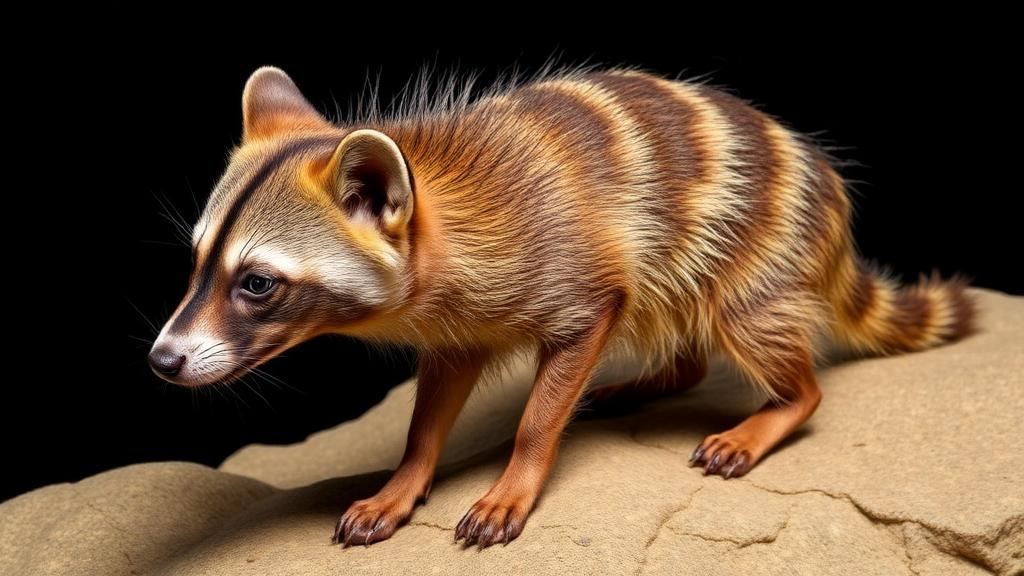
A 3.3-million-year-old skull pulled from a volcanic mudflow in the South Caucasus has turned out to belong to an entirely new species of raccoon dog, and its preserved brain imprint is forcing scientists to rethink how canid brains evolved. The fossil, unearthed at the Late Pliocene site of Jradzor in Armenia, has been formally named Nyctereutes urartuensis sp. nov., after the ancient Iron Age kingdom of Urartu that once spanned Asia Minor, the Caucasus and Mesopotamia. The discovery, published in the Swiss Journal of Palaeontology, is remarkable not only because it adds a new branch to the raccoon dog family tree, but because the shape of its fossilized brain surface hints at a social life far more complex than that of any raccoon dog alive today.
Raccoon dogs are among the strangest members of the dog family. The living species, Nyctereutes procyonoides, is a small, short-legged canid with a masked face that bears an uncanny resemblance to a true raccoon, an animal it is not related to at all. Native to East Asia and famously introduced into Europe, the raccoon dog is an opportunistic omnivore with crushing teeth adapted for a diet in which meat makes up less than thirty percent. Despite this low modern diversity, the fossil record tells a very different story: at least ten species of Nyctereutes have been described from Pliocene and Pleistocene deposits across Eurasia and Africa, from Morocco and Tanzania to China and Western Europe. The genus first appears around six million years ago in Morocco, with early forms such as N. tingi in China and N. donnezani in France and Spain dispersing westward in successive pulses of diversification.
The Jradzor site itself is a treasure trove for understanding how animals moved between continents. Nineteen fossiliferous horizons at the locality have yielded forty-eight vertebrate taxa, including hippopotamuses, hyraces and other carnivorans, deposited in a short-lived dammed lake between 4.3 and 3.03 million years ago. The raccoon dog remains come exclusively from a single layer, JZ-7, dated by argon-argon dating of an underlying ash bed and magnetostratigraphy to 3.3 plus or minus 0.03 million years ago. Sedimentological analysis shows that this particular bed was laid down by a lahar, a catastrophic volcanic mudflow that trapped and transported large mammals rapidly. The South Caucasus sits at the crossroads of Asia, Europe and Africa, making Jradzor a pivotal site for reconstructing the biogeographic corridors along which Pliocene faunas dispersed.
The new species is known from a well-preserved cranium with much of its dentition intact, a right hemimandible, and several additional jaw and palate fragments. The occlusal surfaces of the skull and lower jaw match perfectly, suggesting they belonged to a single individual. The cranium is strikingly elongated from front to back, with a marked postorbital constriction, high sagittal crest and prominent parasagittal crests. Its auditory bullae are inflated but shortened, and its upper carnassial bears an enlarged protocone. The first upper molar has equal-sized paracone and metacone cusps with an expanded crushing surface, while the lower carnassial retains a slender, elongated trigonid. Crucially, the mandible shows only a poorly developed subangular lobe, a feature that in more derived raccoon dogs becomes strongly expanded as part of the adaptation toward a hypocarnivorous diet.
This mosaic of primitive and derived traits is what sets the Jradzor raccoon dog apart. In overall cranial shape and size it resembles the primitive N. tingi from China and Greece, and it shares the modest subangular lobe of that species. Yet its tooth proportions diverge sharply: the upper molar lacks the squared occlusal outline typical of the derived N. megamastoides, the lower carnassial talonid is not greatly enlarged, and the second lower molar shows a distinctive elongated talonid. The combination does not match any previously described species. Instead, the closest affinities lie with specimens from the roughly coeval Turkish site of Çalta-1, which had long been referred to the Western European N. donnezani but which the new analysis suggests may belong to the same lineage as the Armenian material.
To test these affinities quantitatively, the researchers ran principal component analyses on cranial, upper dental and lower dental measurements across a broad comparative sample of fossil and extant canids, drawing on specimens housed in museums from Florence and Paris to New York and Tbilisi. The analyses consistently separated the extant raccoon dogs, which are much smaller, from the fossil forms. Among the fossils, N. megamastoides stood apart, while N. sinensis and N. vulpinus partially overlapped. The Jradzor specimen fell close to the primitive-like group, near N. cf. tingi from Megalo Emvolon in Greece and material from Tsaochuang in China, but occupied its own distinct region of the morphospace, reinforcing its status as a separate taxon.
The most spectacular part of the study, however, came from looking inside the skull. Using computed tomography and micro-CT scanning at the University of Basel, the team digitally reconstructed the endocast, the imprint of the brain left on the inner surface of the braincase. The fossil brain is rostrocaudally elongated rather than inflated from side to side, with a small, mediolaterally enlarged gyrus proreus at the front. The sulcus proreus runs straight down alongside the gyrus orbitalis without reaching the sulcus praesylvius, and the sulcus cruciatus is flat. Most notably, the gyrus sigmoideus, a ridge bounded by the ansate and coronal sulci, shows a parenthesis-like outline rather than the heart-shaped form seen in the living raccoon dog, and the sulcus pseudosylvius reaches half the height of the sylvian gyrus, the deepest development of this sulcus among all analysed fossil raccoon dogs.
These brain features place the fossil closer to the tribe Canini, the group that includes wolves, jackals and South American canids, than to the fox-like Vulpini to which raccoon dogs belong on molecular evidence. The researchers compared the endocast with those of seven extant canid species, including the wolf, golden jackal, black-backed jackal, bat-eared fox, red fox and crab-eating fox, as well as published endocasts of other fossil raccoon dogs from China, Poland, France and Greece. Geometric morphometric analysis using fourteen landmarks on the left hemisphere showed that the Jradzor brain falls within the variability of the jackal-like species Canis aureus and Lupulella mesomelas, occupying a region of the morphospace distinct from both the living raccoon dog and the more fox-like species.
The team also measured the relative volume of the anterior cerebrum, the frontal region of the brain associated with social information processing. Across the extant sample, the grey wolf, which lives in large packs, shows the largest frontal region, followed by the jackal-like canids, which form flexible social units and can aggregate into small packs during harsh seasons. The fox-like species show significantly lower values. The fossil raccoon dog from Jradzor falls squarely within the jackal-like range, suggesting that this Pliocene species may have lived in stable breeding pairs but retained the capacity to organise into small seasonal packs, a social structure more complex than that of any raccoon dog alive today.
The study also challenges several long-held assumptions about canid brain anatomy. The shape of the cerebellar vermis, previously used to distinguish Nyctereutes from Canis, turns out to be laterally twisted in several fossil species and cannot serve as a reliable diagnostic trait. Likewise, the sulcus endomarginalis, once considered exclusive to the tribe Canini, appears in some fox species such as the red fox, revealing far greater variability than previously recognised. The heart-shaped outline of the gyrus sigmoideus, which once fuelled the idea of a close relationship between the raccoon dog and the crab-eating fox, is now understood to have arisen independently within different raccoon dog lineages. Taken together, the findings underscore the Pliocene as a time of remarkable diversification for the genus and highlight the Caucasus as a pivotal corridor in canid evolution, offering new perspectives on the evolutionary trajectories of omnivorous dog species whose descendants, the modern raccoon dogs, ended up with smaller brains and simpler social lives than their ancient Armenian relatives.
Subject of Research: A new Pliocene raccoon dog species from Armenia with a jackal-like fossil brain imprint
Article Title: Systematics and palaeoneurology of a new Pliocene raccoon dog ( Canidae , Nyctereutes ) from Jradzor (Armenia)
Article References: Bartolini-Lucenti, S., Meyer, M., Frosali, S., Madurell-Malapeira, J., Liu, W., Costeur, L., Becker, D., & Vasilyan, D. (2026). Systematics and palaeoneurology of a new Pliocene raccoon dog (Canidae, Nyctereutes) from Jradzor (Armenia). Swiss Journal of Palaeontology, 145, 213-249. https://doi.org/10.3897/sjp.145.180388
Image Credits: AI Generated
Keywords: Nyctereutes, raccoon dog, Pliocene, Armenia, palaeoneurology, Canidae, fossil, Caucasus, endocast, Jradzor, evolution, hypocarnivorous
Cite Scienmag News
Cassandra Pierce. (October 18, 2026). Fossil Raccoon Dog From Armenia Rewrites the Story of Canid Brain Evolution. Scienmag. https://scienmag.com/fossil-raccoon-dog-from-armenia-rewrites-the-story-of-canid-brain-evolution/
Cassandra Pierce. "Fossil Raccoon Dog From Armenia Rewrites the Story of Canid Brain Evolution." Scienmag, 18 October 2026, https://scienmag.com/fossil-raccoon-dog-from-armenia-rewrites-the-story-of-canid-brain-evolution/. Accessed 18 October 2026.
Cassandra Pierce. "Fossil Raccoon Dog From Armenia Rewrites the Story of Canid Brain Evolution." Scienmag. October 18, 2026. https://scienmag.com/fossil-raccoon-dog-from-armenia-rewrites-the-story-of-canid-brain-evolution/


