


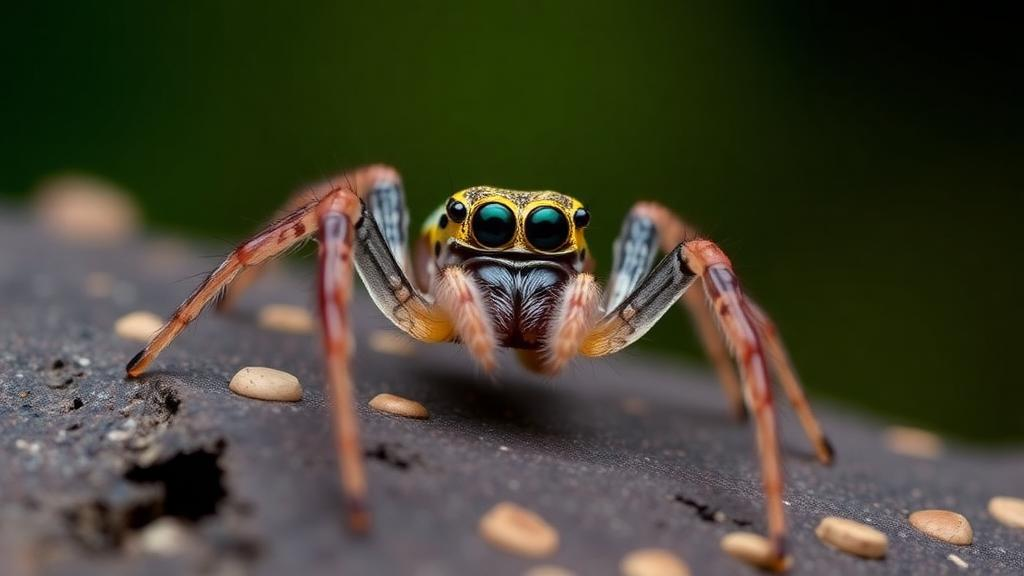
Deep in the rainforests of Batanta, one of the larger islands of Indonesia’s Raja Ampat archipelago, researchers have documented something remarkable: three brand-new species of jumping spiders, along with the first-ever spider records from a group of islands that has somehow escaped scientific attention for centuries. The discovery, published in the open-access journal ZooKeys, not only introduces three new species to science but also reshuffles the family tree of an entire group of spiders, moving century-old species into new taxonomic homes based on both physical anatomy and DNA evidence.
The new species belong to the genus Canama, a group of jumping spiders in the family Salticidae that is instantly recognisable by the dramatically oversized jaws of the males. These are not the delicate, needle-like fangs of many spiders; Canama males sport chelicerae that are thick, broad, and often wider than they are long, armed with complex arrays of teeth that look almost like defensive weaponry. It is precisely these exaggerated structures that have made the genus both easy to spot and difficult to classify, because similar-looking species have historically been shuffled between Canama and its close relative Bathippus without clear consensus.
The research team, working from the Hungarian Natural History Museum in Budapest, used an integrative approach that combined traditional morphological examination with modern molecular phylogenetics. Specimens were collected during field expeditions to Batanta and the smaller surrounding islands of Birie and Arefi between 2019 and 2025, preserved in 96% ethanol, and then subjected to detailed microscopic analysis. Legs, chelicerae, and male palps were carefully dissected and photographed using stacked imaging techniques that combine multiple focal planes into a single sharp image, allowing researchers to document every tooth, curve, and spine with precision.
The three new species are Canama horobi, named in honour of Hungarian ornithologist Róbert Horváth who initiated biodiversity research on Batanta; Canama limagigi, whose name derives from the Indonesian words for “five teeth,” referring to the distinctive arrangement of five teeth on the male chelicerae; and Canama wanita, from the Indonesian word for “woman,” a nod to the fact that this species is known only from female specimens. Each species was diagnosed using a combination of characters including the shape of the embolus, the coiled sperm-delivery structure on the male palp, the retrolateral tibial apophysis (RTA), and the configuration of teeth on the chelicerae.
To confirm that these morphological assignments were correct, the researchers turned to DNA. They extracted genomic DNA from leg tissue and amplified three gene fragments: the mitochondrial COI barcode region, a partial sequence spanning the ND1 and 16S RNA genes, and the divergent D2 and D3 domains of the nuclear 28S RNA gene. The resulting alignment of 3,314 nucleotide positions was analysed using both maximum-likelihood methods in IQ-TREE and Bayesian inference in MrBayes, with 1,000 ultrafast bootstrap replicates to assess confidence. Both approaches produced trees with the same topology, firmly placing all three new species within Canama as a monophyletic group, with C. wanita and C. limagigi appearing as sister species closely related to a cluster containing C. fimoi, C. extranea, and C. triramosa.
But the study did not stop at describing new species. The researchers also redescribed two Indonesian jumping spiders that had been languishing in obscurity since their original descriptions in 1911: Bathippus dentiferellus and Bathippus seltuttensis, both known only from holotype specimens collected on Aru Island more than a century ago. After careful comparison of their palpal structures, cheliceral dentition, and other anatomical features with the type species of Canama, the team concluded that these spiders had been placed in the wrong genus all along. They formally transferred both species to Canama, along with a third species, Bathippus dilanians, originally described by Thorell in 1881.
The distinction between Canama and Bathippus rests on a suite of characters that the researchers systematically evaluated. Male Canama have chelicerae that are bulky and wider than long, whereas Bathippus males have thin jaws that can stretch to two or three times the length of the prosoma. The embolus in Canama coils more than a full circle and sits at roughly a 30-degree angle perpendicular to the plane of the cymbium, while in Bathippus it coils only once and lies parallel. The RTA in Canama is long, well-developed, and curved at the tip, contrasting with the small, finger-like, straight RTA of Bathippus. Female genitalia also differ, with Canama possessing round, less-swollen spermathecae with a median ridge and genital openings positioned below the spermathecae.
The discovery of C. wanita presented a particular puzzle. The holotype female, collected on Birie Island near a coastal eco-resort in 2019, was initially sequenced using the COI gene to test whether it might be the unknown female of either C. limagigi or C. horobi, both known only from males on nearby Batanta. However, the genetic distances proved far too great: 8.346% between the C. wanita holotype and C. limagigi, and 9.621% between it and C. horobi. These distances are well beyond what would be expected within a single species, leading the researchers to describe it as distinct while acknowledging that it could potentially represent the previously unknown female of either C. dorcas or C. forceps, two species whose females remain undescribed.
The broader significance of this work extends beyond the taxonomy of a single spider genus. The researchers highlight that their study addresses what ecologists call Linnean and Wallacean shortfalls: the gaps in our knowledge of what species exist and where they live. Batanta, the fourth-largest island in the Raja Ampat Regency, which encompasses roughly 1,500 islands, had never before yielded a single published jumping spider record. Despite citizen science observations on platforms like iNaturalist, the only published arachnological data from the island prior to this study concerned tailless whip scorpions (Amblypygi). The absence of records reflected an absence of sampling effort rather than an absence of spiders, a pattern repeated across much of the Indonesian archipelago, one of the planet’s most biodiverse regions.
The researchers also note that much work remains to be done even within the genera they studied. Of the nine Canama species now recognised, six are known from only one or two papers, often without clear illustrations. Similarly, 25 of the 30 known Bathippus species suffer from the same obscurity. The character systems used to distinguish these spiders, including cheliceral morphology, tooth arrangement, and palpal structures, vary widely across species, making clear diagnoses and testable morphological characters essential for accurate species placement. As this study demonstrates, the enlarged chelicerae alone are not sufficient to assign species to these genera, and molecular data provides a crucial independent line of evidence. With ten new DNA sequences, 49 original images, and a distribution map now deposited in the public record, this work provides both a foundation for future exploration of Raja Ampat’s spider fauna and a reminder that even well-studied groups in well-known regions can still yield surprises when someone finally looks closely enough.
Subject of Research: Taxonomy and molecular phylogenetics of new jumping spider species from Raja Ampat, Indonesia
Article Title: First chance to see: New jumping-spider species from Batanta, Indonesia ( Araneae , Salticidae , Euophryini )
Article References: Takács-Vágó, H., Mayer, Á. S., Szabó, K., Kovács, T., & Szűts, T. (2026). First chance to see: New jumping-spider species from Batanta, Indonesia (Araneae, Salticidae, Euophryini). ZooKeys, 1293, 241-263. https://doi.org/10.3897/zookeys.1293.190325
Image Credits: AI Generated
DOI: 10.3897/zookeys.1293.190325
Keywords: jumping spiders, Canama, Batanta, Raja Ampat, new species, taxonomy, Salticidae, molecular phylogenetics, Indonesia, biodiversity, chelicerae, ZooKeys
Cite Scienmag News
Drew Townsend. (October 16, 2026). Three New Jumping Spider Species Discovered on Indonesia’s Batanta Islands. Scienmag. https://scienmag.com/three-new-jumping-spider-species-discovered-on-indonesias-batanta-islands/
Drew Townsend. "Three New Jumping Spider Species Discovered on Indonesia’s Batanta Islands." Scienmag, 16 October 2026, https://scienmag.com/three-new-jumping-spider-species-discovered-on-indonesias-batanta-islands/. Accessed 16 October 2026.
Drew Townsend. "Three New Jumping Spider Species Discovered on Indonesia’s Batanta Islands." Scienmag. October 16, 2026. https://scienmag.com/three-new-jumping-spider-species-discovered-on-indonesias-batanta-islands/


