


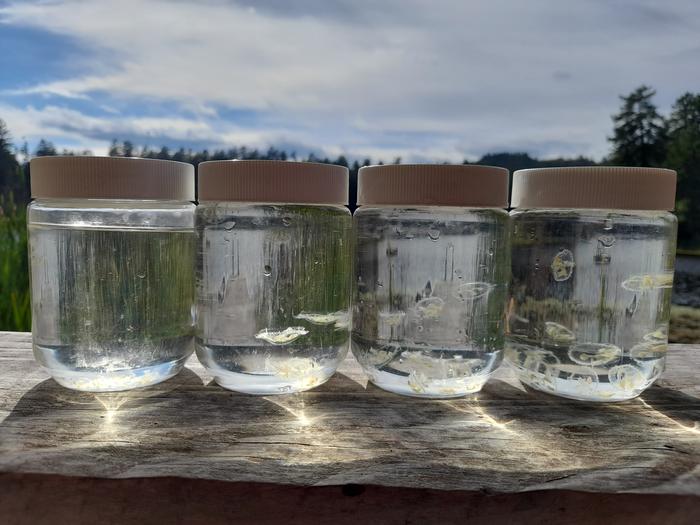
An invasive, freshwater jellyfish is popping up in B.C. waters in the thousands and future sightings could increase rapidly, according to UBC research.

Credit: Polina Orlov
An invasive, freshwater jellyfish is popping up in B.C. waters in the thousands and future sightings could increase rapidly, according to UBC research.
The peach blossom jellyfish clones have been spotted in 34 places in B.C., its furthest northern range in North America, and a recent paper predicts sightings and the number of locations will increase by the end of the decade as climate change extends this range.
Dr. Florian Lüskow, who completed the research during his postdoctoral fellowship at UBC’s department of earth, ocean and atmospheric sciences (EOAS), and Dr. Evgeny Pakhomov, professor in EOAS and the Institute for the Oceans and Fisheries (IOF), discuss the mysterious jelly.
What do we know about these jellyfish?
FL: This is an introduced jellyfish species from China which has spread around the world. We know very little about how they affect ecosystems and biodiversity of these systems in Canada, because the research hasn’t been done yet. The worry is that they harm indigenous species by outcompeting them. We’re the only researchers in Canada investigating these jellyfish, with help from citizen scientists around B.C.
Peach blossom jellyfish have been reported in B.C. since 1990, mainly in the Lower Mainland, on Vancouver Island, around the Sunshine Coast and more recently, as far inland as Osoyoos Lake. Between 1990 and 2023, a 34 year span, there have been 85 sightings, counted once per location per year, where each sighting could be one or thousands of jellyfish. But in this decade alone, we are predicting about 80 sightings, and likely in more than the 34 locations currently observed.
We know that of the 100 jellyfish examined so far, each has been male comprised of the same genetic material, which means these thousands of jellyfish are effectively clones and originated from the same polyp or a small cluster of polyps—the stage of a jellyfish which lives at the bottom of a body of water.
EP: Polyps are very small, usually around a millimetre in size, and it is challenging to locate them. They inhabit shallow areas and can be found on rocks and submerged wood debris. Hence, we usually know about jellyfish introduction when we see the floating medusa form produced by polyps appear in the water, which appear only when water temperature is higher than 21 degrees Celsius —so polyps could be in many more lakes without us knowing about it. We do not know how and when introduction of the species occurred, but it was likely through medusa-producing polyps carried on recreational boats or on the bills or feet of birds when feeding.
We found medusae in ponds, quarries and lakes, but never in creeks or rivers. And, we know that the jellyfish aren’t harmful to humans, because their stings can’t pierce human skin.
How is climate change affecting these jellies?
FL: B.C. is the northernmost point in this continent for the peach blossom jellyfish’s range. It relies on mild winters and high summer temperatures to reproduce, so we wouldn’t see them in the Prairies because the winters are too cold.
EP: If climate change leads to freshwater temperature increases across B.C., we will likely see wider spread. Modelling indicates that even Alaskan reservoirs may potentially see invasion. However, there is a silver lining: So far only males, which are genetically identical, have been observed. This means that the jellyfish cannot complete their sexual reproduction and thus its adaptation to new environments will be limited. This would curtail their spread.
What are the next steps?
EP: The priority should be two-fold: first, to properly map the actual distribution of the peach blossom jellyfish, including range, in B.C. Second, to better quantify the jellyfish impact on freshwater ecosystems, including young salmon.
FL: To achieve the first objective, we’d like to use environmental DNA, which is a tool that ascertains the DNA in a sample of water. This would allow us to find out if the jellyfish is present even if we can’t see it, say, in its polyp form.
We’d also like to receive observations wherever they occur. People who spot a peach blossom jellyfish can submit a report to iNaturalist, the Invasive Species Council of BC, or to us.
This would help us answer fundamental questions about the jellyfish and its impact on B.C. ecosystems and species, allowing better informed management recommendations.
Journal
Canadian Journal of Zoology
Cite Scienmag News
Sloane Callahan. (September 3, 2024). Thousands of jellyfish clones are multiplying in B.C. lakes. Scienmag. https://scienmag.com/thousands-of-jellyfish-clones-are-multiplying-in-b-c-lakes/
Sloane Callahan. "Thousands of jellyfish clones are multiplying in B.C. lakes." Scienmag, 3 September 2024, https://scienmag.com/thousands-of-jellyfish-clones-are-multiplying-in-b-c-lakes/. Accessed 5 September 2026.
Sloane Callahan. "Thousands of jellyfish clones are multiplying in B.C. lakes." Scienmag. September 3, 2024. https://scienmag.com/thousands-of-jellyfish-clones-are-multiplying-in-b-c-lakes/

