


MRI scans are commonly used to diagnose a variety of conditions, anything from liver disease to brain tumors. But, as anyone who has been through one knows, patients must remain completely still to avoid blurring the images and requiring a new scan. A prototype device described in ACS Sensors could change that. The self-powered sensor detects movement and shuts down an MRI scan in real time, improving the process for patients and technicians.

Credit: Adapted from ACS Sensors 2024, DOI: 10.1021/acssensors.4c00319
MRI scans are commonly used to diagnose a variety of conditions, anything from liver disease to brain tumors. But, as anyone who has been through one knows, patients must remain completely still to avoid blurring the images and requiring a new scan. A prototype device described in ACS Sensors could change that. The self-powered sensor detects movement and shuts down an MRI scan in real time, improving the process for patients and technicians.
During an MRI scan, a patient must stay entirely still for several minutes at a time, otherwise “motion artifacts” could appear and blur the final image. To ensure a clear picture, patient movement needs to be identified as soon as it happens, allowing the scan to stop and for the technician to take a new one. Motion tracking could be achieved using sensors embedded into the MRI table; however, magnetic materials can’t be used because metals interfere with the MRI technology itself. One technology that’s well-suited for this unique situation, and avoids the need for metal or magnetic components, is the triboelectric nanogenerator (TENG), which powers itself using static electricity generated by friction between polymers. So, Li Tao, Zhiyi Wu and colleagues wanted to design a TENG-based sensor that could be incorporated into an MRI machine to help prevent motion artifacts.
The team created the TENG by sandwiching two layers of plastic film painted with graphite-based conductive ink around a central layer of silicone. These materials were specifically chosen as they would not interfere with an MRI scan. When pressed together, electrostatic charges from the plastic film moved to the conductive ink, creating a current that could then flow out through a wire.
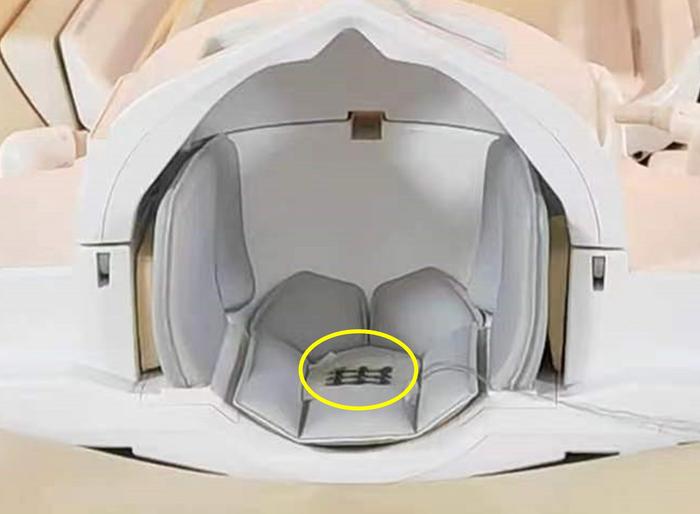
This sensor was incorporated into an MRI table designed to lay under a patient’s head. In tests, when a person turned their head from side to side or raised it off the table, the sensor detected these movements and transmitted a signal to a computer. Then, an audible alert played, a pop-up window on the technician’s computer appeared and the MRI scan ceased. The researchers say that this work could help make MRI scans more efficient and less frustrating for patients and technicians alike by producing better images during a single procedure.
The authors do not acknowledge a funding source for this work.
###
The American Chemical Society (ACS) is a nonprofit organization chartered by the U.S. Congress. ACS’ mission is to advance the broader chemistry enterprise and its practitioners for the benefit of Earth and all its people. The Society is a global leader in promoting excellence in science education and providing access to chemistry-related information and research through its multiple research solutions, peer-reviewed journals, scientific conferences, eBooks and weekly news periodical Chemical & Engineering News. ACS journals are among the most cited, most trusted and most read within the scientific literature; however, ACS itself does not conduct chemical research. As a leader in scientific information solutions, its CAS division partners with global innovators to accelerate breakthroughs by curating, connecting and analyzing the world’s scientific knowledge. ACS’ main offices are in Washington, D.C., and Columbus, Ohio.
To automatically receive news releases from the American Chemical Society, contact newsroom@acs.org.
Note: ACS does not conduct research, but publishes and publicizes peer-reviewed scientific studies.
Follow us: X, formerly Twitter | Facebook | LinkedIn | Instagram
Journal
ACS Sensors
Article Title
Flexible Sensor for Real-Time Monitoring of Motion Artifacts in Magnetic Resonance Imaging
Article Publication Date
16-May-2024
Cite Scienmag News
Denise Maddox. (May 31, 2024). This self-powered sensor could make MRIs more efficient. Scienmag. https://scienmag.com/this-self-powered-sensor-could-make-mris-more-efficient/
Denise Maddox. "This self-powered sensor could make MRIs more efficient." Scienmag, 31 May 2024, https://scienmag.com/this-self-powered-sensor-could-make-mris-more-efficient/. Accessed 4 September 2026.
Denise Maddox. "This self-powered sensor could make MRIs more efficient." Scienmag. May 31, 2024. https://scienmag.com/this-self-powered-sensor-could-make-mris-more-efficient/

