


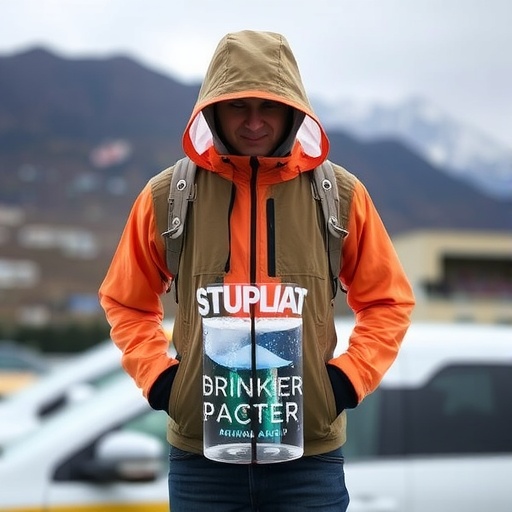
In a groundbreaking advancement poised to revolutionize access to potable water, engineers at The University of Texas at Austin have engineered an innovative wearable technology: a jacket capable of harvesting drinking water directly from atmospheric moisture. This breakthrough transcends conventional understandings of water collection, traditionally dominated by static devices fixed in place, by introducing a dynamic, personal hydration system that adapts to human mobility. This technology holds immense promise, especially for populations spending prolonged periods in environments lacking reliable water infrastructure, including outdoor enthusiasts, agricultural workers, emergency personnel, and military operators.
Historically, atmospheric water harvesting systems have been bulky, stationary units, such as panels or large-scale sorbent beds, requiring a stable setup and often considerable energy input. The novel approach championed by Guihua Yu and colleagues at the Cockrell School of Engineering marks a paradigm shift, emphasizing integration of moisture-collecting fibers directly into wearable textiles. This strategic design exploits the fabric’s inherent surface area and flexibility, enabling the jacket fabric itself to act as a water collection interface. By embedding this capability within a wearable medium, the research team has reimagined personal hydration as an on-the-go, self-sustaining process.
At the core of the jacket’s water-harvesting ability is a meticulously engineered hydrogel fabric derived from biomass materials. This fabric exhibits superior hygroscopicity, absorbing moisture vapor directly from ambient air. What differentiates this innovation from previous moisture absorption materials is its hierarchical fiber architecture, which facilitates rapid vapor-to-liquid phase transition and expedited water transport across the fabric matrix. Rather than simply absorbing water, the fabric functions as a conduit that channels condensed moisture toward localized, detachable harvesting units embedded in the garment.
These detachable units operate as foldable collectors that, once saturated with moisture from the textile, harness solar energy to induce gentle heating. This thermal activation triggers the release of liquid water from the hydrogel matrix, enabling efficient condensation and collection without requiring electrical power. The jacket has demonstrated remarkable efficiency, producing between 400 and 900 milliliters of potable water per day, an output contingent on ambient relative humidity. This volume equates to approximately 14 to 30 ounces, sufficient to meaningfully supplement drinking water needs in low-resource settings.
The scientific ingenuity lies in addressing a fundamental bottleneck in wearable water harvesting: the rapid and directional transport of water molecules from the fabric surface into a collectable form. Keith Johnston, co-author of the study, highlights that the design transcends mere absorption by engineering precise pathways for water movement—from vapor adhesion on fiber surfaces, to condensation into liquid, and subsequent macroscopic migration through the textile. This transport mechanism ensures scalability from benchtop experiments to robust, field-deployable wearables.
Further emphasizing its practical potential, the research group envisions extending this hydrogel textile technology beyond apparel to incorporate it into essential outdoor gear, such as backpacks, tents, and emergency shelters. By integrating water capture into everyday objects, the technology offers a decentralized, passive solution to water scarcity, especially critical in remote, arid, or infrastructure-deficient regions globally.
Complementing the wearable jacket, the same research consortium has developed an independent water harvesting device exhibiting record-performance metrics in diverse climates, including the arid Chihuahuan Desert and humid Austin. This apparatus yielded 1.3 liters of clean water daily per deployed unit, equating to an unprecedented 4.3 liters per kilogram of moisture-capturing material. This milestone surpasses prior atmospheric water harvesting benchmarks, reinforcing the real-world viability of atmospheric moisture as a sustainable drinking water source.
Weixin Guan, one of the lead authors of the companion study published in Nature Water, remarks that this achievement represents a significant leap from molecular design concepts to operational field technology, underscoring the team’s multidisciplinary approach. The hydrogel’s biomass derivation and solar-driven water release process coalesce into an environmentally benign cycle, ideal for regions confronting water stress, including North Africa, the Middle East, South Asia, and sub-Saharan Africa.
This technology’s societal implications are wide-ranging. In addition to providing hydration in wilderness or military scenarios, it holds transformative potential for disaster relief operations where traditional water infrastructure may be compromised. The passive, off-grid nature of this approach circumvents the logistical challenges associated with water delivery, storage, and purification in crisis zones.
The device stems from the research team’s broader innovation, known as AirGel, a material that garnered top honors at the 2025 National Collegiate Inventors Competition. This accolade reflects the AirGel’s pioneering status in the realm of water capture technologies and signifies strong intellectual and commercial interest in scalable solutions for the global water crisis.
The University of Texas team’s work fundamentally reconceptualizes water harvesting by embedding it into personal wearables, bridging the gap between scientific innovation and practical human needs. By transforming the mundane fabric into a high-performance, moisture-attracting platform, they have engineered a solution that blends sustainability, usability, and technological sophistication.
With ongoing research, improvements could include optimizing fabric structure for varying climatic conditions, enhancing water yield, and integrating real-time monitoring to inform users on humidity levels and water collection status. Such advancements will be crucial in catalyzing widespread adoption and ensuring this technology can be tailored to meet diverse environmental and cultural contexts.
The emergence of this water-harvesting jacket ultimately signals a new frontier in wearable technology—one that marries material science, environmental engineering, and human-centered design to address one of humanity’s most pressing challenges: access to clean, reliable water.
News Publication Date: 10-Jun-2026
Web References:
References:
- Yu, G., Johnston, K., Guan, W., et al. (2026). Scalable hierarchical textile fibers toward personalized wearable atmospheric water harvesting. Science Advances. DOI: 10.1126/sciadv.aed9949.
- Guan, W., et al. (2026). [Field study of record atmospheric water harvesting device]. Nature Water.
Keywords
Materials science, hydrogel fabric, atmospheric water harvesting, wearable technology, moisture capture, sustainable hydration, solar-driven condensation, decentralized water access, environmental engineering, water scarcity solutions, portable water harvesting, personal hydration systems
Cite Scienmag News
Denise Maddox. (June 12, 2026). This Jacket Extracts Drinking Water Directly from the Air. Scienmag. https://scienmag.com/this-jacket-extracts-drinking-water-directly-from-the-air/
Denise Maddox. "This Jacket Extracts Drinking Water Directly from the Air." Scienmag, 12 June 2026, https://scienmag.com/this-jacket-extracts-drinking-water-directly-from-the-air/. Accessed 4 September 2026.
Denise Maddox. "This Jacket Extracts Drinking Water Directly from the Air." Scienmag. June 12, 2026. https://scienmag.com/this-jacket-extracts-drinking-water-directly-from-the-air/


