


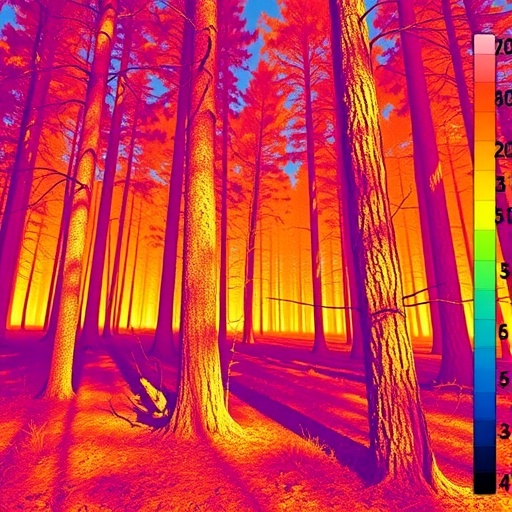
In recent years, the intensification of drought events worldwide has posed significant threats to forest ecosystems, compromising their ability to sustain biodiversity, carbon storage, and water cycling. Among these events, flash droughts—rapid onset droughts characterized by abrupt moisture deficits—have garnered increasing attention due to their devastating impacts on vegetation health and ecosystem stability. Traditional approaches to monitoring forest water stress are often hampered by delayed detection, limiting timely intervention measures. However, a groundbreaking study by Song, Guan, Liddell, and colleagues introduces an innovative technique harnessing thermal infrared energy balance modeling to identify early forest water stress signals during flash drought episodes, offering a promising avenue for proactive ecosystem management.
The crux of this novel methodology lies in leveraging thermal infrared remote sensing data to capture subtle fluctuations in canopy temperature—a critical indicator of transpiration and water use by forests. Under water stress conditions, trees tend to close their stomata to conserve moisture, resulting in reduced transpiration rates and a corresponding increase in leaf temperature. By intricately modeling the energy balance at the forest canopy surface, the researchers translate thermal infrared measurements into precise estimates of evapotranspiration, enabling a sensitive detection of forest water stress onset well before conventional drought indices reflect visible damage.
Central to this advancement is the integration of an energy balance framework, which accounts for the complex interactions between incoming radiation, sensible heat flux, latent heat flux, and ground heat storage at the canopy scale. The researchers combined high-resolution thermal infrared imagery with meteorological data inputs such as air temperature, humidity, wind speed, and solar radiation to solve the surface energy balance equations. This comprehensive modeling approach allowed for the quantification of actual evapotranspiration rates, distinguishing vegetative stress responses during flash droughts that often evade earlier detection via soil moisture or precipitation records alone.
Importantly, the study addresses the temporal challenges posed by flash droughts, which develop swiftly over days to weeks, leaving little room for reactive forest management. Traditional drought assessments relying on cumulative precipitation deficits or soil moisture anomalies often lag behind the physiological stress experienced by trees. By deploying thermal infrared energy balance modeling in a near real-time monitoring framework, the authors successfully captured early-warning signals—characterized by canopy temperature anomalies and reduced latent heat fluxes—that precede visible reductions in forest vigor.
This capacity for early detection is transformative, allowing forest managers and policymakers to implement timely mitigation strategies such as targeted irrigation, controlled thinning, or fire risk reduction efforts. Furthermore, the approach enhances the understanding of forest drought dynamics under varying climatic conditions, promoting predictive modeling efforts that integrate ecohydrological feedbacks influencing carbon and hydrological cycles.
The researchers rigorously validated their model outputs through comparison with ground-based sap flow measurements, leaf water potential observations, and flux tower data from representative forest sites. These ground-truth datasets reinforced the accuracy of the thermal infrared energy balance approach, demonstrating strong coherence with direct physiological indicators of tree water stress. Such validation underscores the robustness of the methodology, amplifying confidence in its application across diverse forested landscapes.
Another compelling aspect of this research is its scalability and adaptability. The reliance on satellite or airborne thermal infrared sensors enables broad spatial coverage, permitting the surveillance of vast and remote forest areas that are difficult to access physically. This scalability is especially crucial as flash droughts may manifest heterogeneously across regions with varying topographic, edaphic, and vegetative characteristics, requiring spatially explicit monitoring tools to inform localized responses.
In addition to practical forest management applications, the technique has profound implications for global carbon cycle modeling. Forests act as critical carbon sinks, with drought-induced water stress diminishing photosynthetic activity and thereby altering carbon sequestration rates. By integrating accurate evapotranspiration and water stress metrics derived from thermal infrared energy balance modeling, Earth system models can be refined to capture drought impacts more precisely, enhancing climate change projections and mitigation planning.
The study further sheds light on the interplay between rapid moisture deficits and vegetation physiology during flash droughts. By dissecting the temporal sequence of energy flux alterations, the researchers illuminate how forests prioritize water conservation through stomatal regulation in response to sudden environmental stressors. This nuanced mechanistic insight bridges gaps between remote sensing observations and plant eco-physiological processes, fostering interdisciplinary advances in drought science.
Crucially, the methodology demonstrated sensitivity to early signals even before canopy spectral changes or leaf wilting became apparent, reflecting its high potential as a preemptive warning system. Early-stage stress detection is paramount for conservation efforts, enabling intervention before irreversible damage or mortality occurs, thus safeguarding forest ecosystem resilience in the face of escalating climate variability.
Moreover, the approach aligns well with ongoing advancements in sensor technologies, such as the deployment of next-generation thermal infrared instruments on satellite platforms like ECOSTRESS and the upcoming NASA Surface Biology and Geology mission. These technological synergies promise to operationalize the early detection framework at global scales with enhanced temporal frequency and spatial resolution, revolutionizing drought monitoring paradigms.
The innovation presented by Song et al. also emphasizes the need for integrative datasets combining remote sensing, meteorological, and ecological ground observations to unravel complex drought phenomena. Their interdisciplinary strategy serves as a model for future research efforts aiming to tackle the multifaceted challenges of ecosystem drought resilience under rapid environmental change.
To translate these scientific advancements into actionable policy, the study advocates cross-sector collaboration between researchers, forest managers, water resource planners, and climate adaptation stakeholders. Effective early-warning systems rooted in thermal infrared energy balance modeling can inform adaptive forest management practices, mitigate wildfire risks, and optimize water allocation during critical drought windows.
In summation, the pioneering use of thermal infrared energy balance modeling to detect early forest water stress during flash droughts marks a significant leap forward in drought science and ecosystem monitoring. By coupling detailed energy flux analyses with advanced remote sensing capabilities, this approach enables prompt identification of physiological stress, offering a crucial tool for enhancing forest resilience. As climate change intensifies the frequency and severity of flash droughts globally, such innovative methodologies are indispensable for safeguarding forest ecosystems and the essential services they provide to humanity.
Cite Scienmag News
Violet Maxwell. (June 2, 2026). Thermal Imaging Reveals Early Forest Drought Stress. Scienmag. https://scienmag.com/thermal-imaging-reveals-early-forest-drought-stress/
Violet Maxwell. "Thermal Imaging Reveals Early Forest Drought Stress." Scienmag, 2 June 2026, https://scienmag.com/thermal-imaging-reveals-early-forest-drought-stress/. Accessed 4 September 2026.
Violet Maxwell. "Thermal Imaging Reveals Early Forest Drought Stress." Scienmag. June 2, 2026. https://scienmag.com/thermal-imaging-reveals-early-forest-drought-stress/


