


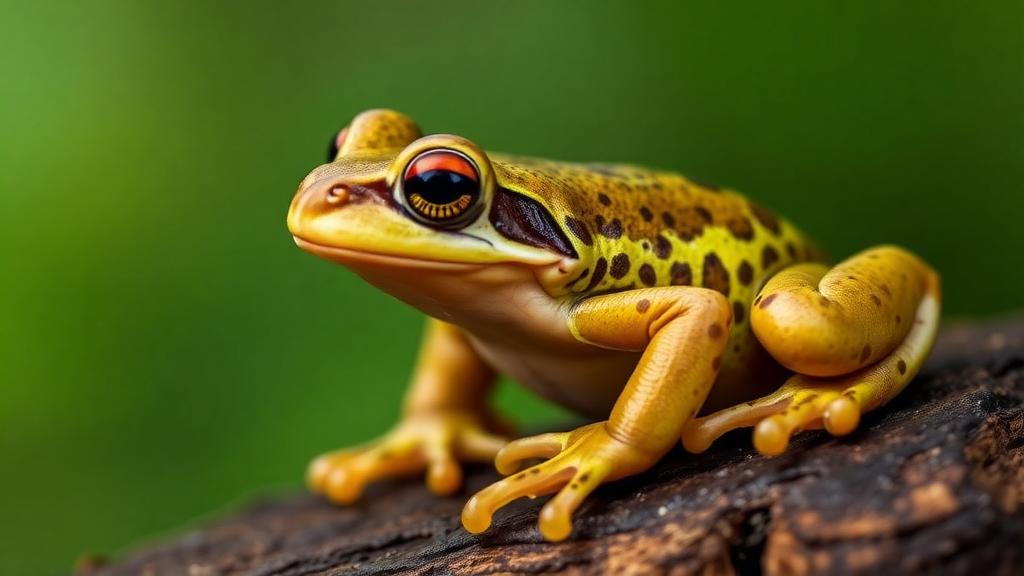
In the high Andean grasslands of Ecuador, at nearly 3,000 meters above sea level, a small black frog with a reddish belly is quietly rewriting its own obituary. Atelopus ignescens, known locally as the jambato, was once the most common and widespread high-Andean amphibian in Ecuador before vanishing so dramatically in the early 1980s that scientists declared it extinct. Its rediscovery near the locality of Angamarca, in Cotopaxi province, became one of the most celebrated conservation stories in the Neotropics. Now, a new study published in the journal Herpetozoa has achieved another first: for the first time in the 175 years since the species was formally described, researchers have documented and characterized the calls of this emblematic frog, revealing a surprisingly rich vocal repertoire produced at volumes so low that the sounds are almost inaudible even at close range.
The jambato’s near-disappearance was not an isolated tragedy. Across the Neotropics, harlequin toads of the genus Atelopus suffered catastrophic population collapses driven by a combination of threats, including the deadly chytrid fungus Batrachochytrium dendrobatidis, the destruction of habitats as agricultural frontiers expanded, and the impacts of introduced species such as rainbow trout, Oncorhynchus mykiss, which prey on native amphibians in Andean streams. The genus became a global symbol of the amphibian extinction crisis, with dozens of species vanishing or declining toward oblivion. Against this grim backdrop, the survival and rediscovery of A. ignescens stands out as a rare story of resilience, and every new piece of biological information about the species carries weight for its ongoing protection.
Despite decades of research on the taxonomy and conservation of Atelopus, their acoustic communication has remained remarkably poorly understood. Of the roughly 100 recognized species in the genus, vocalizations have been described for only about 24. In Ecuador, home to 25 Atelopus species, the calls of only one other species, A. exiguus, had previously been documented. Part of the reason for this gap is anatomical: the vast majority of Atelopus species lack a tympanic middle ear, the structure that in most frogs transmits sound vibrations to the inner ear. Without eardrums, these frogs were long assumed to be effectively deaf, a presumption that discouraged bioacoustic research and led to misconceptions about their capacity for acoustic communication.
The new study dismantles that assumption. Working at Angamarca, in the western foothills of the Andes within an ecosystem of evergreen shrubland, páramo grassland and agricultural mosaic, the researchers recorded the vocalizations of an adult male jambato calling from grasses and herbaceous vegetation at ground level. The recordings, made between 10:00 and 12:00 on December 8, 2021, were captured using a cell phone storing audio in FLAC format at a sampling rate of 44.1 kHz and 24-bit resolution, then converted to WAV and analyzed with the bioacoustic software Raven 1.6 using standardized spectral and temporal parameters. The recordings are now archived at the Laboratorio de Biología Evolutiva of Universidad San Francisco de Quito and at the Fonoteca Zoológica of the Museo Nacional de Ciencias Naturales in Madrid, ensuring the data remain available for future comparison.
The analysis revealed a repertoire of three distinct call types, classified as tonal, short and pulsed calls, spanning a structural continuum from non-pulsed to pulsed emissions. Tonal calls, defined by durations exceeding 100 milliseconds, typically show a downward frequency modulation, sometimes with a more complex upward-downward pattern. Short calls last no more than 100 milliseconds and also descend in frequency. Pulsed calls, by contrast, consist of repetitive bursts of 13 to 15 individual pulses, each lasting no more than 21 milliseconds. Across all call types, the mean dominant frequency sits at about 1.7 kHz, with mean minimum and maximum frequencies of roughly 1.50 and 1.78 kHz respectively, and the calls are generally downward frequency modulated at a mean rate of about 1.66 Hz per millisecond.
The temporal structure of the repertoire is equally distinctive. Calls averaged 370 milliseconds in duration but were emitted at long intervals averaging about 7.5 seconds, producing a mean call rate of roughly 11 calls per minute. Individual calls comprised a mean of about 1.6 notes, with note durations averaging 66 milliseconds delivered at a rate of about 2.9 notes per second, while pulses within pulsed calls averaged 7.67 milliseconds in duration at a rapid mean rate of about 90 pulses per second. Amplitude envelopes varied systematically among call types: tonal calls reached maximum amplitude quickly, with a mean rise time of about 36 percent of total call duration followed by a slower decay, whereas short calls showed a more balanced, progressive rise and decay of roughly equal proportions.
Perhaps the most striking quality of these vocalizations is their sheer subtlety. The calls are low-intensity sounds that the researchers compare to the whispering of rodents, and the short non-pulsed call type was not even discernible to the human ear at the moment of recording. This faintness echoes an anecdotal description from 1973, when the naturalist Peters characterized the jambato’s calls as a slight, low sound difficult to hear even at close range. Such inconspicuous vocalizations likely contributed to the long-standing belief that these frogs barely vocalize at all, and they raise fascinating questions about how the signals function in the dense grasslands and rushing streams of Andean páramo habitat, where visual signals such as the species’ diurnal displays may complement or even outweigh acoustic ones.
The question of how a frog without a tympanic middle ear can hear at all remains one of the most intriguing puzzles surrounding the genus. The absence of eardrums does not mean harlequin toads are deaf; evidence suggests they rely on extratympanic mechanisms of audition, pathways by which sound reaches the inner ear through other routes, such as transmission through body tissues or the lungs. Similar mechanisms have been proposed for other earless frogs, but the details for Atelopus remain poorly resolved. The authors emphasize that much more research is needed to understand these alternative hearing pathways and to determine the relative importance of acoustic communication in a genus whose behavior is otherwise characterized by multimodal signaling that integrates both auditory and visual components.
The bioacoustic baseline established for A. ignescens carries practical consequences beyond pure curiosity. Because each call type has now been quantified with precise spectral and temporal parameters, conservationists can deploy passive acoustic monitoring, autonomous recorders that listen continuously in the field, to detect jambato populations in remote Andean localities without disturbing them. Such methods could reveal new surviving populations and help track the species’ recovery over time. Acoustic data may also help resolve lingering taxonomic uncertainties within the species complex, since call structure often serves as a diagnostic character distinguishing closely related frog species. Given that A. ignescens was the first amphibian species ever described from Ecuador, in 1849, the fact that its voice went formally undocumented until now underscores how much fundamental biology remains to be discovered even about the most iconic species.
The jambato’s story has become a touchstone for amphibian conservation across Ecuador and the wider Neotropics, a reminder that species written off as extinct can persist in refuges waiting to be found. By endowing this resilient frog with an acoustic identity, the researchers have added a new dimension to efforts to comprehend and preserve it. The whisper of the jambato, nearly lost amid one of the worst extinction crises ever to strike a vertebrate class, has now been heard, measured and archived. Whether those faint calls guide scientists to more hidden populations, or inspire deeper investigation into how earless frogs perceive sound, they ensure that this Andean survivor will not be disappearing quietly, and that its subtle voice will not fall on truly deaf ears.
Subject of Research: First description of the vocal repertoire of the rediscovered Ecuadorian harlequin frog Atelopus ignescens
Article Title: Vocalizations of Atelopus ignescens (Cornalia, 1849): The repertoire of a resilient species that whispers not to disappear
Article References: Batallas, D., Guayasamin, J. M., & Vega-Yánez, M. A. (2024). Vocalizations of Atelopus ignescens (Cornalia, 1849): The repertoire of a resilient species that whispers not to disappear. Herpetozoa, 37, 421-428. https://doi.org/10.3897/herpetozoa.37.e134923
Image Credits: AI Generated
DOI: 10.3897/herpetozoa.37.e134923
Keywords: Atelopus ignescens, jambato, harlequin toads, bioacoustics, amphibian conservation, Ecuador, Andes, extratympanic hearing, chytrid fungus, passive acoustic monitoring, Herpetozoa, rediscovered species
Cite Scienmag News
Drew Townsend. (October 19, 2026). The Whispering Return of Ecuador’s Jambato Frog Reveals a Hidden Acoustic World. Scienmag. https://scienmag.com/the-whispering-return-of-ecuadors-jambato-frog-reveals-a-hidden-acoustic-world/
Drew Townsend. "The Whispering Return of Ecuador’s Jambato Frog Reveals a Hidden Acoustic World." Scienmag, 19 October 2026, https://scienmag.com/the-whispering-return-of-ecuadors-jambato-frog-reveals-a-hidden-acoustic-world/. Accessed 19 October 2026.
Drew Townsend. "The Whispering Return of Ecuador’s Jambato Frog Reveals a Hidden Acoustic World." Scienmag. October 19, 2026. https://scienmag.com/the-whispering-return-of-ecuadors-jambato-frog-reveals-a-hidden-acoustic-world/


